


Strainer Basket Type
In industrial fluid handling, the selection of a specific strainer basket type is a critical engineering decision that directly impacts the longevity of downstream equipment such as pumps, valves, and heat exchangers. Industrial strainers serve as the primary line of defense against particulate contamination, and the basket—the internal element that captures debris—must be precisely matched to the flow rate, pressure, and chemical composition of the process fluid.
Choosing the correct Strainers & Baskets involves more than just selecting a size; it requires an understanding of structural design, material science, and fluid dynamics. This guide examines the various configurations of strainer baskets, their technical specifications, and the engineering considerations necessary for optimal performance in demanding B2B environments.
Classifying Strainer Basket Types by Housing Configuration
The physical architecture of the strainer housing largely dictates the strainer basket type required. While the housing provides the pressure vessel, the basket determines the filtration efficiency and the maintenance requirements of the system.
Simplex Strainer Baskets
Simplex strainers are used in systems where the flow can be interrupted for cleaning. The basket type used in these units is typically a top-loading design. These are common in batch processing or in systems where the particulate load is low, allowing for scheduled downtime. The basket must be robust enough to withstand the full system pressure if it becomes blinded by debris.
Duplex (Twin) Strainer Baskets
In continuous-flow applications—such as chemical refineries or power generation cooling systems—duplex strainers are employed. These systems use two separate baskets with a diversion valve. When one basket reaches its maximum pressure drop, the flow is diverted to the second basket, allowing the first to be cleaned without stopping the process. The strainer basket type here must be identical in both chambers to ensure consistent flow characteristics.
Y-Strainer and T-Strainer Baskets
Y-strainers typically use a cylindrical or conical basket (often called a screen). These are suited for high-pressure steam or gas lines where the amount of debris is minimal. T-strainers (or Tee-strainers) utilize a basket that is easily accessible from the top or side, often used in larger diameter piping where space is a constraint. The basket design in a T-strainer is often more complex, sometimes requiring internal reinforcements to prevent collapse under high differential pressure.
Structural Variations: Slanted vs. Flat Bottom Designs
The geometry of the basket bottom is a key factor in how the strainer handles solids and maintains flow velocity. Engineers must choose between several structural types based on the orientation of the inlet and outlet ports.
* Flat Bottom Baskets: These are the most common and are used in standard vertical baskets. They provide a large surface area for debris collection and are easy to clean. They are ideal for applications where gravity assists in settling the particles at the base of the basket.
* Slanted (Inclined) Bottom Baskets: In some housing designs, the inlet and outlet are at different heights. A slanted bottom basket is engineered to align with the internal flow path, reducing turbulence and ensuring that the fluid passes through the filtration media with minimal resistance. This type is often found in high-flow water treatment systems.
* Conical Baskets (Temporary/Start-up): Often used during the commissioning of a new pipeline, these baskets (or strainers) are designed to capture large construction debris like welding slag. They are typically removed once the system has been flushed, though some permanent conical designs exist for high-velocity gas applications.
Filtration Media: Perforated Metal vs. Wire Mesh
The "media" is the part of the basket that performs the actual separation. The choice between perforated metal and wire mesh depends on the required filtration accuracy (measured in microns or inches).
Perforated Metal Baskets
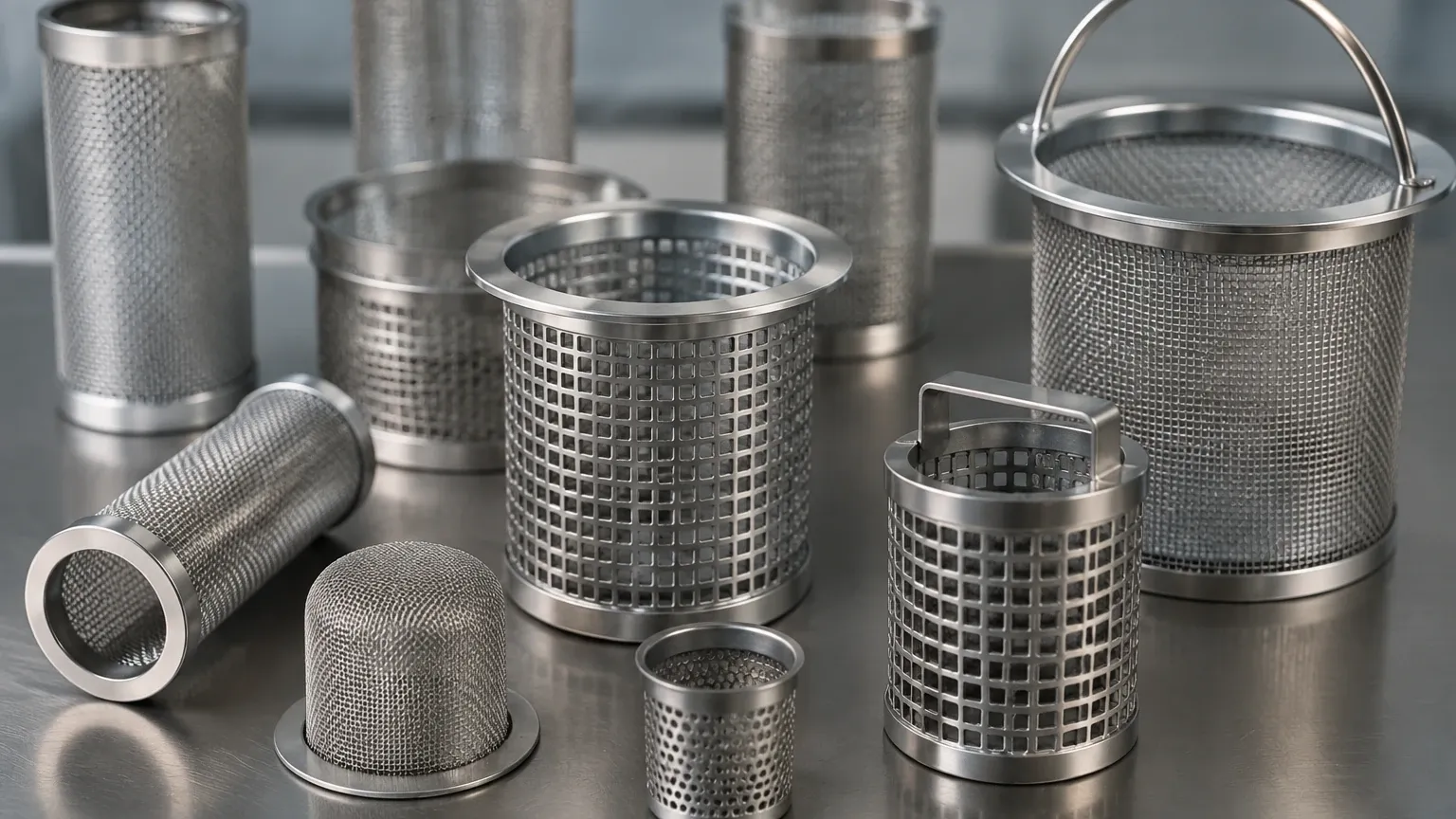
These are constructed from a single sheet of stainless steel with punched holes. They are exceptionally durable and act as a "coarse" filter. Common hole sizes range from 1/32" to 1/2". Perforated metal is often used as the primary structure for a basket, even if a finer mesh is added, because it provides the mechanical strength needed to resist the force of the fluid flow.
Wire Mesh Lined Baskets
For finer filtration (down to 5 microns), a stainless steel wire mesh is layered over the perforated metal support. This creates a multi-stage filtration effect. The perforated metal provides the "skeleton," while the wire mesh provides the precision. In the pharmaceutical and food industries, high-grade stainless steel mesh is mandatory to ensure no contaminants pass through while maintaining the ability to be thoroughly sanitized.
Engineering the Open Area Ratio
A critical performance metric for any strainer basket type is the "Open Area Ratio" (OAR). This is the ratio between the total open area of the holes in the basket and the cross-sectional area of the inlet pipe.
For most industrial applications, an OAR of 6:1 or 8:1 is recommended. A higher OAR means that the strainer can collect more debris before the pressure drop (ΔP) becomes excessive. If the OAR is too low, the basket will clog quickly, leading to frequent maintenance and potential pump cavitation due to restricted flow. When specifying a basket, engineers must calculate the OAR based on the percentage of open area provided by the specific perforation pattern or mesh count.
Material Selection for Industrial Environments
Since strainers are often exposed to corrosive chemicals, high temperatures, and abrasive particles, material selection is paramount. Kaifil specializes in stainless steel solutions because of the material's versatility and durability.
1. 304 Stainless Steel: The standard for general-purpose industrial applications. It offers good corrosion resistance and is cost-effective for water, oil, and mild chemical services.
2. 316/316L Stainless Steel: Contains molybdenum, which provides superior resistance to chlorides and pitting. This is the preferred material for marine environments, chemical processing, and pharmaceutical applications where "L" (low carbon) variants are used to prevent sensitization during welding.
3. Specialty Alloys: In extreme cases involving high-concentration acids or extreme temperatures, alloys like Monel or Hastelloy may be used for the basket construction, though stainless steel remains the industry benchmark for the majority of B2B filtration needs.
Customization and OEM Considerations
Standard off-the-shelf baskets often fail to meet the specific needs of specialized machinery. Customization is a core strength of manufacturers like Kaifil, where the strainer basket type can be tailored to the exact dimensions and performance requirements of the application.
* Handle Design: Baskets can be equipped with bail handles, fixed handles, or even threaded lifting eyes for heavy-duty baskets that require mechanical hoists for removal.
* Reinforcement: For high-pressure systems, baskets can be reinforced with external rings or internal longitudinal bars to prevent the basket from bursting or collapsing under a heavy cake load.
* Gaskets and Seals: To prevent "bypass" (where fluid escapes around the edges of the basket without being filtered), the top flange of the basket can be fitted with O-rings or flat gaskets made of Viton, EPDM, or PTFE.
Maintenance and Total Cost of Ownership (TCO)
While the initial purchase price of a strainer basket is a factor, the Total Cost of Ownership is determined by durability and ease of maintenance. A poorly designed strainer basket type will require more frequent cleaning and may suffer from "blinding"—where particles become wedged so deeply in the media that they cannot be removed.
Cleaning Cycles
Industrial systems should be equipped with differential pressure gauges. A common rule of thumb is to clean or replace the basket when the pressure drop across the strainer reaches 5-10 PSI over the clean pressure drop.
Durability and Replacement
Stainless steel baskets are designed for long-term reuse. However, repeated cleaning—especially if high-pressure washing or chemical baths are used—can eventually fatigue the wire mesh. Regular inspection for broken wires or distorted perforations is essential to prevent unfiltered fluid from reaching downstream components.
Conclusion: Selecting the Right Solution
Identifying the appropriate strainer basket type requires a balance of hydraulic performance, material compatibility, and mechanical strength. Whether the application involves protecting a high-pressure hydraulic system or ensuring the purity of a food-grade liquid, the basket is the heart of the filtration process.
By focusing on high-quality stainless steel construction and precise engineering of the open area ratio, procurement teams and engineers can ensure their systems operate with maximum uptime and minimal risk. For those requiring specialized dimensions or specific filtration ratings, working with an experienced manufacturer like Kaifil ensures that the Strainers & Baskets provided are optimized for the unique challenges of the industrial environment.
