


Strainer Basket Tea
In the industrial beverage sector, the efficiency of extraction processes directly impacts product quality, flavor consistency, and operational throughput. For large-scale tea production—ranging from ready-to-drink (RTD) bottled teas to concentrated extracts for the food industry—the hardware used for solid-liquid separation is a critical engineering consideration. A strainer basket tea system, designed for industrial extraction, must balance fine filtration with high flow rates while maintaining strict hygienic standards.
Industrial filtration components, specifically Strainers & Baskets, serve as the primary barrier between raw botanical materials and the final liquid product. Selecting the correct configuration requires an understanding of mesh dynamics, material science, and the mechanical stresses of high-volume processing. This article explores the technical requirements, engineering specifications, and selection criteria for strainer baskets used in professional tea and botanical extraction.
The Role of Precision Strainers in Industrial Tea Processing
Industrial tea processing differs significantly from consumer-level brewing. In a commercial facility, thousands of liters of extract are processed hourly. The strainer basket acts as a structural housing for the tea leaves or botanical solids, allowing the solvent (usually hot water) to circulate through the bed of material while preventing fine particles from entering the downstream piping or heat exchangers.
Solid-Liquid Separation Dynamics
The primary function of the strainer basket is to achieve effective solid-liquid separation. In tea extraction, the "fines" or small leaf particles can cause turbidity (cloudiness) in the final product if not properly managed. However, if the mesh is too restrictive, it can lead to excessive pressure drops and reduced flow, which slows down the production cycle.
Engineering a strainer basket for tea requires calculating the open area of the mesh. A higher open area percentage reduces the resistance to flow, which is essential when working with gravity-fed systems or low-pressure pumps. For pressurized extraction vessels, the basket must also be reinforced to withstand the mechanical force of the liquid moving through the compacted leaf mass.
Engineering Specifications for Tea Strainer Baskets
When specifying a strainer basket for industrial beverage applications, engineers must look beyond simple dimensions. The performance of the component is dictated by its construction method and the precision of its filtration media.
Mesh Selection and Micron Ratings
Tea leaves vary significantly in size, from whole-leaf varieties to "dust" and "fannings" used in high-speed extraction.
* Coarse Filtration: For whole-leaf extraction, a perforated metal basket or a coarse wire mesh (typically 20 to 40 mesh) may be sufficient to retain the bulk solids.
* Fine Filtration: For finer grades of tea or when a clear extract is required, a secondary layer of fine woven wire mesh (100 mesh or higher) is often integrated into the basket design.
Kaifil specializes in multi-layer designs where a fine mesh is supported by a heavy-duty perforated metal cage. This provides the necessary filtration accuracy (down to specific micron levels) without sacrificing the structural integrity of the basket under the weight of wet solids.
Flow Rate and Pressure Drop
In a B2B environment, downtime is a significant cost driver. If a strainer basket tea system clogs too quickly, the process must be halted for cleaning. Engineers calculate the "Clean Pressure Drop" to ensure the system starts within optimal parameters. As the basket fills with solids, the pressure drop increases. Designing baskets with a larger surface area—such as pleated designs or multi-basket housings—can extend the time between cleaning cycles.
Material Selection: Why Stainless Steel is Essential
The chemical environment of tea extraction is surprisingly demanding. Tea contains polyphenols, tannins, and organic acids that can be mildly corrosive over long periods of exposure, especially at the elevated temperatures required for extraction (typically 70°C to 95°C).
Grade 304 vs. 316L Stainless Steel
* Grade 304 Stainless Steel: This is the standard for many food-grade applications. It offers excellent corrosion resistance and is cost-effective for general beverage processing.
* Grade 316L Stainless Steel: For facilities that use aggressive cleaning chemicals (such as caustic soda or nitric acid in CIP cycles) or process highly acidic botanicals, 316L is preferred. The addition of molybdenum provides superior resistance to pitting and crevice corrosion.
All components provided by Kaifil for the beverage industry emphasize high-quality stainless steel to ensure that no metallic off-flavors are introduced into the product and that the equipment meets FDA and international food safety standards.
Customization Options for High-Volume Extraction
Standard off-the-shelf strainers rarely meet the specific needs of a large-scale extraction facility. Customization is often required to integrate the strainer basket into existing tanks, vessels, or piping systems.
Structural Reinforcements
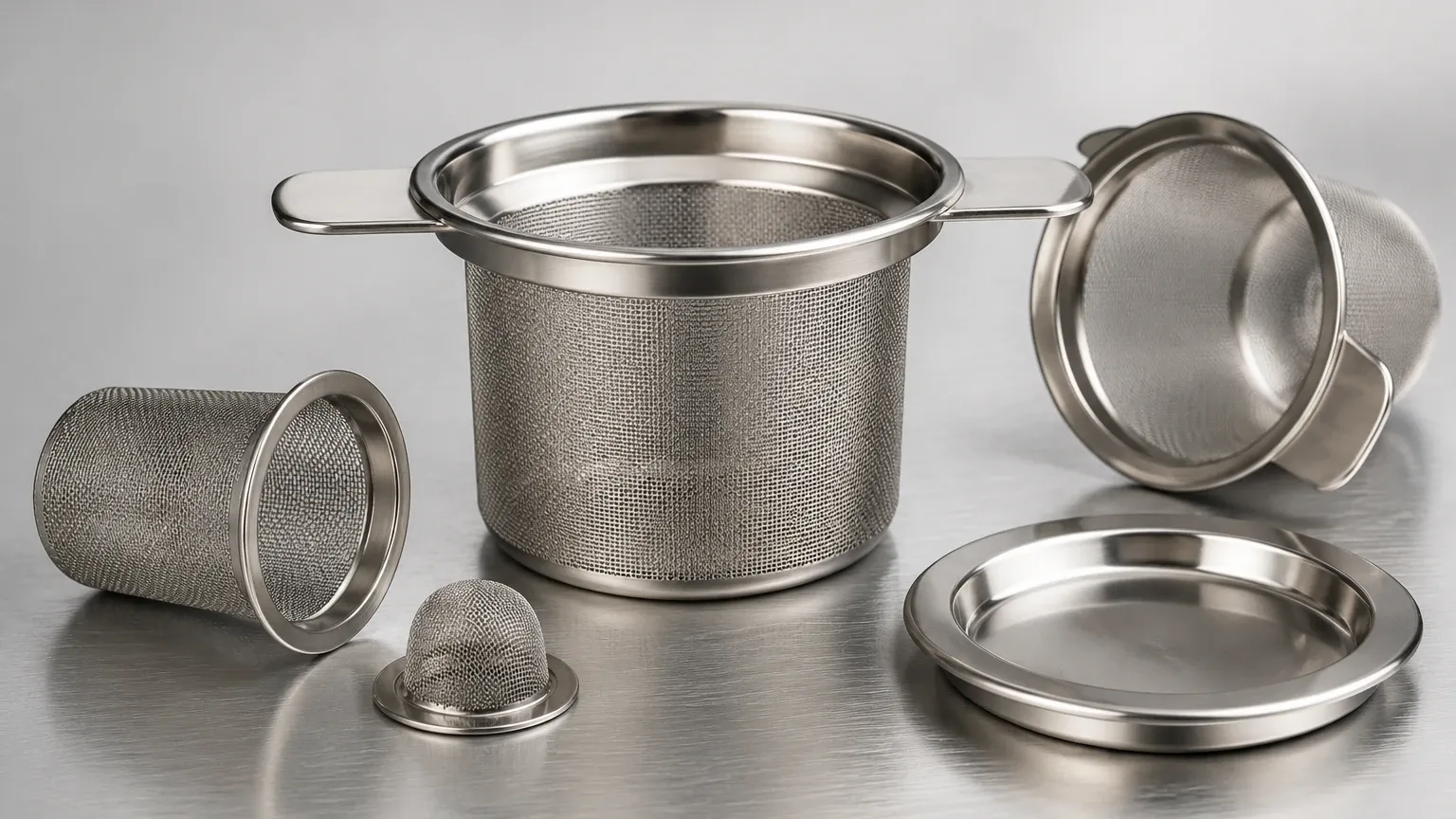
In large extraction tanks, the weight of the wet tea leaves can reach hundreds of kilograms. A standard wire mesh basket would collapse under this load. Custom Strainers & Baskets are engineered with reinforced rims, heavy-duty support ribs, and lifting handles designed for overhead cranes.
Tailored Geometry
Depending on the vessel design, baskets may need to be cylindrical, conical, or rectangular. The flange design is also critical; a precision-machined flange ensures a bypass-free seal, preventing raw solids from leaking around the edges of the basket and contaminating the filtered extract.
Maintenance and Cleaning Protocols for Food-Grade Strainers
In the food and beverage industry, the ability to clean equipment is as important as its filtration performance. Biofilm buildup or residual organic matter can lead to microbial contamination and batch spoilage.
Clean-in-Place (CIP) Compatibility
Modern tea processing lines utilize CIP systems to sanitize equipment without disassembly. Strainer baskets must be designed with "sanitary" construction, meaning smooth welds, polished surfaces (often Ra < 0.8 μm), and the absence of dead zones where particles can become trapped.
Manual Cleaning and Durability
For systems where baskets are manually removed and cleaned, durability is paramount. Frequent handling, high-pressure hosing, and manual scrubbing can damage delicate wire mesh. Using a sintered mesh or a robust perforated metal support ensures the basket maintains its shape and filtration accuracy over years of service.
Common Risks in Industrial Strainer Selection
Choosing the wrong strainer basket can lead to several operational failures that impact the bottom line:
1. Bypass: If the basket does not fit perfectly within the housing, liquid will take the path of least resistance, carrying solids into the final product.
2. Media Migration: Poorly manufactured wire mesh can shed individual wires or fragments, posing a physical hazard in food products. High-quality welding and edge binding are essential to prevent this.
3. Premature Blinding: If the micron rating is too fine for the specific tea grade, the mesh will "blind" (clog) almost instantly, leading to frequent production halts.
4. Structural Failure: Using a basket not rated for the specific flow velocity or weight of the solids can lead to buckling, which may damage downstream pumps or valves.
Selecting the Right Strainers & Baskets for Your Facility
When partnering with a manufacturer like Kaifil, engineers should be prepared to provide specific data points to ensure the resulting product meets the application's demands. Before finalizing a design for a strainer basket tea application, consider the following:
* Total Suspended Solids (TSS): What is the volume of solids per batch?
* Particle Size Distribution: What is the smallest particle that must be retained?
* Operating Temperature and Pressure: What are the maximum conditions the basket will face?
* Chemical Compatibility: What cleaning agents will be used in the facility?
* Flow Direction: Will the liquid flow from the inside out or the outside in?
By addressing these technical factors, purchasing teams can move beyond commodity-grade filters and invest in precision-engineered components that optimize extraction efficiency and ensure product purity.
Conclusion
The humble strainer basket is a linchpin in the industrial tea extraction process. Whether it is used for a simple cold-brew extraction or a complex multi-stage thermal extraction, the quality of the Strainers & Baskets determines the clarity, flavor, and safety of the beverage. For engineers and plant managers, focusing on material integrity, mesh precision, and structural durability is the most effective way to reduce total cost of ownership and maintain high production standards.
Kaifil continues to support the global beverage industry by providing customized stainless steel filtration solutions that meet the rigorous demands of modern food processing. By combining advanced manufacturing techniques with deep engineering expertise, we ensure that every strainer basket tea system we produce delivers reliable, long-term performance in the most demanding industrial environments.
