


Strainer Basket Target
In industrial fluid handling systems, the term "target" often refers to the specific performance objectives, filtration accuracy, or structural requirements that a component must meet to ensure process integrity. When discussing a strainer basket target, engineers and procurement specialists are focused on the precise alignment between the basket’s design and the operational demands of the system. Whether the goal is protecting high-value downstream equipment like pumps and heat exchangers or ensuring the purity of a final product, the selection of the correct strainer basket is a critical engineering decision.
Achieving the optimal Strainers & Baskets configuration requires a deep understanding of fluid dynamics, material science, and the specific characteristics of the contaminants being targeted for removal. This guide explores the technical parameters involved in defining a strainer basket target, from filtration precision to structural durability.
Defining the Filtration Target: Accuracy and Particle Retention
The primary function of any strainer basket is the removal of solid particles from a liquid or gas stream. The "target" in this context is the smallest particle size that must be captured to prevent damage or contamination. Defining this target involves more than just selecting a mesh size; it requires an analysis of the particle distribution within the process fluid.
Micron Rating and Mesh Selection
For most industrial applications, the filtration target is defined in microns (µm). Stainless steel wire mesh is the standard medium for fine filtration, offering precise openings that can range from several millimeters down to 5 microns. Engineers must balance the desire for high-purity (a finer target) with the physical reality of flow resistance. A target that is too fine for the application will lead to rapid clogging and excessive pressure drops, while a target that is too coarse will allow damaging debris to pass through to sensitive components.
Perforated Metal vs. Wire Mesh
Depending on the strainer basket target for particle size, the construction material may vary:
* Perforated Metal: Best suited for coarse filtration or as a support structure for finer mesh. It provides high mechanical strength and is ideal for removing large debris like scale, stones, or welding slag.
* Wire Mesh: Used when the filtration target is fine. It is often layered or pleated to increase surface area, providing higher dirt-holding capacity without significantly increasing the footprint of the basket.
Material Engineering for Harsh Environments
A critical component of hitting the strainer basket target for longevity is material selection. Industrial processes often involve corrosive chemicals, high temperatures, or high-pressure environments that can degrade inferior materials.
Stainless Steel Grades
Kaifil specializes in custom stainless steel solutions, typically utilizing 304 or 316L grades.
* Grade 304: Suitable for general industrial use, providing excellent strength and basic corrosion resistance for water treatment and food-grade applications.
* Grade 316L: The target material for chemical processing, pharmaceutical, and marine environments. The addition of molybdenum and a lower carbon content provides superior resistance to pitting and crevice corrosion, especially in chloride-rich environments.
Temperature and Chemical Compatibility
When defining the target specifications, engineers must confirm the chemical compatibility of the basket material with the process fluid. For example, in high-temperature steam applications, the thermal expansion coefficients of the basket and the strainer housing must be considered to prevent bypassing or mechanical failure of the basket seals.
Engineering for Hydraulic Performance
A successful strainer basket target is one that achieves the required filtration without compromising the hydraulic efficiency of the system. This involves calculating the allowable pressure drop ($\\Delta P$) and ensuring the basket has sufficient open area.
The Open Area Ratio (OAR)
One of the most important technical metrics is the Open Area Ratio. This is the ratio of the total area of the holes in the basket to the cross-sectional area of the inlet pipe. A common industry target is an OAR of 6:1 or 8:1. A higher ratio ensures that even as the basket begins to collect debris, there is still enough free path for the fluid to flow without causing a significant spike in pressure. If the OAR is too low, the velocity of the fluid through the mesh increases, which can lead to particle "breakthrough" or physical deformation of the basket.
Flow Velocity and Turbulence
High flow velocities can cause turbulence within the strainer housing, leading to erosion of the basket material or the housing walls. By designing the strainer basket target with a larger surface area (such as using pleated designs), the effective velocity through the media is reduced, extending the life of the component and improving filtration efficiency.
Structural Integrity and Mechanical Design
Strainer baskets are subject to significant mechanical stresses, especially during start-up or when the basket becomes heavily loaded with debris. The strainer basket target for structural integrity must account for the maximum differential pressure the basket might encounter before cleaning.
Reinforcement Techniques
For high-pressure applications, a simple wire mesh basket is often insufficient. Engineers may specify:
* Support Cages: Heavy-duty perforated metal cylinders that house the finer mesh, preventing it from collapsing under pressure.
* Reinforced Rims and Handles: Ensuring the basket can be safely removed and reinstalled without deforming the sealing surfaces.
* Bridges and Braces: Internal supports that maintain the shape of large-diameter baskets used in heavy industrial sectors.
Sealing and Bypass Prevention
The effectiveness of the filtration target is nullified if fluid can bypass the basket. Precision-machined flanges, O-rings, or spring-loaded hold-down assemblies are used to ensure a tight seal between the basket and the strainer body. Identifying the correct sealing target is essential for applications where zero-leakage is required.
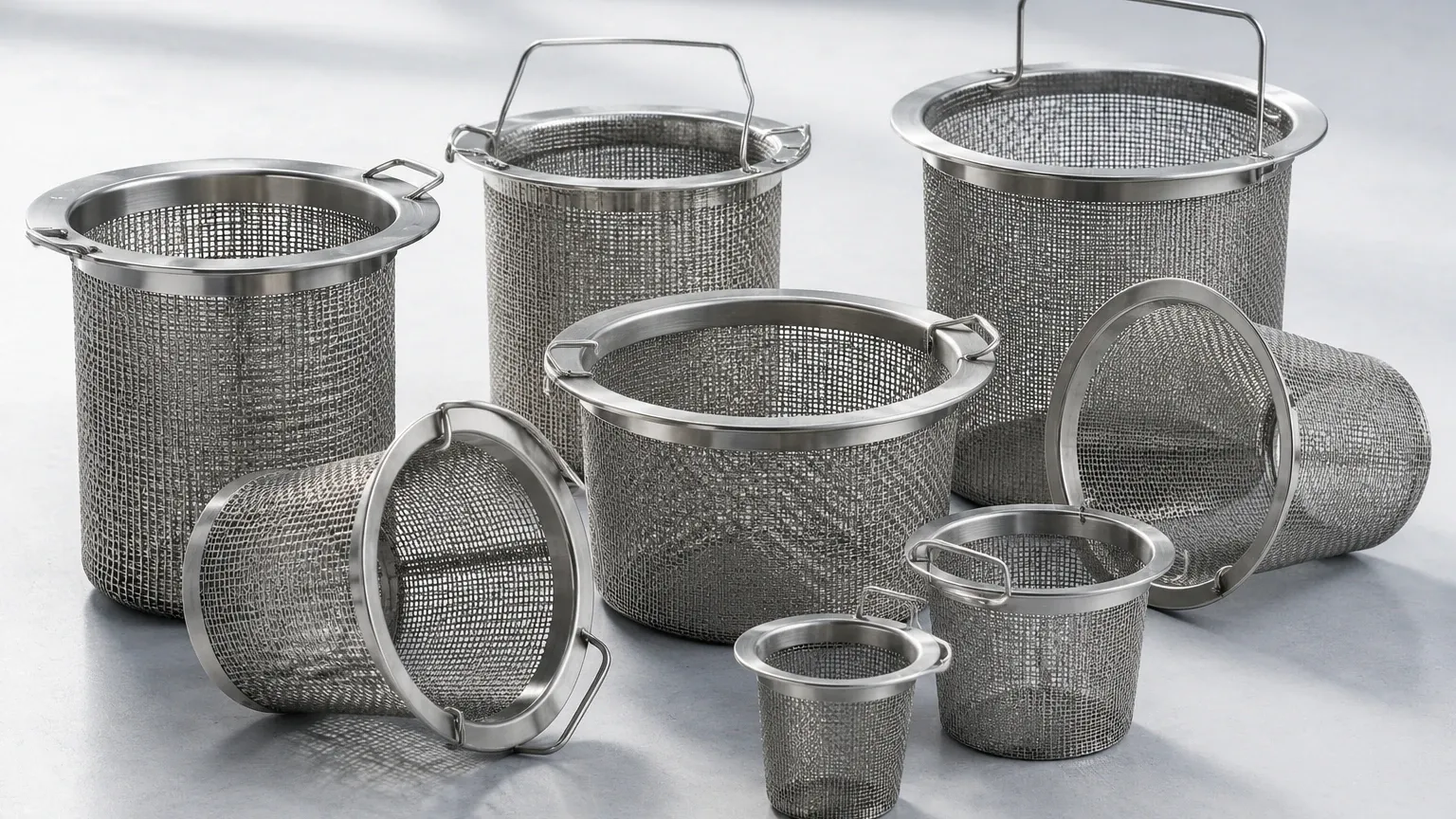
Customization: Meeting the Specific Strainer Basket Target
Off-the-shelf filtration products often fail to meet the specific needs of complex industrial systems. This is where custom manufacturing becomes necessary. A custom strainer basket target allows for the optimization of every variable mentioned above.
OEM and Tailored Solutions
Kaifil provides OEM services that allow engineers to specify non-standard dimensions, unique material combinations, and specialized handle designs. Whether the requirement is a slanted basket for a specific housing geometry or a multi-stage basket that targets different particle sizes in a single pass, customization ensures that the filtration component is an exact fit for the application.
Prototyping and Technical Validation
In the design phase, technical teams often work with manufacturers to validate the strainer basket target through CAD modeling and pressure drop calculations. This ensures that the final product will perform as expected under actual operating conditions, reducing the risk of costly downtime or equipment failure.
Maintenance and Total Cost of Ownership
Evaluating the strainer basket target also involves looking at the long-term operational costs. A basket that is easy to clean and durable enough to withstand repeated sterilization or high-pressure washing will offer a lower total cost of ownership than a cheaper, disposable alternative.
Cleaning Cycles and Monitoring
Differential pressure gauges are the primary tool for monitoring when a basket has reached its debris-holding target. Setting the "dirty" alarm at the correct threshold prevents the basket from reaching a critical pressure point that could cause structural failure.
Replacement vs. Refurbishment
High-quality stainless steel baskets are often cleanable and reusable. However, the target for replacement should be clearly defined based on the integrity of the mesh. Any signs of wire fraying, hole enlargement (blinding), or permanent deformation of the support structure indicate that the basket no longer meets the required filtration target and must be replaced to protect the system.
Conclusion: Precision in Filtration
Identifying and achieving the correct strainer basket target is a multifaceted process that combines filtration physics with mechanical engineering. By carefully selecting the micron rating, material grade, and structural design, industrial professionals can ensure their systems operate at peak efficiency with minimal risk of contamination or mechanical damage.
For those seeking reliable, high-performance filtration components, Kaifil offers a comprehensive range of custom solutions designed to meet the most demanding industrial targets. To explore specific configurations or discuss a custom design for your application, Review product options and application support to find the ideal solution for your filtration needs.
