


4 Basket Strainer Dimensions
In industrial fluid handling systems, the 4-inch basket strainer is a fundamental component used to protect downstream equipment such as pumps, valves, and flow meters from particulate contamination. Selecting the correct Strainers & Baskets requires a comprehensive understanding of both external housing dimensions and internal basket geometry. For engineers and procurement teams, the technical specifications of a 4-inch strainer are not merely about fitting a pipe; they dictate the system's flow capacity, pressure drop, and maintenance requirements.
This guide examines the critical engineering considerations regarding 4 basket strainer dimensions, providing the technical data necessary to ensure compatibility with existing piping layouts and performance expectations.
Understanding Standard 4-Inch Basket Strainer Dimensions
When discussing a "4 basket strainer," the dimension typically refers to the Nominal Pipe Size (NPS) of the inlet and outlet connections. However, the physical footprint of the strainer housing is significantly larger than the pipe diameter to accommodate the internal basket and provide a reservoir for collected solids.
Face-to-Face (FTF) Dimensions
The face-to-face dimension is the total length of the strainer from the inlet flange face to the outlet flange face. For a standard 4-inch flanged basket strainer, this dimension often ranges between 10 inches and 15 inches, depending on the pressure rating (e.g., ASME Class 150 vs. Class 300) and the specific manufacturer design. Maintaining consistency in FTF dimensions is critical for drop-in replacements in existing systems.
Overall Height and Center-to-Bottom
The height of the strainer housing is divided into two parts: the distance from the centerline of the pipe to the top of the cover, and the distance from the centerline to the bottom of the sump. For a 4-inch unit, the center-to-bottom dimension is particularly important because it determines the volume of the basket and the frequency of cleaning cycles. A deeper housing allows for a larger basket, which provides a higher dirt-holding capacity.
The Relationship Between Housing Size and Filtration Area
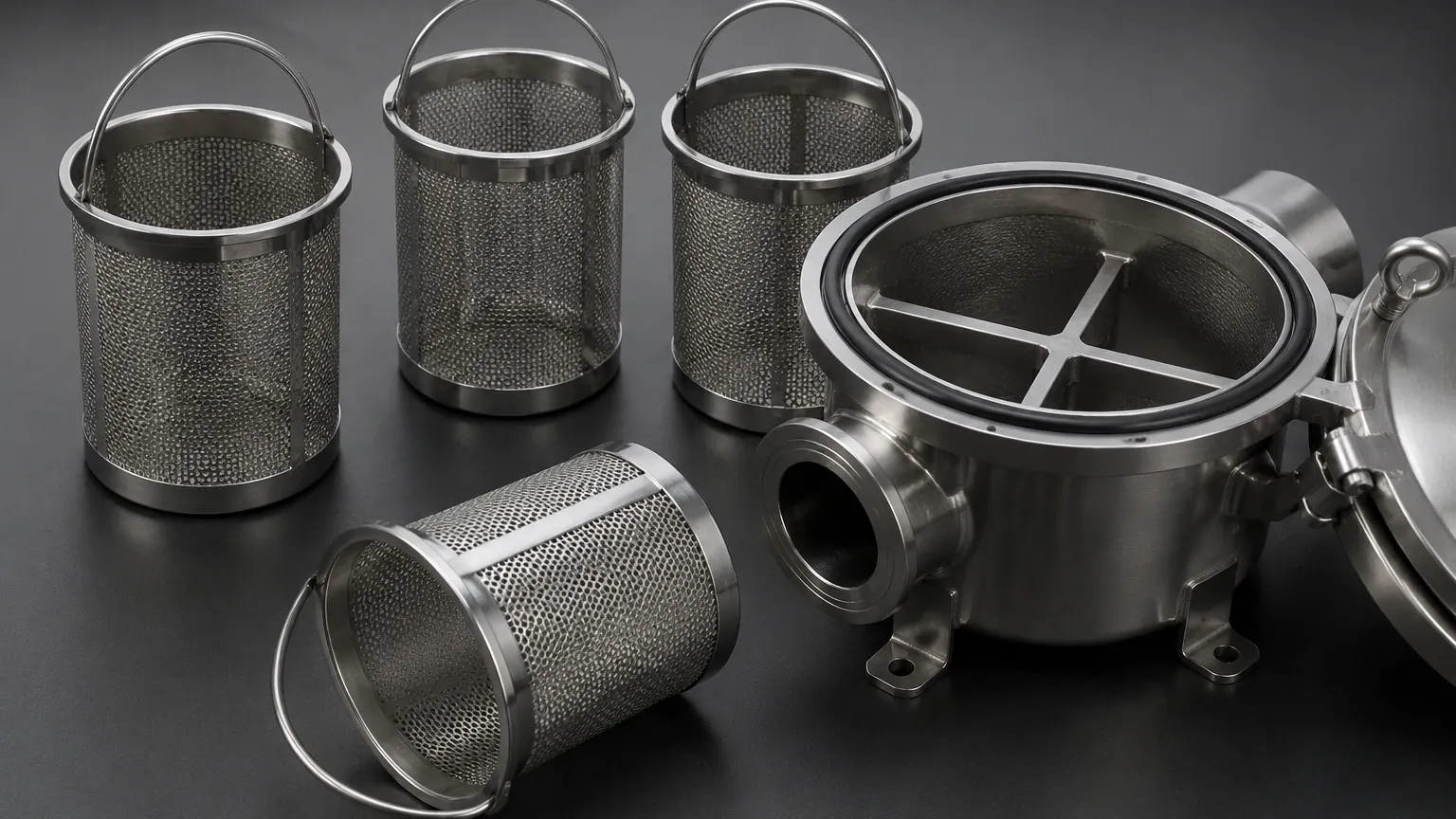
The primary reason for the bulk of a basket strainer is to maximize the filtration surface area. A 4-inch strainer is designed to handle flow rates that would quickly clog a simpler Y-strainer. To achieve this, the internal basket must have a surface area several times larger than the cross-sectional area of the 4-inch inlet pipe.
Open Area Ratio (OAR)
Engineers often look for an Open Area Ratio (OAR) of at least 6:1 or 8:1. This means the total open area of the basket's mesh or perforations is six to eight times the area of the inlet pipe. To achieve this ratio within 4 basket strainer dimensions, the basket itself must be substantially taller and wider than the 4-inch pipe diameter. If the housing dimensions are too compact, the OAR decreases, leading to a higher initial pressure drop and more frequent maintenance intervals.
Critical Dimensional Parameters for Engineering Selection
When specifying a basket strainer for a new project or a replacement, several dimensional parameters must be confirmed to ensure a proper fit and functional performance:
1. Flange Specifications: For 4-inch strainers, flanges usually follow ASME B16.5 standards. A Class 150 flange will have an outside diameter of 9 inches with 8 bolt holes, while a Class 300 flange will have a 10-inch diameter. These dimensions must match the mating piping exactly.
2. Cover Removal Clearance: This is perhaps the most overlooked dimension. To remove the basket for cleaning, there must be sufficient vertical clearance above the strainer. For a typical 4-inch basket strainer, a clearance equal to at least the height of the basket (often 8 to 12 inches above the cover) is required.
3. Drain and Vent Sizes: Standard 4-inch strainers usually feature a 1/2-inch or 3/4-inch NPT drain plug at the bottom and a vent plug on the cover. These dimensions are essential for installing blow-down valves or pressure gauges.
4. Dry and Wet Weight: The physical dimensions contribute to the weight of the unit. A 4-inch cast stainless steel strainer can weigh between 70 and 120 lbs. Engineering supports must be designed to handle the "wet weight" when the unit is full of fluid.
Impact of 4 Basket Strainer Dimensions on Flow Dynamics
The internal geometry of the strainer housing directly influences the fluid velocity and the resulting pressure drop (ΔP). In a 4-inch system, fluid enters the housing and must transition from the high-velocity inlet pipe into the larger volume of the strainer body.
If the 4 basket strainer dimensions are optimized, the fluid velocity slows down as it enters the basket, allowing heavier particles to settle at the bottom while finer particles are caught by the mesh. A cramped housing design causes turbulence, which can lead to "scouring"—where fluid flow pushes previously trapped debris through the mesh or causes premature wear on the basket material.
Flow Coefficient (Cv)
The Cv value represents the flow of water in gallons per minute (GPM) that will pass through the strainer with a 1 PSI pressure drop. A well-dimensioned 4-inch basket strainer typically has a Cv ranging from 150 to 280. Variations in this number are usually due to the internal clearance between the basket and the housing wall. More generous internal dimensions result in a higher Cv and better energy efficiency for the pumping system.
Customization and OEM Dimensional Flexibility
While standard off-the-shelf strainers meet many industrial needs, unique application constraints often require customized 4 basket strainer dimensions. As a specialized manufacturer, Kaifil provides engineering support for modifications that standard suppliers may not offer.
Space-Constrained Installations
In modular skid designs or tight mechanical rooms, a standard face-to-face dimension might be too long. Custom housings can be engineered with offset nozzles or compact bodies, provided the internal basket surface area is maintained through higher-density pleating or high-strength wire mesh.
High-Capacity Baskets
For systems with high solids loading, the center-to-bottom dimension can be extended to accommodate a "high-capacity" basket. This allows the strainer to operate longer between cleanings without increasing the footprint of the inlet/outlet piping. This is particularly useful in water treatment and chemical processing where downtime is costly.
Material Selection and Dimensional Integrity
The choice of material—typically Grade 304 or 316 stainless steel—impacts the long-term dimensional stability of the strainer. Unlike plastic or lower-grade alloys, stainless steel maintains its tolerances under thermal cycling and high-pressure surges.
In high-temperature applications, thermal expansion must be accounted for in the piping layout. The dimensions of a 4-inch stainless steel strainer will change slightly at 400°F compared to ambient temperature. Precision manufacturing ensures that the basket seating surface remains perfectly circular and flat, preventing "bypass"—where unfiltered fluid escapes around the edges of the basket because of dimensional warping.
Maintenance and Clearance Requirements
Properly integrating a 4-inch strainer into a facility requires planning for its lifecycle, not just its installation. The physical dimensions dictate the maintenance workflow:
* Basket Removal: If the strainer is installed too close to overhead piping or structural beams, operators will be unable to lift the basket out for cleaning. This often leads to neglected maintenance and eventual pump failure.
* Drain Access: The bottom drain must be accessible for the installation of a ball valve. This allows for "blow-down" cleaning, where the sump is flushed without opening the cover.
* Cover Bolting: Whether using a quick-opening swing bolt cover or a standard bolted cover, there must be enough circumferential room for a technician to use a wrench or operate the handles.
Conclusion: Selecting the Right 4-Inch Strainer
Evaluating 4 basket strainer dimensions is a critical step in industrial system design. By focusing on the face-to-face length, the open area ratio, and the necessary maintenance clearances, engineers can ensure that their filtration solution provides maximum protection with minimal pressure loss.
Whether you are designing a new hydraulic circuit or replacing a legacy unit in a food processing plant, the precision of the housing and basket dimensions will determine the total cost of ownership. For applications requiring specific dimensional tolerances or custom filtration performance, working with a manufacturer that understands the nuances of stainless steel fabrication is essential for long-term operational success.
