


4 Strainer Basket
In industrial fluid handling systems, the protection of downstream equipment—such as pumps, valves, meters, and heat exchangers—is paramount to operational longevity and cost-efficiency. The 4 strainer basket, designed for systems with a 4-inch nominal pipe size (NPS), serves as a critical mechanical barrier. These components are engineered to remove unwanted solids from liquid or gas streams through a perforated or wire mesh medium.
As a specialized manufacturer, Kaifil provides high-performance Strainers & Baskets tailored to the rigorous demands of chemical processing, water treatment, and food and beverage production. Selecting the correct 4 strainer basket requires a deep understanding of material science, fluid dynamics, and structural engineering to ensure the component survives the mechanical stresses of industrial flow while maintaining filtration precision.
Engineering Specifications of the 4-Inch Strainer Basket
A 4 strainer basket is defined by its compatibility with 4-inch piping systems, but its internal dimensions and configuration vary significantly based on the strainer housing (Simplex, Duplex, or Y-strainer). The primary objective of the basket design is to maximize the surface area available for filtration while fitting within the constraints of the housing.
Material Selection and Chemical Compatibility
Industrial environments often involve corrosive fluids or high-temperature processes. Therefore, material selection is the first technical hurdle in procurement.
1. Stainless Steel 304: The standard for general-purpose industrial applications. It offers excellent resistance to atmospheric corrosion and many organic and inorganic chemicals. It is frequently used in water treatment and general manufacturing.
2. Stainless Steel 316/316L: Containing molybdenum, SS316 provides superior resistance to chlorides and acetic acid. This is the preferred material for marine environments, pharmaceutical manufacturing, and aggressive chemical processing. The "L" (low carbon) variant is utilized when welding is required to prevent carbide precipitation.
3. Specialty Alloys: For highly specialized applications involving extreme acids or high-temperature oxidation, alloys like Monel or Hastelloy may be integrated into the basket design.
Dimensional Accuracy and Tolerances
For a 4 strainer basket to function effectively, it must seat perfectly within the strainer body. If the basket is too loose, fluid will bypass the filtration media (a phenomenon known as "blow-by"), allowing contaminants to pass downstream. Kaifil utilizes precision manufacturing to ensure that flange diameters and basket heights meet strict tolerances, ensuring a positive seal against the housing seat.
Filtration Media: Perforations and Wire Mesh
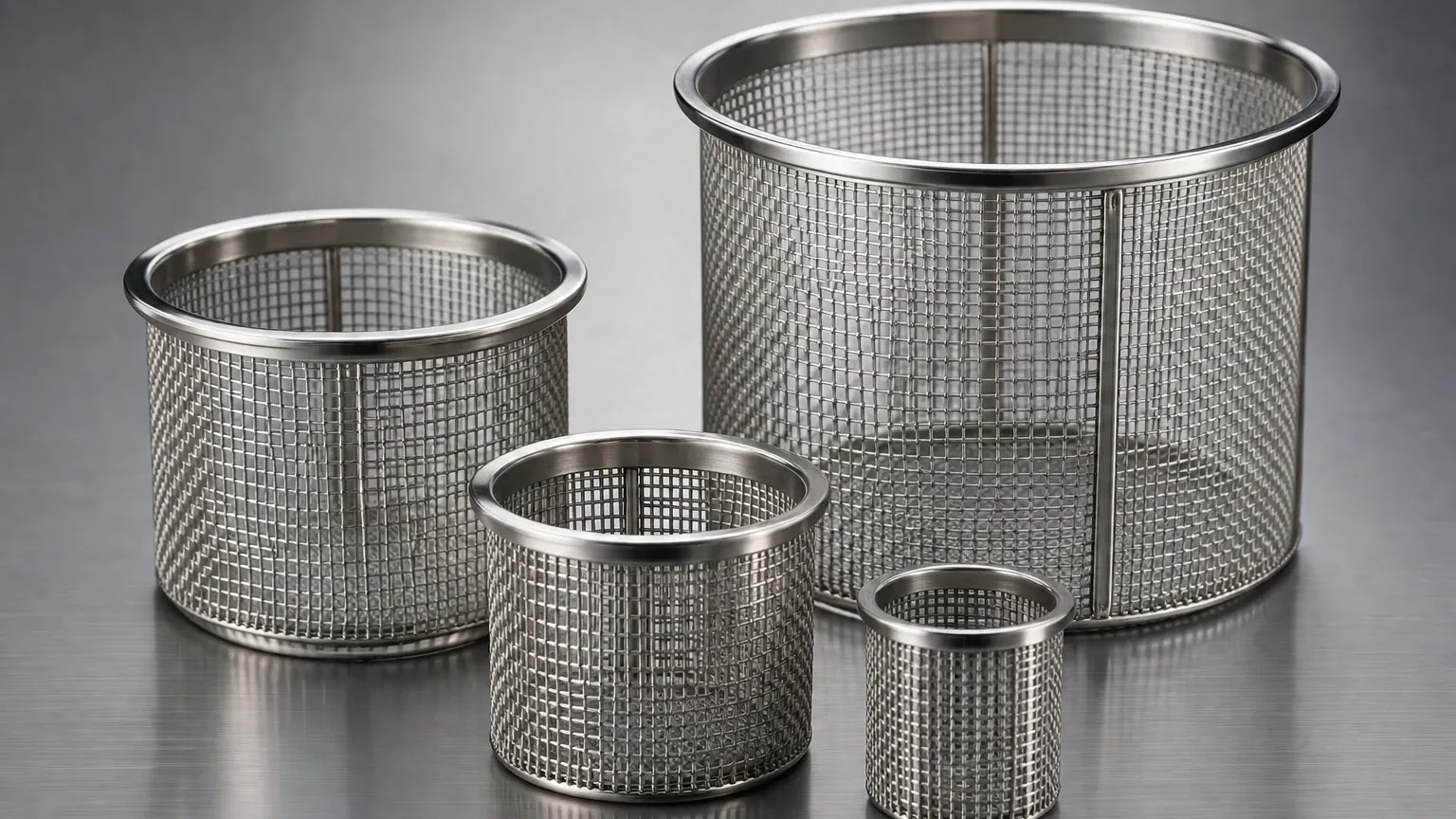
The performance of a 4 strainer basket is largely dictated by its filtration media. Depending on the size of the particles to be removed, the basket may consist of a single perforated sheet or a combination of a perforated support basket and a fine wire mesh liner.
Perforated Metal Bases
Perforated metal serves as the structural foundation. Common hole patterns include staggered rounds, which provide the best balance between structural strength and open area. Typical perforation sizes for a 4-inch system range from 1/32" to 1/2". Engineers must calculate the "Open Area Ratio," which is the ratio of the total area of the holes to the cross-sectional area of the inlet pipe. A high-quality 4 strainer basket should ideally offer an open area ratio of at least 6:1 to minimize initial pressure drop and extend the time between cleaning cycles.
Wire Mesh Linings
When finer filtration is required—down to the micron level—a stainless steel wire mesh is lined inside or outside the perforated basket.
* Coarse Mesh (20 to 60 mesh): Used for removing sand, scale, and large debris.
* Fine Mesh (100 to 400 mesh): Used for precision applications where even minute particles could damage sensitive downstream instrumentation.
At Kaifil, the mesh is securely bonded to the perforated metal using advanced welding techniques to ensure that the mesh does not tear or collapse under high differential pressure.
Structural Integrity and Reinforcement
A 4 strainer basket is subjected to significant hydraulic forces, especially as it becomes clogged with debris. As the "cake" builds up on the filter media, the differential pressure ($ΔP$) increases. If the basket is not structurally sound, this pressure can lead to basket deformation or catastrophic failure (bursting).
Reinforcement Techniques
To handle high-pressure applications, several reinforcement methods are employed:
* Heavy-Duty Bottoms: The bottom of the basket often bears the brunt of the fluid impact. Reinforcing the bottom with a thicker plate or a cross-member support prevents sagging.
* Side Bracing: Vertical bars or bands can be welded to the exterior of the perforated metal to provide hoop strength against internal pressure.
* Double-Wall Construction: In extreme cases, two layers of perforated metal are used to sandwich the fine mesh, protecting it from both internal and external mechanical stress.
Burst Pressure Considerations
Engineers must confirm the maximum allowable differential pressure (MADP) for a 4 strainer basket. While a clean basket may only see a pressure drop of 1-2 PSI, a fouled basket might face 20-50 PSI. The basket must be designed to withstand the full system pressure in the event of a total blockage, although most systems include safety bypasses or pressure sensors to trigger a cleaning cycle before this occurs.
Key Performance Indicators: Pressure Drop and Flow Capacity
The primary goal in selecting a 4 strainer basket is to achieve the required filtration level with the lowest possible impact on system flow.
Calculating Pressure Drop
The total pressure drop across a strainer is the sum of the drop through the housing and the drop through the basket. For the basket specifically, factors include:
* Fluid Viscosity: Thicker fluids (like heavy oils or resins) require larger perforations or more surface area to maintain flow.
* Velocity: As flow velocity increases, the pressure drop increases exponentially ($P ∝ v^2$).
* Percentage of Clogging: It is common practice to size a basket based on a "50% clogged" state to ensure the system remains operational even as debris accumulates.
Flow Distribution
In a 4-inch system, the entry velocity of the fluid can be substantial. A well-designed basket ensures that the fluid is distributed evenly across the entire surface area. If the fluid is concentrated on one spot, that area of the mesh will wear out prematurely, and the effective filtration area is reduced.
Customization and OEM Options for Industrial Applications
Standard off-the-shelf baskets often fail to meet the specific needs of complex industrial layouts. Customization is where manufacturers like Kaifil provide the most value to engineering teams.
Handle and Lifting Configurations
Since a 4 strainer basket can become quite heavy when filled with debris and fluid, the design of the handle is vital for operator safety and ease of maintenance. Options include:
* Fixed Bail Handles: For easy manual extraction.
* Slotted Handles: To lock the basket into the housing and prevent rotation.
* Lifting Eyes: For larger or heavier baskets that require mechanical assistance (hoists) for removal.
Specialized Geometries
While the cylindrical basket is standard, some housings require specialized shapes:
* Slant-Top Baskets: Used in angled strainer bodies to maximize surface area.
* Multi-Basket Designs: Some large 4-inch housings utilize multiple smaller baskets to make manual cleaning easier for a single operator.
* Magnetic Inserts: For applications involving metal machining or grinding, magnetic rods can be placed inside the basket to capture fine ferrous particles that might otherwise pass through the mesh.
Maintenance, Cleaning, and Replacement Cycles
The longevity of a 4 strainer basket is directly tied to the maintenance protocol. Unlike disposable filter cartridges, stainless steel baskets are designed to be cleaned and reused, providing a lower total cost of ownership (TCO).
Cleaning Procedures
1. Manual Cleaning: The basket is removed and sprayed with a high-pressure water jet or cleaned with a brush. Care must be taken not to damage the fine wire mesh.
2. Ultrasonic Cleaning: For baskets used in the pharmaceutical or food industries, ultrasonic baths can remove microscopic particles trapped within the mesh weave.
3. Chemical Cleaning: If the debris is a hardened resin or chemical deposit, compatible solvents may be used to dissolve the contaminant without affecting the stainless steel integrity.
Determining Replacement
Even the most durable 4 strainer basket will eventually require replacement. Signs that a basket has reached the end of its service life include:
* Permanent Deformation: If the basket walls are bowed or the bottom is distended.
* Mesh Fraying: Broken wires in the mesh can bypass contaminants and may also break off, becoming contaminants themselves.
* Corrosion Pitting: Small pits in the metal can harbor bacteria (in food apps) or lead to structural weak points.
Why Engineering Teams Choose Kaifil
Selecting a 4 strainer basket is not merely a commodity purchase; it is a technical decision that impacts the reliability of an entire production line. Kaifil’s expertise in custom stainless steel filtration ensures that every basket is built to the specific hydraulic and chemical requirements of the application.
By focusing on high-grade materials, precision welding, and optimized open area ratios, Kaifil helps engineers reduce downtime and protect their most valuable assets. Whether you are designing a new system or looking for a more durable replacement for an existing installation, understanding the technical nuances of Strainers & Baskets is the first step toward optimized filtration performance.
Before finalizing a specification for a 4 strainer basket, engineers should confirm the fluid's specific gravity, the maximum flow rate in GPM (gallons per minute), the nature of the solids (fibrous, granular, or abrasive), and the required micron rating. These data points allow for the selection of a basket that provides the perfect balance of protection and throughput.
