


Basket Strainer 90
In industrial fluid handling, the protection of sensitive downstream equipment—such as pumps, valves, flow meters, and heat exchangers—is a primary engineering concern. Debris, scale, and particulate matter can cause catastrophic mechanical failure or significant process downtime. Among the various mechanical separation tools available, the basket strainer is a cornerstone of coarse filtration. Specifically, the basket strainer 90 configuration, characterized by its right-angle inlet and outlet orientation, offers unique advantages for specific piping layouts and space-constrained environments.
Selecting the right Strainers & Baskets requires more than just matching a pipe diameter. It involves a deep understanding of fluid dynamics, material compatibility, and the specific geometric requirements of the installation site. This guide examines the technical nuances of the 90-degree basket strainer, providing engineers and purchasing teams with the factual data needed to optimize their filtration systems.
Understanding the Basket Strainer 90 Configuration
The "90" in a basket strainer 90 typically refers to the 90-degree angle between the inlet and the outlet ports. While standard inline strainers allow fluid to pass through in a straight path, the right-angle design is engineered for specific structural and hydraulic purposes.
Spatial Efficiency in Piping Design
In many industrial skids and plant layouts, space is at a premium. A 90-degree basket strainer allows the filtration unit to serve as both a strainer and a piping elbow. By integrating the filtration stage into a turn in the piping, engineers can reduce the overall footprint of the system and eliminate the need for additional elbow fittings, which in turn reduces the number of potential leak points (welds or flanged connections).
Flow Dynamics and Turbulence
From a hydraulic perspective, a 90-degree turn inherently introduces more turbulence than a straight run. However, high-quality basket strainers are designed with enlarged housing chambers. This increased volume slows the fluid velocity as it enters the strainer body, allowing for efficient separation and minimizing the pressure drop ($ΔP$) usually associated with right-angle turns. The internal geometry is critical; a well-designed basket strainer 90 ensures that the fluid is distributed evenly across the surface of the basket media rather than concentrating impact on a single point, which could lead to premature mesh fatigue.
Material Integrity and Industrial Durability
For demanding applications in chemical processing, pharmaceuticals, and food production, the material of construction for the strainer housing and the internal basket is non-negotiable. Stainless steel remains the industry standard due to its mechanical strength and resistance to corrosion.
Stainless Steel Grades: 304 vs. 316L
* Type 304 Stainless Steel: Suitable for general-purpose industrial applications, water treatment, and less aggressive chemical environments. It provides excellent structural integrity and cost-effectiveness.
* Type 316L Stainless Steel: Essential for pharmaceutical and food-grade applications, as well as environments involving chlorides or high acidity. The addition of molybdenum enhances pitting resistance. In a basket strainer 90 used in sanitary environments, the internal surfaces are often polished to specific Ra (Roughness Average) values to prevent bacterial growth and ensure ease of cleaning.
Gasket and Seal Compatibility
The effectiveness of a strainer is also dependent on its sealing mechanism. Depending on the fluid temperature and chemical composition, seals may be constructed from EPDM, Viton (FKM), PTFE, or Buna-N. For high-pressure applications, the cover of the strainer is typically secured with heavy-duty bolts or a quick-release swing-bolt mechanism, allowing for rapid maintenance without specialized tools.
Key Performance Indicators for Engineers
When evaluating a basket strainer 90, engineers must look beyond the physical dimensions and focus on the performance metrics that impact the total system efficiency.
Pressure Drop (ΔP) Calculations
The pressure drop across a strainer is the difference in pressure between the inlet and the outlet. It is influenced by the fluid's viscosity, flow rate, and the percentage of the basket that is clogged. A critical design factor is the "Open Area Ratio" (OAR). A high-performance basket strainer should offer an OAR of at least 6:1 or 8:1. This means the total open area of the basket mesh is six to eight times the cross-sectional area of the inlet pipe. A high OAR ensures that even as the basket collects debris, the pressure drop remains within acceptable limits for a longer period, extending the time between cleaning cycles.
Flow Coefficient (Cv)
The Cv value represents the volume of water (in gallons per minute) that will flow through the strainer with a pressure drop of 1 psi. For a basket strainer 90, the Cv is slightly lower than an inline version of the same size due to the directional change of the fluid. Engineers must confirm that the selected strainer's Cv is compatible with the pump's performance curve to avoid cavitation or reduced flow rates.
Filtration Accuracy and Mesh Selection
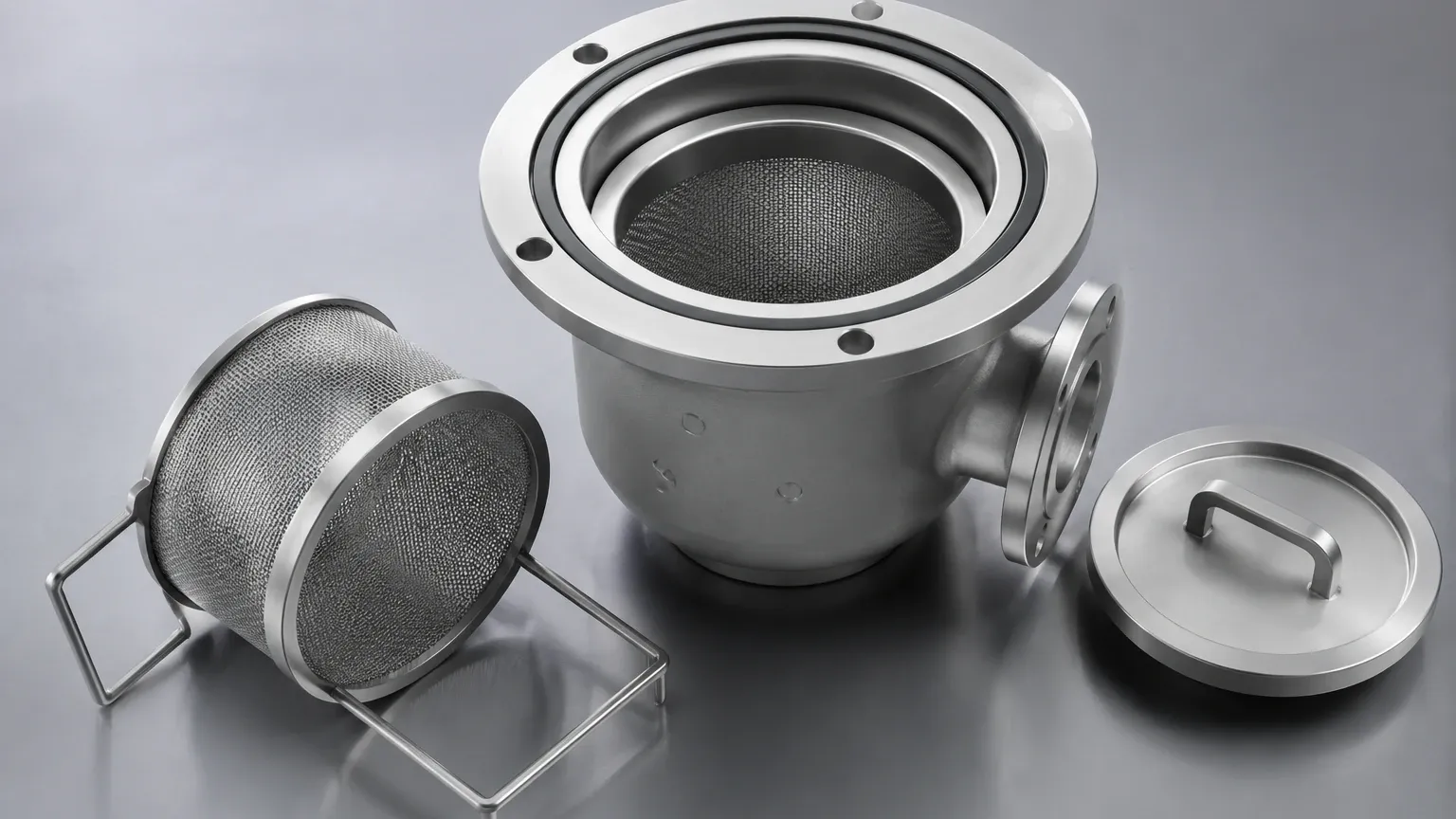
The "basket" in the basket strainer 90 is the functional heart of the unit. It is typically a two-stage component: a heavy-duty perforated metal plate that provides structural support, and a fine wire mesh lining that determines the filtration accuracy.
Micron vs. Mesh Size
* Mesh Size: Refers to the number of openings per linear inch. A higher mesh count indicates a finer filter. For example, a 40-mesh screen has smaller openings than a 20-mesh screen.
* Micron Rating: A more precise measurement referring to the actual size of the particles that the mesh will intercept.
In industrial applications, the choice of mesh depends on the smallest particle that could damage downstream equipment. For pump protection, a coarse mesh (e.g., 20 to 40 mesh) may suffice. For nozzle protection in spray systems, a much finer mesh (e.g., 100 to 200 mesh) is required. Because the basket strainer 90 often handles high-velocity flows at a turn, the mesh must be securely bonded or welded to the perforated basket to prevent "bypass"—where fluid and debris leak around the edges of the filter media.
Installation and Maintenance Protocols
Proper installation and a rigorous maintenance schedule are vital for the longevity of both the strainer and the system it protects.
Orientation and Support
A basket strainer 90 must be installed in the correct orientation to ensure that the basket can be removed vertically (top-entry). Because these units can be heavy, especially when full of fluid and debris, adequate piping support must be provided to prevent stress on the flanges.
Monitoring and Cleaning
The most common cause of strainer failure or system inefficiency is neglected maintenance.
1. Differential Pressure Gauges: It is highly recommended to install DP gauges across the inlet and outlet. When the pressure differential reaches a pre-set limit (typically 5-10 psi over the clean drop), the basket must be cleaned.
2. Blow-down Valves: Some 90-degree strainers are equipped with a drain port at the bottom of the housing. This allows for a "blow-down" to remove heavy sediment without opening the housing, though it does not replace the need for periodic manual basket cleaning.
3. Basket Removal: During manual cleaning, the system must be depressurized. The basket should be inspected for signs of mesh tearing or structural deformation. If the mesh is compromised, the basket strainer 90 will no longer provide the rated protection, and the basket must be replaced immediately.
Total Cost of Ownership and Customization
While the initial purchase price of a basket strainer 90 is a factor, the total cost of ownership (TCO) includes maintenance labor, spare parts (baskets and seals), and the cost of potential downtime.
The Value of Customization
Standard off-the-shelf strainers may not meet the specific needs of a complex industrial process. Customization options provided by manufacturers like Kaifil allow for:
* Custom Inlet/Outlet Sizes: Matching non-standard piping without reducers.
* Specialized Coatings: For handling highly abrasive or corrosive slurries.
* Integrated Heating Jackets: For high-viscosity fluids (like resins or chocolate) that must be kept at a specific temperature to flow through the mesh.
* Magnetic Inserts: To capture fine ferrous particles that might otherwise pass through a standard mesh.
By working with a manufacturer that understands the engineering behind Strainers & Baskets, purchasing teams can ensure they receive a component that is optimized for their specific flow conditions and longevity requirements.
Conclusion: Confirming Requirements for the Next Step
Before finalizing the procurement of a basket strainer 90, technical professionals should confirm the following data points with their supplier:
1. Maximum Operating Pressure and Temperature: Ensure the housing and seal ratings exceed the system's peak conditions.
2. Fluid Viscosity: High-viscosity fluids require larger baskets and coarser mesh to maintain acceptable flow rates.
3. Corrosion Allowance: Confirm that the stainless steel grade is appropriate for the chemical profile of the process fluid.
4. Cleaning Clearance: Ensure there is enough vertical space above the strainer to fully extract the basket for maintenance.
A well-specified basket strainer is an investment in the reliability of the entire industrial process. By prioritizing technical performance metrics and material quality, engineers can ensure efficient, long-term protection for their most critical mechanical assets.
