


Engineering Guide to the Stainless Steel Mesh Filter Guard: Selection and Performance
In industrial fluid systems, the protection of sensitive downstream components—such as high-pressure pumps, flow meters, and level sensors—is a critical engineering priority. A stainless steel mesh filter guard serves as a primary line of defense, intercepting particulate matter that could otherwise lead to mechanical wear, instrumentation drift, or catastrophic system failure. Unlike standard process filters designed for high-volume contaminant removal, a filter guard is often engineered for high structural integrity and specific flow characteristics to ensure system stability.
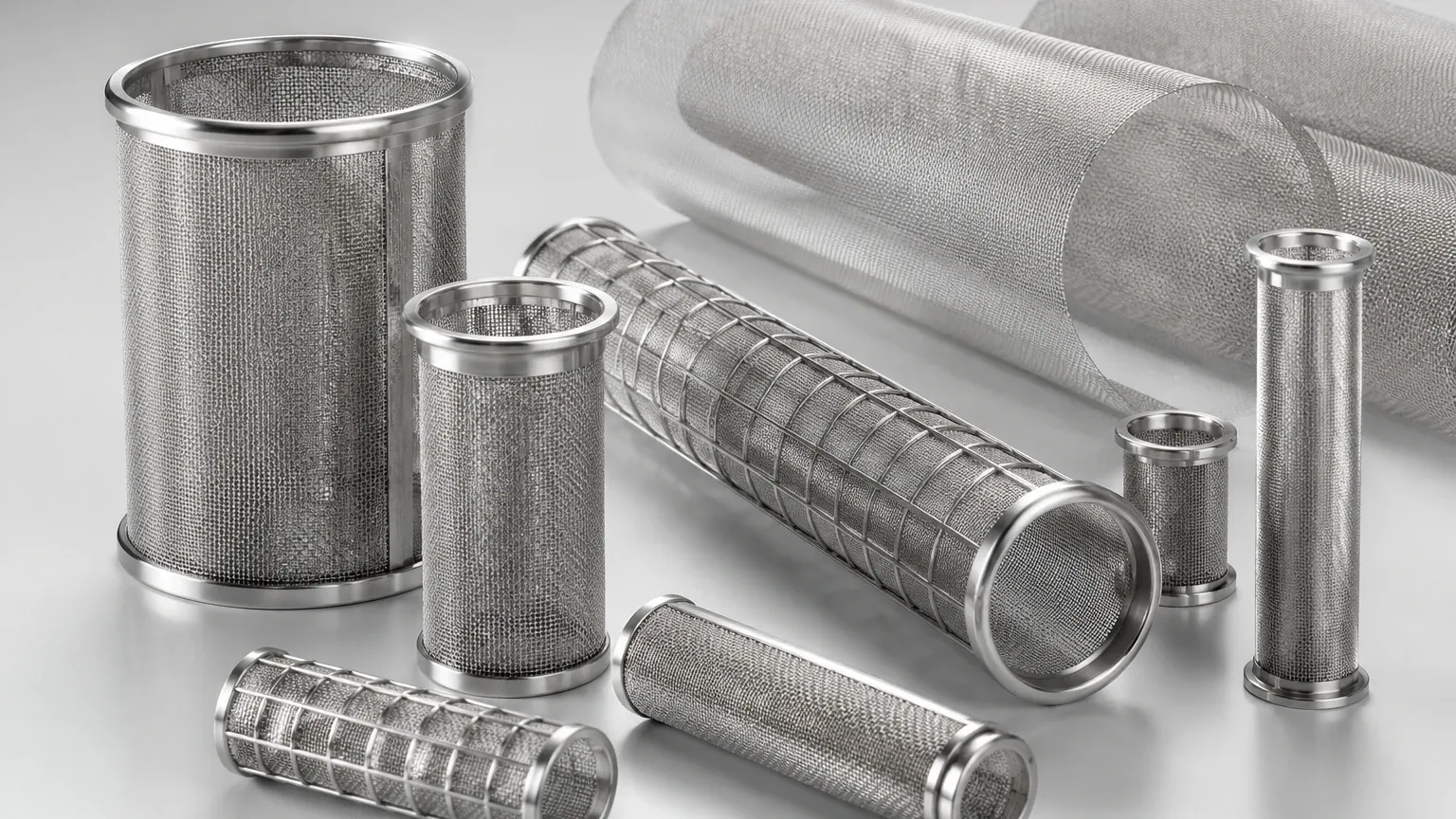
Selecting the correct Wire Mesh Filter Cylinders & Tubes requires a deep understanding of fluid dynamics, material compatibility, and the mechanical stresses inherent in industrial environments. This guide examines the technical considerations essential for engineers and procurement teams when specifying these components for demanding applications.
Operating Principles of Filter Guards in Industrial Systems
The primary function of a stainless steel mesh filter guard is to provide a physical barrier while maintaining a low-pressure drop. In many instrumentation applications, such as protecting level transmitters or chemical injection nozzles, the guard must prevent the ingress of solids without creating turbulence or significant flow restriction that could interfere with measurement accuracy.
These components typically utilize a cylindrical geometry to maximize the effective filtration area (EFA) within a compact footprint. By using Wire Mesh Filter Cylinders & Tubes, engineers can achieve a high ratio of open area to total surface area. This design ensures that even as the mesh begins to capture debris, the system does not experience a rapid spike in differential pressure (Delta P), which could trigger premature safety shutdowns or pump cavitation.
Material Selection: 304 vs. 316L Stainless Steel
Material science is the foundation of filter guard longevity. Industrial environments often involve corrosive chemicals, high temperatures, or stringent hygienic requirements. Kaifil utilizes various grades of stainless steel to meet these demands:
* Grade 304 Stainless Steel: Suitable for general industrial applications, including water treatment and hydraulic oils. It offers excellent mechanical strength and basic corrosion resistance at a cost-effective price point.
* Grade 316L Stainless Steel: The standard for chemical processing, pharmaceuticals, and marine environments. The addition of molybdenum and a lower carbon content provides superior resistance to pitting and crevice corrosion, particularly in chloride-rich environments.
* Specialty Alloys: For extreme conditions involving high-concentration acids or temperatures exceeding 500°C, specialized alloys may be required to maintain the structural integrity of the mesh.
When specifying a stainless steel mesh filter guard, engineers must also consider the compatibility of the joining methods. TIG welding or plasma welding is preferred over soldering to ensure that the joints remain as corrosion-resistant as the base mesh material.
Key Selection Criteria for Wire Mesh Filter Cylinders & Tubes
Choosing the right filter guard involves balancing several competing technical requirements. Engineers should evaluate the following parameters during the design phase:
1. Micron Rating and Weave Type
The micron rating defines the largest particle that can pass through the mesh. For a guard application, the rating is typically chosen to be slightly smaller than the tightest clearance in the downstream equipment. Common weave types include:
* Plain Weave: Offers high flow rates and is easy to clean.
* Dutch Weave: Provides higher strength and finer filtration levels (down to 5-10 microns) by using a denser arrangement of wires.
* Twilled Weave: Used for heavier wires to achieve a high degree of mechanical stability.
2. Structural Reinforcement
In high-pressure systems, a single layer of fine mesh may collapse under the force of the fluid. To prevent this, Wire Mesh Filter Cylinders & Tubes are often designed with a multi-layer structure. This may include a fine inner filtration layer supported by a coarser outer mesh or a perforated metal core. This reinforcement allows the guard to withstand high differential pressures without deforming.
3. Flow Rate and Pressure Drop
Every filter introduces resistance. Engineers must calculate the expected pressure drop across the stainless steel mesh filter guard at the maximum system flow rate. If the Delta P is too high, it can lead to energy inefficiency or mechanical failure of the mesh itself.
Customization and OEM Considerations
Off-the-shelf solutions rarely meet the precise requirements of specialized industrial machinery. Customization is often necessary to integrate the filter guard seamlessly into existing housings or equipment manifolds. Key customization options include:
* End Cap Configurations: Options include Double Open End (DOE), Single Open End (SOE) with various O-ring seals, or threaded connections (NPT/BSP) for secure mounting.
* Dimensional Precision: Custom lengths and diameters are essential for ensuring a bypass-free fit within the filter housing.
* Surface Finishes: For food and beverage or pharmaceutical applications, electro-polishing may be required to remove surface imperfections and prevent bacterial growth.
As a manufacturer, Kaifil works closely with OEM partners to develop bespoke Wire Mesh Filter Cylinders & Tubes that align with specific equipment footprints and performance benchmarks.
Installation and Maintenance Constraints
The performance of a stainless steel mesh filter guard is heavily dependent on proper installation and a rigorous maintenance schedule.
Sealing Integrity
A filter guard is only effective if 100% of the fluid passes through the mesh. Any bypass around the ends of the cylinder renders the guard useless. Engineers should specify high-quality gaskets or O-rings (Viton, EPDM, or PTFE) that are compatible with the process fluid and operating temperature.
Cleaning and Reusability
One of the primary advantages of stainless steel is its cleanability. Depending on the contaminant type, guards can be cleaned using:
* Backwashing: Reversing the flow to dislodge particles.
* Ultrasonic Cleaning: Using high-frequency sound waves in a solvent bath to remove fine particles embedded deep within the weave.
* Chemical Cleaning: Using acids or alkalis to dissolve organic or mineral deposits (ensuring the chemical is compatible with the steel grade).
Application Risks and Mitigation
Engineers must be aware of potential failure modes when implementing a stainless steel mesh filter guard:
* Fatigue Failure: In systems with pulsating flows (e.g., downstream of a reciprocating pump), the mesh can experience vibration-induced fatigue. This is mitigated by adding internal support structures or using thicker wire diameters.
* Media Migration: If the mesh is poorly manufactured, individual wires may break off and enter the downstream flow. High-quality sintering or secure welding of the mesh edges is necessary to prevent this.
* Chemical Incompatibility: Using 304 stainless steel in a high-chloride environment can lead to rapid stress corrosion cracking. Always verify the chemical profile of the process fluid before selection.
Procurement Checklist for International Buyers
When sourcing Wire Mesh Filter Cylinders & Tubes for global projects, purchasing teams should confirm the following technical details to ensure quality and compliance:
1. Material Certification: Request Mill Test Reports (MTRs) to verify the chemical composition of the stainless steel.
2. Filtration Accuracy: Confirm whether the micron rating is "absolute" (99.9% efficiency) or "nominal" (approx. 60-80% efficiency).
3. Pressure Ratings: Verify the maximum allowable differential pressure (MAWP) the guard can handle before deformation.
4. Tolerance Standards: Ensure the manufacturing tolerances align with the dimensions of the installation housing to prevent bypass.
5. Compliance: For specific industries, check for compliance with FDA (Food and Drug Administration) or ASME (American Society of Mechanical Engineers) standards.
By focusing on these technical boundaries, engineers can ensure that their stainless steel mesh filter guard provides reliable, long-term protection for their most critical industrial assets. Whether the application involves protecting a level sensor in a chemical tank or a high-speed turbine in a power plant, the structural integrity and precision of the filter component remain the deciding factors in system uptime and efficiency.
