


How to Clean Metal Mesh Filter: An Engineering Guide to Maintaining Industrial Filtration Efficiency
In industrial filtration, the longevity and performance of filtration components are critical factors in operational cost management. Stainless steel filters, particularly Wire Mesh Filter Cylinders & Tubes, are valued for their durability and ability to be cleaned and reused multiple times. Unlike disposable polymer or paper cartridges, metal mesh filters can withstand aggressive cleaning protocols, provided the methods used are compatible with the material and the specific nature of the contaminants.
Understanding how to clean metal mesh filter components requires a technical approach that considers the mesh weave, the micron rating, and the chemical properties of the process fluid. Improper cleaning can lead to permanent blinding of the mesh, structural deformation, or loss of filtration precision. This guide outlines the engineering-led procedures for maintaining industrial wire mesh filters to ensure optimal flow rates and extended service life.
The Importance of Regular Maintenance for Wire Mesh Filter Cylinders & Tubes
Industrial filtration systems rely on a stable differential pressure ($ΔP$) to maintain consistent flow rates. As contaminants accumulate on the surface and within the depth of the wire mesh, the effective open area decreases, leading to a rise in pressure. If left unaddressed, this pressure can reach a point where the structural integrity of the filter is compromised, or the system's pump efficiency drops significantly.
Regular cleaning of Wire Mesh Filter Cylinders & Tubes offers several advantages:
1. Total Cost of Ownership (TCO): Reducing the frequency of replacements lowers the long-term expenditure on consumables.
2. Process Consistency: Maintaining clean filters ensures that the filtration accuracy (micron rating) remains within the specified tolerance.
3. Sustainability: Minimizing waste by reusing stainless steel components aligns with industrial environmental goals.
Identifying Contaminants and Choosing a Cleaning Strategy
Before initiating a cleaning protocol, engineers must identify the type of debris trapped in the mesh. Contaminants generally fall into three categories:
1. Hard Particulates
These include metal shavings, sand, or mineral deposits. They usually sit on the surface of the mesh and are relatively easy to remove through mechanical or hydraulic means.
2. Organic and Biological Matter
In food and beverage or pharmaceutical applications, proteins, fats, or biofilms can adhere to the stainless steel wires. These require chemical breakdown or high-temperature treatment to ensure complete removal.
3. Chemical Scales and Polymers
In chemical processing, resins, polymers, or calcium scales may form within the mesh interstices. These often require specialized solvents or ultrasonic cleaning to dislodge without damaging the wire structure.
Primary Methods: How to Clean Metal Mesh Filter
There is no single "best" way to clean a filter; the choice depends on the filter’s geometry and the tenacity of the contaminants.
Ultrasonic Cleaning
Ultrasonic cleaning is perhaps the most effective method for precision Wire Mesh Filter Cylinders & Tubes. This process uses high-frequency sound waves (typically 20 kHz to 40 kHz) to create cavitation bubbles in a liquid medium. When these bubbles implode, they generate microscopic shockwaves that reach deep into the mesh weave, dislodging particles that manual brushing cannot reach.
* Engineering Note: It is essential to use a cleaning solution that is compatible with 304 or 316L stainless steel. Furthermore, the duration of the ultrasonic cycle should be monitored to prevent "cavitation erosion" on very fine mesh (below 20 microns).
Backwashing and Back-pulsing
Backwashing involves reversing the flow of the fluid through the filter. This is often an automated process in industrial systems. By forcing clean fluid or compressed air from the clean side to the dirty side, the accumulated "filter cake" is pushed off the surface.
* Efficiency Tip: For stubborn particles, a "back-pulse"—a sudden, high-pressure burst of air or liquid—is more effective than a steady reverse flow. This creates a mechanical shock that breaks the bond between the contaminant and the wire mesh.
Chemical Cleaning and Pickling
When contaminants are chemically bonded to the stainless steel, chemical baths are necessary.
* Alkaline Degreasing: Used for oils, fats, and organic matter.
* Acid Pickling: Used for mineral scales and rust. Nitric acid or citric acid solutions are common choices.
* Solvent Cleaning: Used for resins, inks, or polymers that are not water-soluble.
Warning: Always ensure the chemical agent does not cause intergranular corrosion. After acid cleaning, the filter must be thoroughly neutralized and rinsed with deionized water to prevent localized pitting.
Thermal Cleaning (Burn-off)
For filters used in plastic extrusion or heavy oil processing, thermal cleaning in a controlled-atmosphere furnace can carbonize organic contaminants. Once the material is reduced to ash, it can be removed via ultrasonic cleaning or high-pressure air.
Step-by-Step Industrial Cleaning Procedure
To standardize the process of how to clean metal mesh filter components, follow these engineering steps:
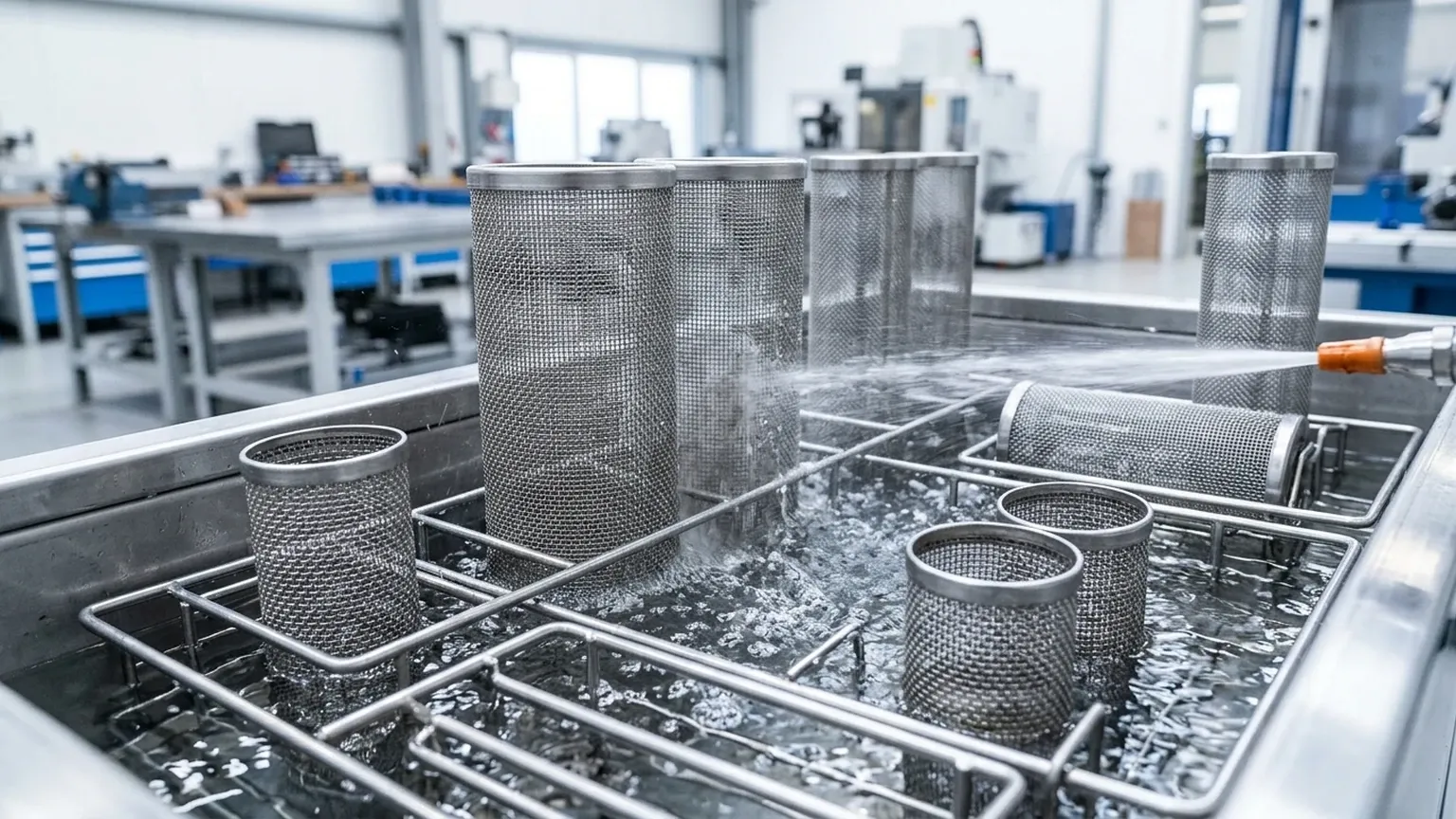
1. Pre-Rinse: Use a low-pressure water hose to remove loose surface debris. Avoid high pressure at this stage, as it may drive particles deeper into the mesh.
2. Soaking: Submerge the Wire Mesh Filter Cylinders & Tubes in a compatible cleaning solution for 30 to 60 minutes. This softens hardened contaminants.
3. Active Cleaning: Place the component in an ultrasonic bath for 15 to 30 minutes. If ultrasonic equipment is unavailable, use a soft-bristle nylon brush to gently scrub the surface. *Never use carbon steel brushes, as they will leave iron particles that lead to rusting.*
4. Rinsing: Rinse with clean, filtered water. For high-purity applications, use deionized water.
5. Drying: Use oil-free compressed air or a drying oven (set below 150°C) to remove moisture. Rapid drying prevents the formation of water spots or mineral deposits.
6. Inspection: Visually inspect the mesh under magnification for any remaining blinding or structural damage.
Verifying Filter Integrity Post-Cleaning
Cleaning is only successful if the filter's performance is restored without compromising its integrity. Engineers should perform two primary tests:
1. The Bubble Point Test
This test measures the pressure required to force air through a liquid-saturated filter. A significant drop in the bubble point pressure compared to the manufacturer's specification indicates that the mesh has been damaged or the pore size has enlarged, meaning the filter no longer meets its micron rating.
2. Differential Pressure Check
Once re-installed, the $ΔP$ across the filter should return to the "clean" baseline level. If the pressure remains high, it indicates that internal blinding (depth fouling) persists, and a more aggressive cleaning method or replacement is required.
When to Replace Rather Than Clean
While Wire Mesh Filter Cylinders & Tubes are designed for reuse, they have a finite lifespan. Replacement is necessary when:
* Work Hardening: Repeated cleaning and pressure cycles cause the stainless steel wires to become brittle, leading to cracks.
* Permanent Blinding: If the $ΔP$ cannot be reduced to within 10-15% of the original clean pressure, the filter is effectively end-of-life.
* Mechanical Deformation: Any visible denting, crushing, or separation of the mesh from the end caps or support cores compromises the bypass seal.
Engineering Considerations for Custom Solutions
When purchasing new filtration components, specifying the right construction can make cleaning significantly easier. For example, plain square weave mesh is easier to clean than complex Dutch weaves because the pores are more direct. However, Dutch weaves offer higher strength and finer filtration.
At Kaifil, we provide customized Wire Mesh Filter Cylinders & Tubes designed with both performance and maintainability in mind. By selecting the appropriate alloy and reinforcement structure, we help industrial operators maximize the interval between cleaning cycles and the total number of successful cleanings possible.
Conclusion
Mastering how to clean metal mesh filter units is a vital skill for maintaining industrial process efficiency. By employing a combination of ultrasonic cleaning, appropriate chemical treatments, and rigorous integrity testing, engineers can ensure that their stainless steel filtration assets provide reliable service for years. Proper maintenance not only protects downstream equipment but also ensures that the final product meets the required purity standards without unnecessary downtime or expenditure.
