


Air Filter Wire Mesh
In industrial environments, air filtration is not merely a matter of air quality; it is a critical component of machinery protection, process purity, and environmental compliance. Among the various media available, air filter wire mesh stands out for its durability, temperature resistance, and cleanability. Unlike disposable synthetic or paper filters, stainless steel wire mesh provides a robust solution capable of withstanding high-pressure differentials and corrosive atmospheres.
For engineers and procurement professionals, selecting the appropriate filtration component requires a deep understanding of fluid dynamics, material science, and mechanical design. This guide explores the technical nuances of wire mesh used in air filtration, focusing on the engineering principles that govern its performance and the selection criteria essential for optimizing industrial systems.
Understanding the Mechanics of Air Filtration via Wire Mesh
Air filtration through metallic mesh operates on several physical principles. While it may seem like a simple mechanical sieve, the capture of particulates involves complex interactions between the air stream, the particle mass, and the wire geometry.
Mechanical Sieving and Interception
Mechanical sieving occurs when a particle is larger than the pore size of the mesh. However, in many industrial air applications, the mesh is designed to capture particles smaller than the absolute opening through interception. This happens when a particle follows a gas streamline but comes within one particle radius of a wire fiber, causing it to adhere to the surface.
Inertial Impaction
In high-velocity air streams, larger or denser particles possess enough inertia that they cannot follow the abrupt change in air direction as it flows around a wire. These particles continue on a straight path, impacting the wire and becoming trapped. This is a primary mechanism for Wire Mesh Filter Cylinders & Tubes used in intake systems for compressors and turbines.
Diffusion (Brownian Motion)
For extremely fine sub-micron particles, filtration is governed by diffusion. These particles move erratically due to collisions with gas molecules. This irregular path increases the probability that the particle will contact a wire surface. While wire mesh is typically associated with coarser filtration, multi-layered or sintered mesh structures can effectively utilize diffusion to capture fine aerosols.
Material Selection and Environmental Compatibility
The performance of air filter wire mesh is heavily dictated by the alloy from which it is manufactured. In industrial settings, environmental factors such as temperature, humidity, and chemical exposure are the primary drivers for material selection.
Stainless Steel Grades: 304 vs. 316L
* Grade 304: The standard for general industrial applications. It offers excellent mechanical strength and basic corrosion resistance suitable for dry air filtration and non-corrosive gas streams.
* Grade 316L: Contains molybdenum, which provides superior resistance to chlorides and marine environments. It is the preferred choice for offshore applications, chemical processing plants, and pharmaceutical cleanrooms where sterilization or aggressive cleaning agents are used.
High-Temperature Alloys
In applications such as exhaust gas filtration or high-temperature kiln air intakes, standard stainless steels may suffer from oxidation or loss of structural integrity. In these instances, alloys like Inconel or Hastelloy are employed to maintain filtration performance at temperatures exceeding 600°C.
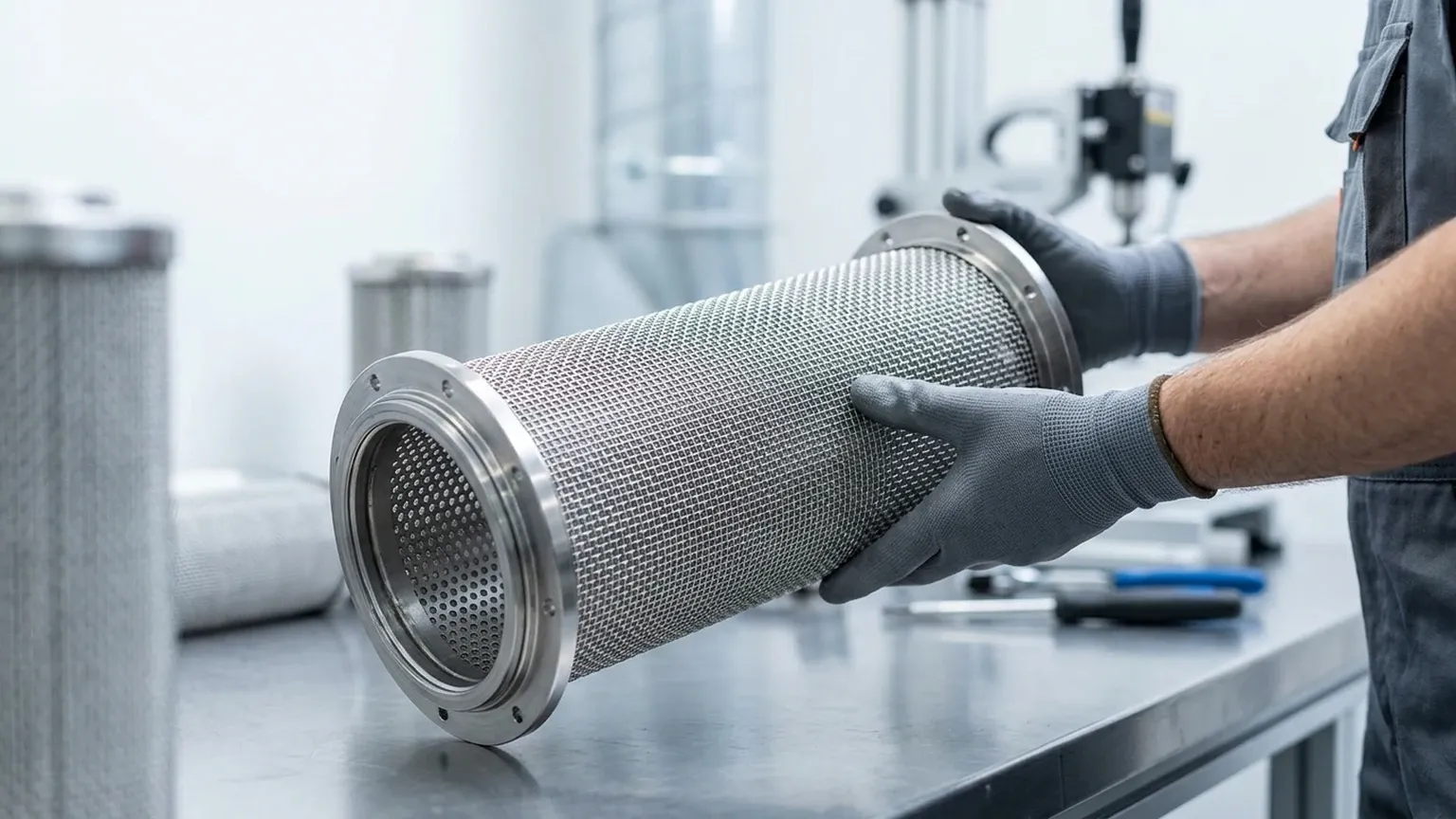
Structural Design: Wire Mesh Filter Cylinders & Tubes
The geometry of the filter element is as important as the mesh itself. In air filtration, the cylindrical or tubular form is favored for its inherent structural strength and efficient use of space.
The Role of Support Cores
Wire mesh is often flexible, especially when high filtration fineness (high mesh count) is required. To prevent the mesh from collapsing under the pressure of the air stream, it is typically wrapped around or housed within a perforated metal core. This core provides the necessary mechanical backbone, allowing the filter to withstand significant pressure drops (Delta P) without deforming.
Pleated vs. Plain Cylinders
To increase the effective filtration area without increasing the overall footprint of the equipment, engineers often specify pleated wire mesh. Pleating can increase the surface area by 3 to 5 times compared to a plain cylinder. This results in:
* Lower face velocity across the mesh.
* Reduced initial pressure drop.
* Extended service life between cleaning cycles.
Welding and Seaming Techniques
For industrial-grade air filter wire mesh, the integrity of the longitudinal seam is paramount. Advanced welding techniques, such as plasma welding or TIG (Tungsten Inert Gas) welding, ensure that the seam is as strong as the parent material and free from bypass gaps. This is a critical quality check for any B2B buyer, as a single failed seam can lead to downstream equipment damage.
Performance Evaluation: Pressure Drop and Efficiency
When specifying a filter for an industrial air system, two metrics dominate the engineering discussion: filtration efficiency and the pressure drop across the media.
Calculating Pressure Drop
The pressure drop (ΔP) is the resistance offered by the filter to the air flow. It is influenced by the air velocity, the viscosity of the gas, and the "open area" of the mesh. A high mesh count provides finer filtration but results in a higher ΔP. If the pressure drop is too high, it forces the system's fans or compressors to work harder, leading to increased energy consumption and potential motor failure.
Dirt-Holding Capacity
In air applications, the dirt-holding capacity refers to the amount of particulate matter the mesh can retain before the pressure drop reaches a critical threshold. Wire mesh filters excel here because they can be designed with specific depths (through multi-layering) to trap particles throughout the media, rather than just on the surface.
Selection Criteria for Technical Purchasing Teams
For procurement and engineering teams, the transition from a technical requirement to a physical product involves several critical confirmations. When sourcing air filter wire mesh components, the following parameters must be defined:
1. Micron Rating: Specify whether the requirement is for "nominal" (average pore size) or "absolute" (maximum pore size) filtration. For critical machinery protection, absolute ratings are preferred.
2. Flow Rate and Velocity: The volume of air (CFM or m³/h) and the velocity at which it hits the filter face. This determines the required surface area to keep ΔP within acceptable limits.
3. Operating Temperature: Both the continuous operating temperature and potential spikes. This influences both material selection and the type of gaskets or seals used on the end caps.
4. Cleaning Protocol: Will the filter be cleaned via ultrasonic bath, back-pulsing, or manual pressure washing? The mesh must be robust enough to survive the intended cleaning method without losing its pore geometry.
5. Interface Requirements: The design of end caps (e.g., DOE – Double Open End, or SOE – Single Open End with a specific O-ring code) is vital for ensuring a leak-proof installation within the existing housing.
Maintenance and Total Cost of Ownership (TCO)
One of the primary advantages of stainless steel air filter wire mesh in a B2B context is the favorable Total Cost of Ownership. While the initial capital expenditure (CAPEX) is higher than that of synthetic media, the operational expenditure (OPEX) is significantly lower.
Cleanability and Reusability
Unlike polymer-based filters that must be disposed of after a single loading cycle, stainless steel mesh can be cleaned and returned to service. In industries like food processing or chemical manufacturing, where filter replacement frequency is high, the ability to reuse a filter dozens or even hundreds of times provides a rapid Return on Investment (ROI).
Avoiding Application Risks
The primary risk in utilizing wire mesh for air filtration is "media migration" or structural failure due to fatigue. High-vibration environments can cause individual wires to work-harden and eventually snap if the mesh is not properly supported. Ensuring that the filter manufacturer uses high-quality, annealed wire and robust support structures is the best mitigation strategy against these risks.
Conclusion
Air filter wire mesh represents a sophisticated engineering solution for demanding industrial environments. By balancing material science with precise structural design, these components provide reliable, long-term filtration that protects expensive downstream assets and ensures process consistency. Whether the application involves high-temperature exhaust, sterile air for pharmaceutical packaging, or heavy-duty intake for industrial compressors, the correct specification of Wire Mesh Filter Cylinders & Tubes is fundamental to system performance. For engineers, the focus should remain on the intersection of filtration efficiency, mechanical durability, and the long-term economic benefits of a cleanable, permanent filtration medium.
