


Engineering Guide to Knitted Wire Mesh Filters: Principles, Selection, and Industrial Application
In industrial filtration and separation processes, the choice of media significantly impacts operational efficiency, maintenance cycles, and the purity of the final output. Among the various technologies available, the knitted wire mesh filter stands out for its unique structural characteristics. Unlike traditional woven wire cloth, which consists of straight wires crossing at right angles, knitted mesh is composed of interlocking loops that form a three-dimensional, flexible matrix.
For engineers and procurement specialists, understanding the mechanical properties and fluid dynamic behavior of knitted mesh is essential for optimizing systems in chemical processing, oil and gas, and pharmaceutical manufacturing. This article explores the technical foundations of knitted mesh filtration, its integration into Wire Mesh Filter Cylinders & Tubes, and the critical parameters for industrial selection.
1. Operating Principles of Knitted Wire Mesh
The primary function of a knitted wire mesh filter is often centered on impingement and coalescence rather than simple mechanical sieving. While it can capture solid particles, its most common industrial roles involve gas-liquid separation (demisting) and liquid-liquid separation (coalescing).
Mist Elimination and Impingement
In gas-liquid separation, a gas stream laden with liquid droplets passes through the knitted mesh. As the gas follows the tortuous path created by the interlocking loops, the heavier liquid droplets, possessing greater inertia, cannot negotiate the turns. They collide with the wire surfaces—a process known as inertial impingement. These droplets then adhere to the wire, coalesce into larger drops, and eventually drain away due to gravity.
Coalescence in Liquid-Liquid Systems
In applications where two immiscible liquids must be separated (such as oil and water), the knitted mesh acts as a high-surface-area medium that encourages the dispersed phase to gather. The irregular, multi-layered structure of the mesh provides numerous contact points where small droplets can merge. Once they reach a critical size, the buoyancy difference between the two liquids allows for efficient phase separation.
Particle Capture
When used for solid-liquid filtration, the knitted mesh provides a deep filtration bed. Unlike a single-layer woven mesh that captures particles on a flat surface, the three-dimensional nature of knitted mesh allows for depth loading. This increases the dirt-holding capacity and can extend the time between cleaning cycles, provided the mesh density is correctly specified for the particle size distribution.
2. Structural Characteristics and Advantages
The manufacturing process of a knitted wire mesh filter involves a knitting machine similar to those used in the textile industry, but utilizing metal wires. This produces several distinct advantages over other filter media:
* High Void Volume: Knitted mesh typically features a void volume (porosity) ranging from 92% to 98%. This high porosity results in an exceptionally low pressure drop across the filter, which is critical for maintaining flow rates in high-volume industrial processes.
* Flexibility and Resilience: The interlocking loop structure gives the mesh a "spring-like" quality. It can be compressed, folded, or rolled into various shapes without losing its structural integrity. This resilience makes it ideal for applications involving high vibration or thermal expansion.
* Customizable Surface Area: By adjusting the wire diameter, the number of stitches per inch, and the number of layers, manufacturers like Kaifil can precisely tune the surface area and density to meet specific filtration requirements.
3. Engineering Specifications for Selection
When specifying a knitted wire mesh filter for an industrial application, several technical variables must be evaluated to ensure performance and longevity.
Material Selection
Corrosion resistance is the primary driver for material selection. Stainless steel is the industry standard due to its durability and chemical compatibility:
* AISI 304: Suitable for general industrial use and applications with mild corrosive exposure.
* AISI 316L: Preferred for marine environments, pharmaceutical processes, and chemical plants where resistance to chlorides and acids is required.
* Specialty Alloys: For extreme environments, materials such as Monel, Inconel, or Hastelloy may be used to withstand high temperatures or highly aggressive chemical reagents.
Wire Diameter and Mesh Density
The wire diameter (typically ranging from 0.1mm to 0.5mm) directly influences the mechanical strength and the available surface area. Finer wires provide more surface area for coalescence but are less robust. Mesh density is often measured in kilograms per cubic meter (kg/m³) or by the number of stitches per unit of length. Higher density improves filtration efficiency but increases the pressure drop.
Multi-Layering and Crimping
To enhance the performance of Wire Mesh Filter Cylinders & Tubes, the mesh is often "crimped." Crimping involves passing the mesh through gears to create corrugations. When these layers are stacked or rolled, the crimps prevent the layers from nesting together, maintaining the high void volume and ensuring uniform flow distribution across the entire filter depth.
4. Integration into Wire Mesh Filter Cylinders & Tubes
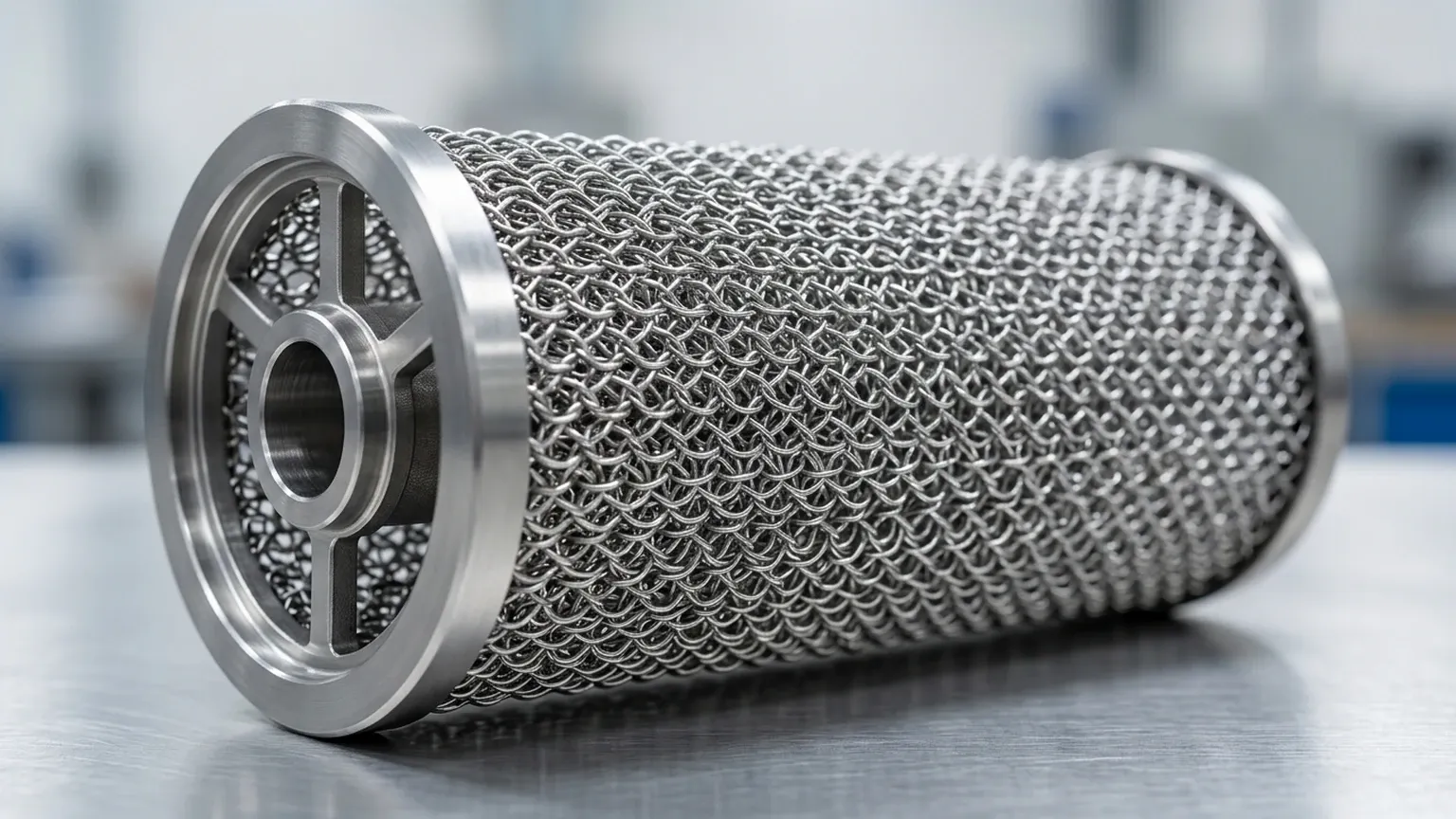
For most industrial housings, the knitted mesh is processed into rigid or semi-rigid components. The integration of knitted media into Wire Mesh Filter Cylinders & Tubes allows for standard installation into existing pipelines and vessel systems.
Structural Support
Because knitted mesh is inherently flexible, it often requires a support structure when subjected to high-pressure differentials. In a cylinder configuration, the knitted mesh is frequently wrapped around a perforated metal core or encased within a stainless steel mesh cage. This ensures the filter maintains its shape under the force of the process fluid.
Sealing and End Caps
Proper sealing is critical to prevent fluid bypass. Industrial filter tubes are typically finished with welded or machined end caps (such as DOE – Double Open End, or SOE – Single Open End with an O-ring). Kaifil provides customized end-cap configurations to ensure compatibility with various industrial filter housings, ensuring that 100% of the process fluid passes through the filtration media.
5. Key Industrial Applications
Chemical and Petrochemical Processing
In distillation columns and evaporation units, knitted mesh demisters are used to prevent liquid carry-over. This protects downstream equipment like compressors and ensures the purity of the gas phase. The ability to customize the mesh density allows engineers to target specific droplet sizes, often down to 5 microns with high efficiency.
Pharmaceutical and Food Production
In these sectors, cleanability and material certification are paramount. Stainless steel knitted filters are used for steam filtration and the removal of fine particulates from liquid ingredients. Their resistance to Clean-in-Place (CIP) chemicals and high-temperature sterilization makes them a durable alternative to disposable polymer filters.
Hydraulic and Lubrication Systems
Knitted mesh is often used as a breather filter or a coarse pre-filter in hydraulic reservoirs. Its ability to handle high flow rates with minimal resistance ensures that pumps are not starved of fluid, while its vibration-damping properties protect the filter element from the mechanical stresses common in heavy machinery.
6. Maintenance and Performance Monitoring
To maintain the efficiency of a knitted wire mesh filter, regular monitoring of the differential pressure (ΔP) is required. A sudden increase in ΔP typically indicates particulate loading or fouling.
* Cleaning Methods: Stainless steel knitted filters can often be cleaned using ultrasonic baths, back-flushing, or chemical solvents, depending on the nature of the contaminant. This reusability significantly reduces the total cost of ownership compared to single-use cartridges.
* Replacement Cycles: While durable, the mesh can eventually suffer from mechanical fatigue or localized corrosion (pitting). Regular inspection during scheduled shutdowns is recommended to check for mesh thinning or structural deformation of the support tubes.
7. Procurement Checklist for International Buyers
When sourcing knitted wire mesh filters for industrial projects, buyers should confirm the following technical details with the manufacturer to ensure the product meets the application’s demands:
1. Chemical Compatibility: Confirm the specific grade of stainless steel or alloy required for the process fluid.
2. Micron Rating vs. Efficiency: Define whether the requirement is for absolute filtration or a specific percentage of droplet removal (e.g., 99% of droplets >10 microns).
3. Operating Conditions: Provide the maximum operating temperature and pressure, as well as the expected flow rate.
4. Mechanical Interface: Specify the exact dimensions (OD, ID, and Length) and the type of end-cap connection required for the housing.
5. Certification: If applicable, request material test reports (MTRs) to verify the alloy composition and compliance with standards such as FDA or ASME.
Conclusion
The knitted wire mesh filter is a versatile and high-performance component in the industrial filtration landscape. By leveraging the interlocking loop structure, these filters provide a unique combination of high void volume, low pressure drop, and exceptional coalescence capabilities. Whether integrated into complex Wire Mesh Filter Cylinders & Tubes or used as standalone demister pads, they offer a reliable solution for demanding chemical and mechanical environments. For engineers, the key to success lies in the precise specification of material, density, and structural support to match the specific fluid dynamics of their process.
