


Knitted Mesh Filter
In industrial filtration and separation processes, the choice of media significantly impacts operational efficiency, maintenance frequency, and the purity of the final output. Among the various technologies available, the knitted mesh filter stands out for its unique mechanical structure and versatility. Unlike traditional woven wire mesh, which consists of straight wires crossing at right angles, knitted mesh is produced using a knitting process that creates a series of interlocking loops. This results in a three-dimensional, flexible, and high-voidage structure that is essential for specific industrial applications such as demisting, flame quenching, and precision liquid-gas separation.
For engineers and procurement specialists, understanding the technical nuances of knitted mesh—ranging from material density to structural integrity—is critical when integrating these components into Wire Mesh Filter Cylinders & Tubes. This guide explores the operating principles, material considerations, and selection criteria necessary for optimizing industrial filtration systems.
1. Operating Principles of Knitted Mesh Filtration
The performance of a knitted mesh filter is primarily defined by its geometric configuration. The interlocking loops create a tortuous path for the fluid (liquid or gas) to pass through. This path facilitates several separation mechanisms:
Inertial Impingement
In gas-liquid separation, such as in demisting applications, small droplets entrained in a gas stream strike the wires of the knitted mesh. Due to their inertia, the droplets cannot follow the gas flow around the wire. They collide with the wire surface, coalesce into larger drops, and eventually drain away due to gravity. This is highly effective for removing droplets down to 3–5 microns.
Depth Filtration
Because the knitted structure can be layered or compressed, it acts as a depth filtration medium. Particles are not just trapped on the surface but are captured within the thickness of the mesh matrix. This allows for a higher dirt-holding capacity compared to single-layer woven screens, extending the service life between cleaning cycles.
High Void Volume
One of the most significant advantages of the knitted mesh filter is its high percentage of open area (void volume), often exceeding 90%. This ensures an exceptionally low pressure drop across the filter, which is vital for maintaining system energy efficiency and preventing cavitation in hydraulic or pumping circuits.
2. Material Selection and Environmental Compatibility
Selecting the correct alloy for a knitted mesh filter is a balance between chemical resistance, temperature limits, and mechanical strength. Since these filters are often used in aggressive chemical processing or high-temperature exhaust systems, material integrity is paramount.
* Stainless Steel 304: The standard choice for general industrial use, offering good corrosion resistance and mechanical stability in non-acidic environments.
* Stainless Steel 316L: Preferred for marine environments, pharmaceutical processing, and chemical applications involving chlorides. The "L" (low carbon) designation ensures better weldability and resistance to intergranular corrosion.
* High-Nickel Alloys (Monel, Inconel, Hastelloy): Utilized in extreme conditions, such as highly acidic gas streams or temperatures exceeding 800°C, where standard stainless steels would suffer from oxidation or stress corrosion cracking.
* Specialty Plastics (PP, PTFE): In specific low-temperature applications where metal contamination must be avoided or where extreme chemical inertness is required, polymer-based knitted meshes are employed.
3. Engineering Considerations for Customization
When designing a filtration system, the physical properties of the knitted mesh must be tailored to the specific process requirements. Engineers typically specify several variables to achieve the desired performance:
Wire Diameter
Common wire diameters range from 0.11mm to 0.35mm. Finer wires provide more surface area for impingement but result in a more delicate structure. Heavier wires offer greater mechanical strength and are used in high-velocity flow environments or as support layers in Wire Mesh Filter Cylinders & Tubes.
Mesh Density
The density of the filter is determined by the number of stitches per centimeter and the degree of compression applied during manufacturing. Higher density increases filtration efficiency for smaller particles but also increases the resistance to flow (pressure drop). In demisting, a density of 100 to 200 kg/m³ is common, whereas flame arrestors may require significantly higher densities to effectively quench heat.
Layering and Crimping
Knitted mesh is often "crimped" to create a wavy profile before being rolled or layered. This crimping prevents the layers from nesting tightly against each other, ensuring that the high void volume is maintained throughout the depth of the filter. This is a critical step in manufacturing high-performance filter cartridges.
4. Integration into Wire Mesh Filter Cylinders & Tubes
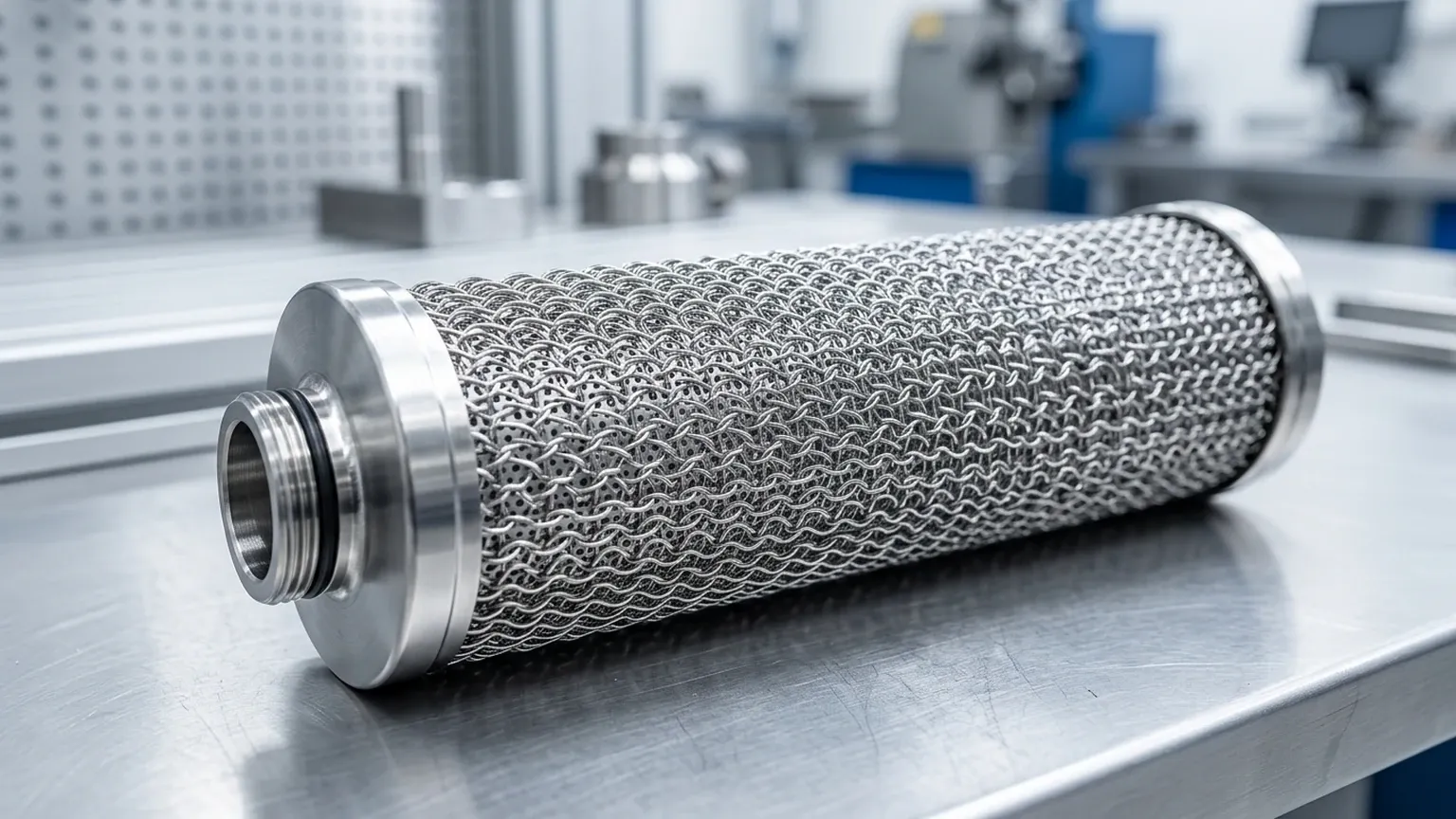
While knitted mesh is a powerful filtration medium on its own, it is frequently integrated into more rigid structures to withstand industrial pressures. The transition from a flexible mesh to a functional industrial component often involves the creation of Wire Mesh Filter Cylinders & Tubes.
In these configurations, the knitted mesh may serve as:
* The Primary Filter Media: Compressed knitted mesh is formed into a self-supporting cylinder or tube for use in oil-mist eliminators or hydraulic breathers.
* A Pre-filtration Layer: Wrapped around a perforated metal core or a fine woven wire mesh to protect the finer inner media from large particulate slugs.
* A Cushioning or Support Layer: Providing a mechanical buffer between rigid components in high-vibration environments, such as automotive exhaust systems or heavy machinery.
By housing the knitted mesh within a cylindrical format, manufacturers can provide a component that is easy to install in standard filter housings while maintaining the structural integrity required for high-flow applications.
5. Key Industrial Applications
The unique properties of the knitted mesh filter make it indispensable across several sectors:
Petrochemical and Oil & Gas
Knitted mesh demisters (mist eliminators) are used in vacuum towers, evaporators, and scrubbers to prevent liquid carryover. This protects downstream equipment like compressors and ensures the purity of the gas stream.
Flame and Spark Arrestors
The high thermal conductivity of metal knitted mesh allows it to absorb and dissipate heat rapidly. When used in a flame arrestor, the mesh quenches the flame front by cooling the burning gas below its ignition temperature, preventing explosions in volatile environments.
Vibration and Sound Dampening
Beyond filtration, the interlocking loop structure acts as a mechanical spring. Knitted mesh gaskets and mounts are used in high-temperature environments (like engine manifolds) to absorb vibration and reduce noise where traditional rubber mounts would fail.
Food and Beverage
Stainless steel knitted mesh is used in the filtration of steam and air used in food processing. Its ability to be thoroughly cleaned and its resistance to sanitizing chemicals make it compliant with stringent hygiene standards.
6. Selection Criteria for International Buyers
For procurement teams and engineers sourcing knitted mesh filters for global projects, several technical factors must be confirmed with the manufacturer to ensure the component is fit for purpose:
1. Micron Rating vs. Efficiency: Unlike woven mesh, which has a fixed pore size, knitted mesh is often rated by its removal efficiency for a specific droplet or particle size at a given flow velocity. Requesting an efficiency curve is more accurate than a single micron rating.
2. Pressure Drop Calculations: Buyers should provide the maximum allowable pressure drop for the system. The manufacturer can then adjust the mesh density and wire diameter to meet this constraint.
3. Chemical Compatibility: Confirm that the alloy selected is resistant to all components of the process fluid, including trace contaminants that may concentrate over time.
4. Mechanical Housing Requirements: Determine if the mesh needs to be supplied as a bulk roll, a die-cut pad, or integrated into Wire Mesh Filter Cylinders & Tubes. Cylindrical formats are generally easier to replace and provide better sealing interfaces.
5. Certification and Compliance: For specific industries, ensure the materials meet standards such as FDA (for food contact), ASME (for pressure vessels), or specific ISO quality management certifications.
7. Maintenance and Total Cost of Ownership
The long-term value of a knitted mesh filter is found in its durability and cleanability. Unlike disposable paper or synthetic filters, stainless steel knitted mesh can often be cleaned and reused. Cleaning methods include ultrasonic baths, backwashing, or chemical cleaning, depending on the nature of the contaminants.
When evaluating the total cost of ownership (TCO), engineers should consider:
* Replacement Frequency: How often does the filter reach its terminal pressure drop?
* Energy Consumption: Does the low pressure drop of the knitted mesh result in significant pump or fan energy savings?
* Process Protection: What is the cost of downtime or equipment damage if the filter fails to remove entrained liquids or particles?
By investing in a high-quality, custom-engineered knitted mesh solution, industrial facilities can achieve a balance of high filtration performance and low operational overhead. Whether used as a standalone demister or integrated into complex Wire Mesh Filter Cylinders & Tubes, the knitted mesh remains a cornerstone of modern industrial separation technology.
