


Engineering Guide to Wire Mesh Filter Washers in Industrial Applications
In industrial fluid handling and gas processing, the integrity of a system often depends on the smallest components. A wire mesh filter washer serves a dual purpose: it acts as a mechanical seal while providing a critical filtration barrier at the point of entry or exit in a pipeline, valve, or nozzle assembly. Unlike standard gaskets, these components are engineered to withstand high differential pressures, corrosive environments, and extreme temperatures, making them indispensable in chemical processing, hydraulic systems, and pharmaceutical manufacturing.
Selecting the correct filtration component requires a deep understanding of material science, fluid dynamics, and mechanical engineering. This guide examines the technical specifications, design considerations, and application risks associated with industrial-grade wire mesh washers and their role within broader Wire Mesh Filter Cylinders & Tubes assemblies.
Engineering Principles of Wire Mesh Filter Washers
The primary function of a wire mesh filter washer is mechanical straining. It is designed to intercept solid contaminants from a fluid or gas stream while allowing the medium to pass through with minimal resistance. The effectiveness of this process is governed by the mesh geometry and the physical properties of the wire.
Surface vs. Depth Filtration
Wire mesh washers primarily operate on the principle of surface filtration. Particles larger than the pore size of the mesh are trapped on the upstream side. Because the mesh is a precision-woven structure, the pore size is highly uniform, providing a predictable "absolute" filtration rating. This is a significant advantage over non-woven or felt-based filters, which may have inconsistent pore distributions.
Mechanical Integrity under Load
In many B2B applications, the washer is compressed between two flanges or within a threaded fitting. The engineering challenge lies in maintaining the filtration area while the perimeter of the washer is under high compressive load. If the mesh is not properly supported or if the wire diameter is insufficient, the mesh can deform, altering the pore size and potentially leading to "bypass"—where unfiltered fluid escapes around the edges or through distorted openings.
Material Selection and Chemical Compatibility
For industrial environments, stainless steel is the standard material due to its mechanical strength and resistance to oxidation. Kaifil specializes in utilizing high-grade alloys to ensure longevity in demanding conditions.
1. AISI 304 Stainless Steel: The most common grade, offering excellent corrosion resistance in most atmospheric and water-based applications. It is cost-effective for general industrial use where extreme chemical exposure is not expected.
2. AISI 316L Stainless Steel: Containing molybdenum, 316L provides superior resistance to chlorides and acids. The "L" (low carbon) designation is critical for components that require welding, as it prevents carbide precipitation and ensures the structural integrity of the filter mesh during the manufacturing process.
3. Specialty Alloys: In high-temperature or highly corrosive chemical processing, materials such as Inconel, Monel, or Hastelloy may be used to prevent premature failure of the wire mesh filter washer.
When selecting a material, engineers must consider the pH of the fluid, the operating temperature, and the presence of any abrasive particles that could cause erosive wear on the wire surfaces.
Critical Design Specifications for Industrial Use
Specifying a wire mesh filter washer involves more than just defining the outer diameter (OD) and inner diameter (ID). Several technical parameters must be balanced to achieve optimal performance.
Mesh Count and Micron Rating
The mesh count refers to the number of openings per linear inch. A higher mesh count generally results in a smaller micron rating (finer filtration). However, as the mesh becomes finer, the wire diameter typically decreases, which can impact the structural rigidity of the washer. Engineers must determine the "nominal" vs. "absolute" micron rating required for their specific equipment protection needs.
Weave Types
* Plain Weave: The simplest and most common weave, where wires cross over and under each other. It offers the highest open area and lowest pressure drop.
* Dutch Weave: This weave uses heavier warp wires and smaller shute wires, resulting in a dense, strong mesh with very fine filtration capabilities. Dutch weave washers are ideal for high-pressure hydraulic applications.
* Twilled Weave: Allows for thicker wires in a given mesh count, providing increased strength for heavy-duty filtration tasks.
Edge Treatment and Framing
To prevent fraying and ensure a proper seal, the edges of a wire mesh filter washer are often treated. Options include:
* Sintered Edges: The wires are fused together using heat and pressure, creating a rigid, non-fraying edge.
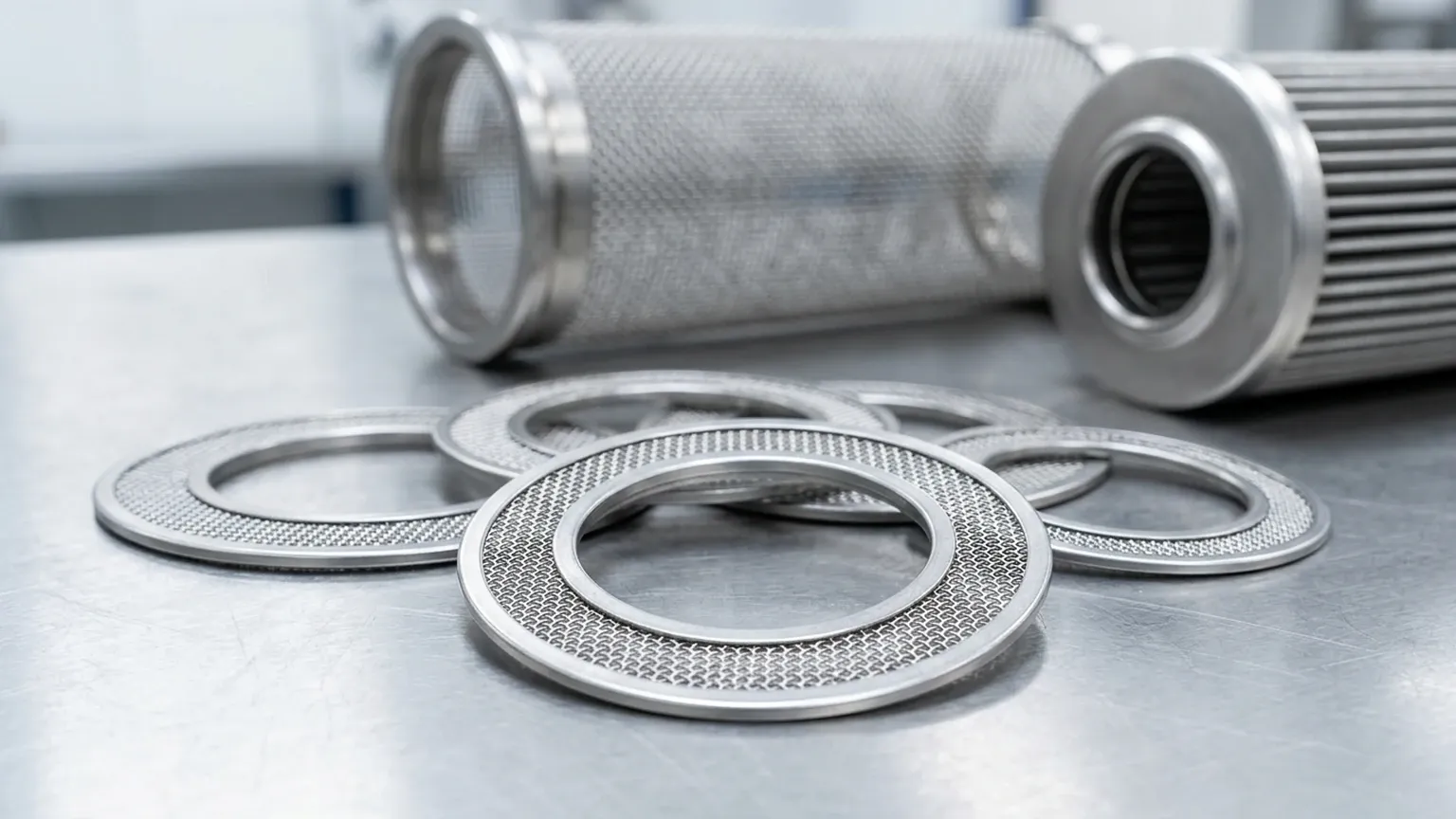
* Metal Framing: The mesh is encased in a solid metal ring (U-shaped cross-section), which provides a robust sealing surface and protects the mesh from compression damage.
* Annealed Edges: Softening the perimeter of the washer to allow it to conform better to irregular sealing surfaces.
Integration with Wire Mesh Filter Cylinders & Tubes
In complex industrial filtration systems, a single washer is rarely the only component. Often, a wire mesh filter washer is used as a secondary safety screen or a seating gasket for larger Wire Mesh Filter Cylinders & Tubes.
For instance, in a high-flow chemical reactor, a large stainless steel filter cylinder may perform the bulk of the filtration. However, at the connection points where the cylinder meets the housing or the outlet manifold, a precision-engineered washer is required to prevent bypass. This "multi-stage" approach ensures that even if the primary filter element is serviced or replaced, the downstream sensitive components—such as flow meters or high-pressure nozzles—remain protected from transient debris.
Customized filtration solutions often involve welding these washers directly onto the ends of tubes or cylinders to create a monolithic, leak-proof filter assembly. This integration is a hallmark of professional OEM manufacturing, where the entire fluid path is analyzed to eliminate potential failure points.
Installation Constraints and Performance Risks
Improper installation or selection of a wire mesh filter washer can lead to significant operational risks. Engineers should be aware of the following factors:
Pressure Drop (Delta P)
Every filter introduces a restriction to flow. As the mesh traps contaminants, the pressure drop across the washer increases. If the initial design does not account for a sufficient "open area," the system may experience reduced flow rates or pump cavitation. It is essential to calculate the effective filtration area (EFA), which is the total area of the openings, not just the total surface area of the washer.
Mesh Blinding and Plugging
Blinding occurs when particles that are approximately the same size as the mesh openings become wedged in the pores. This rapidly increases pressure drop and is difficult to clean. In applications with high concentrations of near-sized particles, a different weave type or a multi-layer sintered mesh may be required to distribute the particle load.
Seating and Torque Specifications
Because these washers often double as seals, the torque applied to the housing bolts is critical. Excessive torque can crush the wire mesh, closing the pores or causing the wire to snap. Conversely, insufficient torque leads to bypass. Using a metal-framed washer can help mitigate this risk by providing a hard stop for the compression force.
Maintenance, Cleaning, and Replacement Cycles
One of the primary advantages of stainless steel wire mesh is that it is cleanable and reusable, offering a lower total cost of ownership compared to disposable polymer filters.
Cleaning Protocols
* Ultrasonic Cleaning: The most effective method for removing fine particles lodged deep within the mesh. High-frequency sound waves create cavitation bubbles that lift contaminants away from the wire surfaces.
* Backwashing: Reversing the flow of the fluid to dislodge the filter cake. This is common in automated systems but may be less effective for washers with complex weaves.
* Chemical Cleaning: Using solvents or acids to dissolve organic or mineral deposits. Material compatibility must be verified before using harsh chemicals.
When to Replace
Despite their durability, wire mesh filter washers have a finite lifespan. They should be replaced if there is evidence of:
* Wire Fatigue: Broken wires or thinning of the wire diameter due to erosion.
* Permanent Deformation: Warping of the washer that prevents a proper seal.
* Incomplete Cleaning: If the "clean" pressure drop remains significantly higher than the original specification after a cleaning cycle, the mesh is likely permanently fouled.
Procurement Considerations for International Buyers
When sourcing wire mesh filter washers for industrial projects, purchasing teams and engineers must confirm several key details with the manufacturer to ensure the components meet the required safety and performance standards.
1. Dimensional Tolerances: For precision equipment, OD and ID tolerances often need to be within +/- 0.05mm. Confirm that the manufacturer’s stamping or laser-cutting process can maintain these levels.
2. Material Traceability: Request Material Test Reports (MTRs) to verify the alloy composition. This is especially important in the pharmaceutical and food industries where compliance with FDA or EU regulations is mandatory.
3. Batch Testing: For high-pressure applications, ask if the manufacturer performs bubble point testing or pressure-hold tests on sample batches to ensure weave integrity.
4. Customization Capabilities: If the standard sizes do not fit, evaluate the manufacturer's ability to produce custom geometries, such as oval washers, multi-layered sintered discs, or washers with integrated handles for easy removal.
By focusing on these technical parameters, B2B buyers can ensure they receive a wire mesh filter washer that provides reliable, long-term protection for their industrial infrastructure. Whether used as a standalone component or as part of a larger system of Wire Mesh Filter Cylinders & Tubes, these precision-engineered metal filters remain a cornerstone of efficient industrial filtration.
