


10 Filter Cartridges
In industrial filtration, the term "10 filter cartridges" often refers to two critical specifications: the 10-inch standard length and the 10-micron filtration rating. These parameters represent some of the most common benchmarks in fluid processing, serving as the backbone for chemical, pharmaceutical, and food and beverage production lines. When selecting Filter Cartridges for high-demand environments, engineers must look beyond basic dimensions to understand the material science, structural integrity, and fluid dynamics that dictate long-term performance.
As a specialized manufacturer, Kaifil provides precision-engineered stainless steel filtration solutions designed to replace or enhance standard 10-inch configurations. This guide examines the technical nuances of 10-micron and 10-inch filtration components, providing the data necessary for informed procurement and system design.
The Role of 10-Micron and 10-Inch Filter Cartridges in Industrial Systems
The "10" designation is a cornerstone of modular filtration. The 10-inch (approximately 254mm) cartridge is the global standard for industrial filter housings, offering a balance between flow capacity and space efficiency. When coupled with a 10-micron rating, these cartridges become versatile tools for both pre-filtration and final polishing stages.
Nominal vs. Absolute 10-Micron Ratings
One of the most frequent points of confusion for purchasing teams is the distinction between nominal and absolute ratings.
* Nominal 10-Micron: This indicates that the filter will retain a majority (typically 60% to 90%) of particles 10 microns or larger. These are often used for general-purpose water treatment or as pre-filters to protect more expensive downstream equipment.
* Absolute 10-Micron: This is a much more rigorous standard, typically requiring a Beta ratio of 5000 or higher, meaning 99.9% of 10-micron particles are captured. In critical applications like hydraulic fluid maintenance or pharmaceutical intermediate processing, absolute-rated stainless steel mesh is mandatory to ensure process consistency.
Dimensional Standards
While the 10-inch length is standard, the end-cap configuration is what determines compatibility with existing housings. Common configurations for 10 filter cartridges include:
* DOE (Double Open End): Requires flat gaskets at both ends; used in standard industrial housings.
* SOE (Single Open End) with Code 7: Features a finned end and double 226 O-rings for a high-integrity, leak-proof seal.
* Code 3 and Code 8: Alternative O-ring configurations for specific high-pressure or sanitary requirements.
Material Selection for 10 Filter Cartridges: 304 vs. 316L Stainless Steel
For industrial applications involving high temperatures, corrosive chemicals, or stringent hygiene requirements, polymer-based filters (such as polypropylene or PES) often fail. Stainless steel is the material of choice for durability and reusability.
304 Stainless Steel
Grade 304 is the most common stainless steel used in filtration. It offers excellent strength and good corrosion resistance for standard water treatment, hydraulic oils, and non-acidic chemical processing. It is a cost-effective solution for 10-micron filtration where the environment is relatively stable.
316L Stainless Steel
For more demanding environments, 316L (low carbon) is required. The addition of molybdenum provides superior resistance to chlorides and pitting. This is the authoritative standard for:
* Marine and Offshore: Resistance to salt-water corrosion.
* Pharmaceuticals: High-purity requirements and resistance to aggressive cleaning agents.
* Food and Beverage: Resistance to organic acids and CIP (Clean-in-Place) chemicals.
* Chemical Processing: Handling of sulfuric or phosphoric acid solutions at specific concentrations.
Structural Engineering: Pleated vs. Cylindrical Mesh Designs
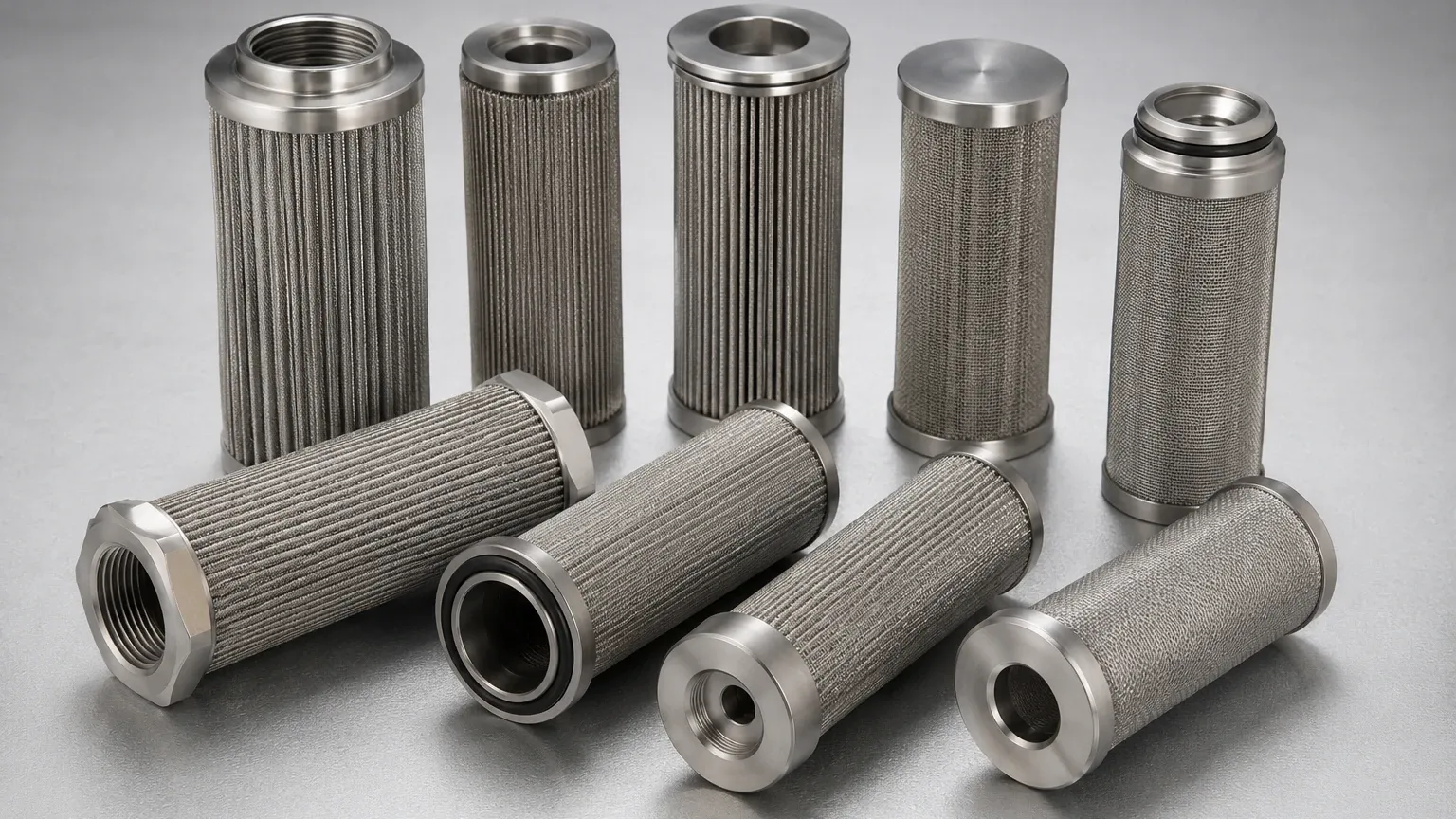
The internal structure of the cartridge dictates how it handles particle loading and fluid velocity. When specifying 10 filter cartridges, engineers must choose between pleated and cylindrical (plain) designs.
Pleated Stainless Steel Cartridges
Pleating involves folding the stainless steel wire mesh or sintered fiber felt to increase the effective filtration area. For a standard 10-inch cartridge, pleating can increase the surface area by 2 to 4 times compared to a cylindrical design.
* Pros: Lower initial differential pressure, higher dirt-holding capacity, and longer service life between cleanings.
* Best For: High-flow applications and fluids with a high concentration of contaminants.
Cylindrical (Plain) Mesh Cartridges
These consist of a single or multi-layer mesh cylinder supported by an internal perforated core.
* Pros: Extremely easy to clean (especially via backwashing or ultrasonic baths) and more robust under high-pressure pulses.
* Best For: Surface filtration where particles are easily dislodged, and applications where the cartridge is frequently cleaned and reused.
Performance Metrics: Flow Rate and Differential Pressure Analysis
When integrating Filter Cartridges into a system, the primary engineering concern is the relationship between flow rate and differential pressure (ΔP).
Initial Pressure Drop
Every filter introduces resistance. A 10-micron stainless steel cartridge will have a specific "clean pressure drop" based on the fluid's viscosity and velocity. Engineers should aim for an initial ΔP of less than 2-3 psi (0.14-0.21 bar) to allow for sufficient operating headroom as the filter loads with contaminants.
Viscosity Considerations
The performance of a 10-micron filter changes significantly with fluid thickness. For example, a cartridge processing hydraulic oil at 32 cSt will exhibit much higher resistance than one processing water at 1 cSt. Kaifil’s engineering team assists in calculating these variables to ensure that the 10-inch housing and cartridge combination can handle the required throughput without cavitating pumps or triggering premature bypass valves.
Dirt Holding Capacity (DHC)
DHC defines how much contaminant a cartridge can retain before reaching its terminal pressure drop (usually 25-35 psi). Pleated 10-micron cartridges excel here, providing a more sustainable Total Cost of Ownership (TCO) by reducing the frequency of maintenance shutdowns.
Application Profiles: Where 10-Micron Filtration is Critical
10-micron filtration is often considered the "sweet spot" for industrial protection. It is fine enough to remove harmful silt and particulates but coarse enough to allow for high flow rates without excessive energy consumption.
1. Hydraulic and Lube Oil Systems
In hydraulic systems, particles in the 5-15 micron range are the most damaging to valves and pumps because they match the clearances of moving parts. A 10-micron absolute-rated stainless steel cartridge provides the necessary protection to prevent component wear and system failure.
2. Food and Beverage Processing
For the filtration of syrups, edible oils, and beverages, 10-micron cartridges serve as a vital clarification step. They remove yeast cells, large proteins, and sediment, ensuring the clarity of the final product while protecting downstream membrane filters (which may be 0.45 or 0.22 microns).
3. Chemical and Petrochemical Refinement
In the production of polymers and specialty chemicals, 10-micron filters are used to remove catalysts and undissolved solids. The ability of stainless steel to withstand temperatures exceeding 200°C makes it indispensable in these exothermic processes.
4. Water Treatment and Desalination
As a pre-filter for Reverse Osmosis (RO) systems, 10-micron cartridges remove suspended solids (TSS) that would otherwise scale or foul the expensive RO membranes. Using cleanable stainless steel 10-inch cartridges in these roles can significantly reduce the environmental waste associated with disposable plastic filters.
Total Cost of Ownership and Maintenance Protocols
One of the primary advantages of choosing stainless steel 10 filter cartridges over disposable media is the long-term economic benefit. While the initial purchase price is higher, the TCO is lower due to cleanability.
Cleaning Methods for Stainless Steel Cartridges
* Ultrasonic Cleaning: The most effective method for 10-micron mesh. High-frequency sound waves create cavitation bubbles that dislodge deeply embedded particles from the mesh pores.
* Backwashing: For systems equipped with the necessary valving, reversing the flow can flush surface-loaded contaminants off the cartridge.
* Chemical Cleaning: Using surfactants or mild acids/bases to dissolve organic or mineral scaling. This is only possible with high-grade materials like 316L stainless steel.
Replacement Cycles
Unlike polymer filters that must be discarded when fouled, a Kaifil stainless steel cartridge can often be cleaned and reused dozens of times. The replacement cycle is determined not by clogging, but by physical wear or the eventual fatigue of the mesh after hundreds of cleaning cycles. For many industrial plants, this extends the hardware lifespan from weeks to years.
Customization and Engineering Support for Industrial Filtration
Standard off-the-shelf solutions do not always meet the specific needs of complex industrial environments. Kaifil specializes in the OEM and customized production of filtration components, allowing engineers to specify exact parameters for their 10 filter cartridges.
Customization Options Include:
* Reinforced Cores: For high-pressure applications where the differential pressure might exceed 100 psi.
* Specific Alloy Selection: Including Monel, Hastelloy, or 310S for extreme temperature or chemical resistance.
* Hybrid Micron Ratings: Multi-layered mesh designs that provide graduated filtration (e.g., a 40-micron outer layer protecting a 10-micron inner layer).
* Bespoke End-Caps: Custom machining to fit proprietary or legacy filter housings that do not follow standard DOE or SOE patterns.
When evaluating filtration requirements, it is essential to partner with a manufacturer that understands the mechanical stresses and chemical interactions at play. By focusing on precision manufacturing and high-quality materials, Kaifil ensures that every 10-micron and 10-inch cartridge delivers predictable, repeatable performance in the most demanding industrial sectors.
For technical specifications, material compatibility charts, or to discuss a custom filtration project, engineers and purchasing teams are encouraged to consult with our technical department. Selecting the right Filter Cartridges is the first step toward optimizing process efficiency and ensuring the longevity of industrial equipment.
