


20 Filter Cartridges
In industrial filtration, the selection of standardized components is critical for ensuring system compatibility, predictable performance, and ease of maintenance. Among the various sizes available in the market, the 20-inch length has emerged as a cornerstone for medium-scale processing applications. When engineers and procurement specialists discuss 20 filter cartridges, they are typically referring to the 20-inch nominal length standard, which provides a strategic balance between effective filtration area and housing footprint.
Understanding the technical nuances of these components is essential for optimizing fluid processing systems, whether in chemical manufacturing, pharmaceutical production, or high-pressure hydraulic applications. This guide examines the engineering considerations, material science, and operational parameters that define high-performance Filter Cartridges in the 20-inch specification.
The Role of 20 Filter Cartridges in Industrial Systems
The 20-inch filter cartridge serves as a versatile middle ground in industrial liquid and gas filtration. While 10-inch cartridges are often sufficient for low-flow laboratory or point-of-use applications, and 30- or 40-inch versions are reserved for massive high-volume throughput, the 20-inch format is frequently the standard for pilot plants, side-stream filtration, and medium-capacity production lines.
From a design perspective, utilizing 20 filter cartridges allows for a compact housing design that still offers significant surface area. This is particularly important in facilities where floor space is at a premium but high filtration efficiency is non-negotiable. By doubling the length of a standard 10-inch cartridge, engineers can effectively double the flow capacity or significantly extend the service life of the filter before reaching the terminal differential pressure. This scalability makes the 20-inch variant a preferred choice for modular filtration skids.
Engineering Specifications: Materials and Construction
The performance of a filter cartridge is fundamentally dictated by its material of construction and its structural design. In demanding industrial environments, stainless steel is the material of choice due to its thermal stability and chemical resistance.
Stainless Steel Alloys
For most industrial applications, 20-inch cartridges are manufactured using either 304 or 316L stainless steel.
- 304 Stainless Steel: Suitable for general industrial use, offering good corrosion resistance and structural integrity.
- 316L Stainless Steel: The "L" denotes low carbon content, which provides superior resistance to intergranular corrosion and is essential for applications involving aggressive chemicals, high-salinity environments, or stringent sanitary requirements in the food and pharmaceutical sectors.
Construction Methods
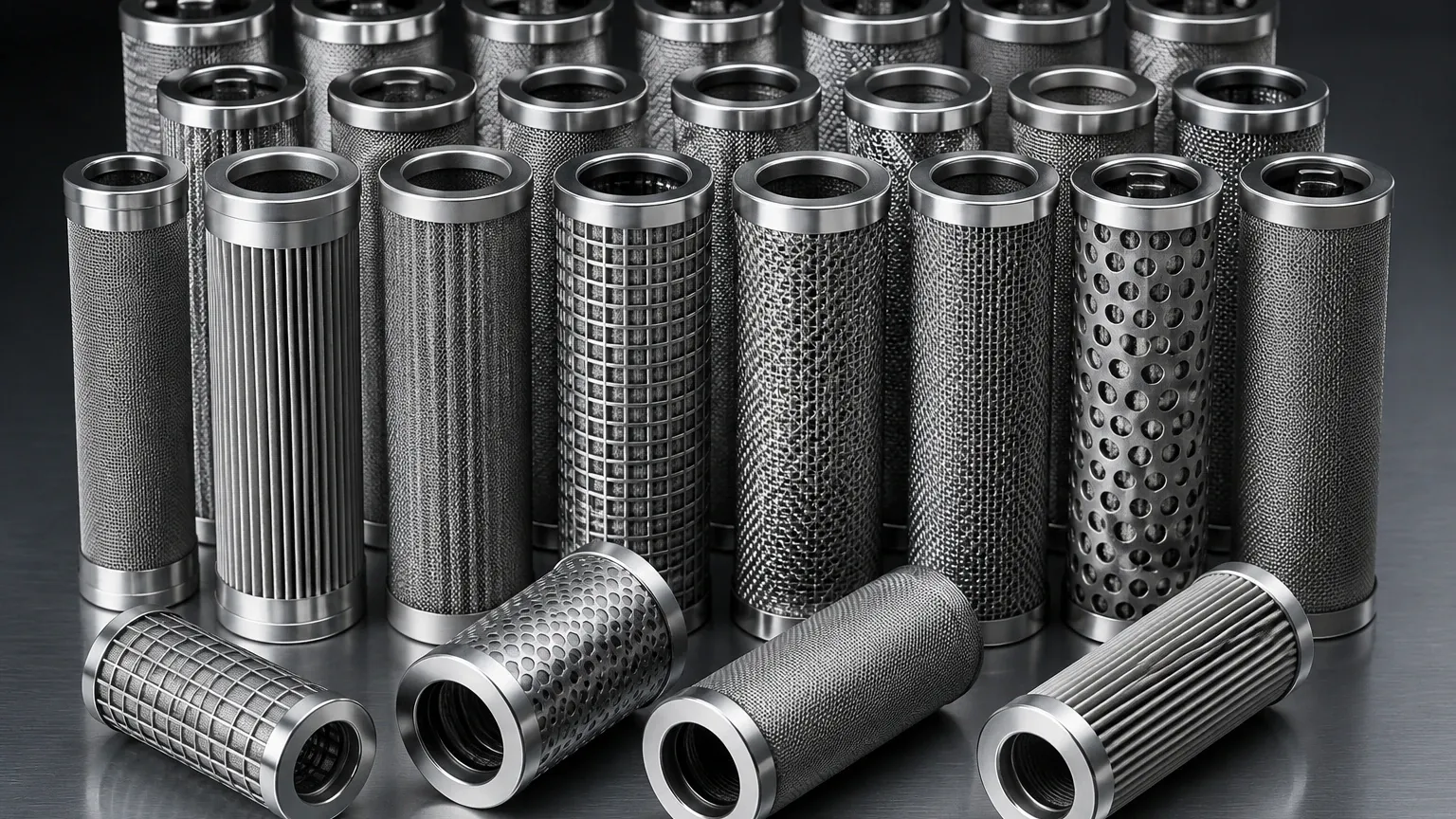
Kaifil specializes in several construction methods for metal filter cartridges, each tailored to specific particle separation needs:
1. Sintered Wire Mesh: Multiple layers of stainless steel wire cloth are sintered together to create a robust, integrated structure. This provides precise pore sizes and excellent mechanical strength, allowing the cartridge to withstand high differential pressures without media migration.
2. Pleated Metal Mesh: By pleating the filtration media, the effective surface area of the 20-inch cartridge is vastly increased. This design is ideal for high-flow applications where low initial pressure drop is required.
3. Sintered Metal Fiber Felt: This non-woven medium offers high porosity and high dirt-holding capacity, making it effective for depth filtration of gel-like contaminants or fine particulates.
Understanding Filtration Efficiency and Micron Ratings
When evaluating 20 filter cartridges, engineers must distinguish between nominal and absolute micron ratings. This distinction determines the reliability of the filtration process and the quality of the final filtrate.
Nominal vs. Absolute Ratings
- Nominal Rating: This is an arbitrary value indicating the filter's ability to retain a percentage of particles of a specific size (usually 60% to 90%). It is often used for pre-filtration stages where total removal is not required.
- Absolute Rating: This indicates that 99.9% (or a specific Beta ratio) of particles at the rated micron size will be captured. For critical processes in the pharmaceutical or microelectronics industries, absolute-rated stainless steel cartridges are mandatory to ensure process consistency.
The Beta Ratio
The Beta ratio ($β$) is a more precise way to measure filtration efficiency. It compares the number of particles of a given size in the influent versus the effluent. For example, a Beta 1000 rating at 5 microns means that for every 1000 particles entering the filter, only one passes through. When sourcing 20-inch cartridges, confirming the Beta ratio for the specific operating conditions is a key step in technical validation.
Compatibility and End-Cap Configurations
A common challenge in replacing or upgrading filtration systems is ensuring the cartridge fits the existing housing. The 20-inch standard refers to the nominal length, but the actual length can vary slightly depending on the end-cap configuration.
Standard End-Cap Styles
1. Double Open End (DOE): The cartridge is open at both ends and requires gaskets (typically EPDM, Viton, or PTFE) to seal against the housing's knife-edge or compression plate.
2. Single Open End (SOE) – Code 7: Features a fin at one end and two 226 O-rings with a locking tab at the other. This is a common high-security seal for critical applications to prevent bypass.
3. SOE – Code 3: Features a flat blind end and two 222 O-rings. This is often used in pharmaceutical housings.
4. NPT/Threaded Fittings: For high-pressure hydraulic or chemical injection systems, 20-inch stainless steel cartridges may feature threaded connections to ensure a leak-proof mechanical seal.
Selecting the correct sealing material is as important as the filter media itself. In high-temperature applications exceeding 200°C, polymer O-rings may fail, necessitating the use of metal-to-metal seals or specialized high-temperature gaskets.
Operational Performance: Flow Rates and Pressure Drop
The efficiency of a filtration system is often measured by its "Clean Pressure Drop" (ΔP). For a 20-inch cartridge, the flow rate is influenced by the viscosity of the fluid, the micron rating of the media, and the total available surface area.
Managing Flux Rates
Flux refers to the flow rate per unit of surface area. In industrial design, it is often better to use multiple 20 filter cartridges in a multi-round housing rather than forcing a high flow through a single cartridge. This reduces the velocity of the fluid as it passes through the media, which improves particle capture efficiency and prevents "breakthrough," where particles are forced through the pores due to excessive pressure.
Viscosity Considerations
As fluid viscosity increases (e.g., in heavy oils or syrups), the pressure drop across the 20-inch cartridge increases proportionally. To maintain a functional flow rate, engineers may need to use a coarser micron rating or increase the total filtration area by using pleated designs. Stainless steel cartridges are particularly advantageous here because they can be cleaned and reused, whereas polymer depth filters would quickly blind and require disposal.
Maintenance, Cleaning, and Replacement Cycles
One of the primary advantages of stainless steel 20-inch filter cartridges is their cleanability. Unlike disposable polypropylene or glass fiber cartridges, metal filters represent a long-term asset rather than a recurring consumable expense.
Cleaning Protocols
To restore the permeability of a stainless steel cartridge, several methods can be employed:
- Backwashing: Reversing the flow of clean fluid through the cartridge to dislodge surface-bound contaminants.
- Ultrasonic Cleaning: Using high-frequency sound waves in a cleaning solvent to remove fine particulates trapped deep within the sintered matrix.
- Chemical Cleaning: Utilizing acids, alkalis, or surfactants to dissolve organic or inorganic scaling, provided the chemicals are compatible with the 316L or 304 alloy.
Monitoring Differential Pressure
Replacement or cleaning cycles should be determined by monitoring the differential pressure across the filter housing. A typical rule of thumb is to initiate a cleaning cycle when the ΔP reaches 1.0 to 1.5 bar (15-22 psi) above the clean starting pressure. Allowing the pressure to climb too high can result in structural deformation of the cartridge or permanent blinding of the media.
Strategic Procurement and Customization Options
For many OEMs and industrial plants, off-the-shelf 20-inch cartridges may not meet the specific demands of a unique process. Customization is often required to address extreme temperatures, unusual chemical compositions, or non-standard housing dimensions.
OEM and Custom Fabrication
Kaifil provides extensive OEM capabilities for those requiring tailored Filter Cartridges. This includes:
- Custom Lengths: While 20 inches is standard, specific housings may require slight variations (e.g., 500mm vs 508mm).
- Reinforced Cores: For high-viscosity or high-pressure applications, an internal perforated core or external shroud can be added to prevent collapse or bursting.
- Specialty Media: Combining different layers of mesh to achieve a specific gradient density for multi-stage filtration within a single cartridge.
Total Cost of Ownership (TCO)
When evaluating the cost of 20 filter cartridges, procurement teams should look beyond the initial purchase price. While a stainless steel cartridge has a higher upfront cost than a disposable plastic one, the TCO over 2-3 years is significantly lower due to the elimination of disposal costs, reduced downtime for change-outs, and the durability of the metal construction. Furthermore, in industries with strict environmental regulations, reducing the waste stream associated with used disposable filters is a significant secondary benefit.
Conclusion
The 20-inch filter cartridge remains a vital component in modern industrial filtration due to its standardized dimensions and proven performance. By selecting high-quality stainless steel construction and the appropriate micron rating, engineers can ensure their systems operate with maximum efficiency and minimal downtime. Whether you are managing a chemical process, a food production line, or a hydraulic system, understanding the technical specifications of your 20 filter cartridges is the first step toward optimized fluid management. For those looking to integrate these components into a new or existing system, consulting with a manufacturer that understands both the engineering and the application is essential for long-term success.
