


20 Inch Water Filter Cartridges
In industrial water treatment and process filtration, the 20-inch format has established itself as a critical standard for balancing flow capacity with spatial efficiency. Whether utilized in pre-filtration for reverse osmosis systems or as final polishers in chemical processing, 20 inch water filter cartridges provide the necessary surface area to manage high-volume throughput without the excessive footprint of larger multi-round housings. For engineers and procurement specialists, selecting the correct cartridge involves more than simply matching dimensions; it requires a deep understanding of fluid dynamics, material compatibility, and the specific mechanical stresses of the application environment.
Industrial filtration systems rely on standardized sizing to ensure interchangeability and ease of maintenance. The 20-inch length is ubiquitous because it offers exactly double the filtration capacity of the standard 10-inch cartridge while utilizing the same diameter footprints—typically 2.5 inches for "Standard/Slim" profiles and 4.5 inches for "Big Blue" or high-flow profiles. This scalability allows facilities to upgrade their filtration capacity by simply replacing housings and cartridges without redesigning the entire piping architecture.
Technical Specifications and Dimensional Standards
When evaluating Filter Cartridges, the first technical hurdle is ensuring housing compatibility. While the length is nominally 20 inches, the actual physical length can vary slightly based on the end-cap configuration. Common configurations include:
* Double Open End (DOE): These cartridges are open at both ends and rely on a gasket or knife-edge seal within the housing to prevent bypass. They are the most common for general water filtration.
* Single Open End (SOE): These often feature specialized end-cap codes, such as Code 7 (226 O-rings with a locking fin) or Code 3 (222 O-rings with a flat cap). These are preferred in high-purity or high-pressure applications where a secure, leak-proof bypass seal is mandatory.
In addition to the end caps, the diameter significantly impacts performance. A 2.5-inch diameter 20-inch cartridge is typically rated for flow rates between 5 and 10 gallons per minute (GPM) depending on the micron rating, whereas a 4.5-inch diameter "Big Blue" version can handle 15 to 25 GPM. Understanding these flow limits is essential to prevent premature fouling and excessive pressure drop.
Material Selection: Stainless Steel vs. Polymeric Media
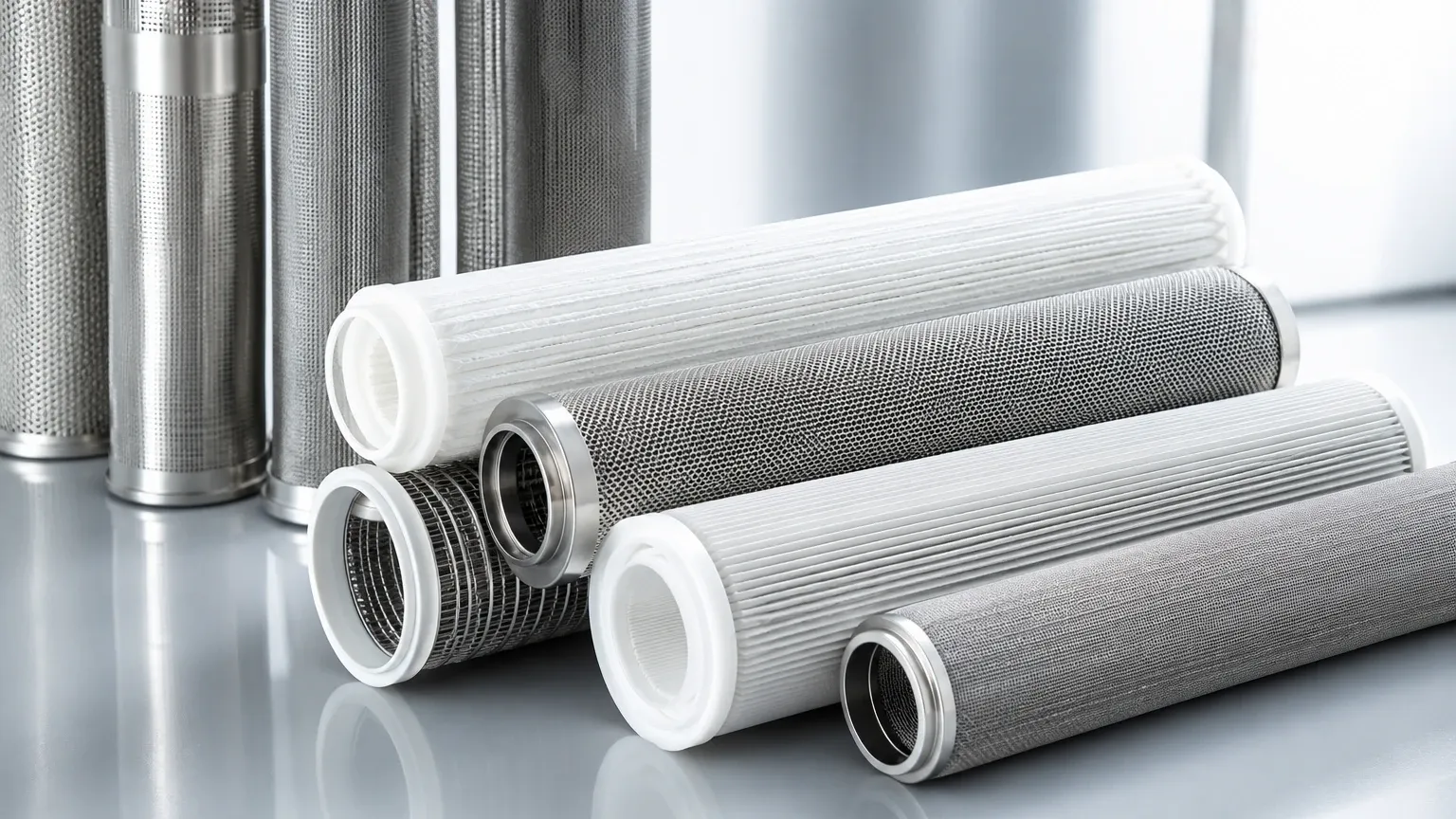
While many 20 inch water filter cartridges are manufactured from disposable materials like melt-blown polypropylene or pleated polyester, industrial environments often demand the durability of metallic media. Kaifil specializes in stainless steel filtration solutions, which offer distinct advantages over polymer-based alternatives in demanding process conditions.
Thermal and Chemical Resistance
Polypropylene cartridges are generally limited to operating temperatures below 60°C (140°F) and are susceptible to degradation when exposed to certain solvents or extreme pH levels. In contrast, 304 or 316L stainless steel cartridges can withstand temperatures exceeding 250°C and offer superior resistance to a wide array of corrosive chemicals. This makes them the preferred choice for steam filtration, hot water loops, and aggressive chemical processing.
Structural Integrity and Differential Pressure
Disposable cartridges are prone to "unloading"—a phenomenon where the filter media deforms under high differential pressure, allowing trapped contaminants to pass through. Stainless steel wire mesh or sintered metal cartridges possess high mechanical strength, allowing them to withstand significantly higher differential pressures (often up to 30-50 PSI or more) without compromising filtration accuracy. This structural rigidity is vital in hydraulic systems and high-viscosity fluid applications.
Engineering Considerations for Flow and Pressure Drop
A primary concern for any filtration engineer is the "Clean Pressure Drop" (ΔP). Every filter media introduces resistance to the flow. For 20 inch water filter cartridges, the ΔP is a function of the media's porosity, the fluid's viscosity, and the flow velocity.
To optimize a system, engineers must calculate the total pressure drop, which includes both the housing losses and the cartridge losses. If the initial ΔP is too high, the "dirt-holding capacity"—the amount of contaminant the filter can trap before reaching its terminal pressure drop—is significantly reduced. Using a 20-inch cartridge instead of a 10-inch cartridge effectively halves the flux (flow per unit area), which exponentially extends the service life of the media by allowing contaminants to distribute across a larger surface.
In applications involving high solids loading, pleated stainless steel cartridges are often utilized. Pleating increases the available surface area by a factor of 2 to 4 compared to cylindrical designs, further reducing the clean ΔP and extending the intervals between cleaning or replacement cycles.
Filtration Mechanisms: Depth vs. Surface Filtration
Understanding how a 20 inch water filter cartridge captures particles is essential for selecting the right micron rating.
1. Depth Filtration: Typically found in wound or melt-blown cartridges, depth filtration traps particles throughout the entire thickness of the media. This is effective for capturing a wide range of particle sizes but is generally a "disposable" technology, as the particles cannot be easily washed out of the matrix.
2. Surface Filtration: This is the primary mechanism for stainless steel wire mesh filters. Particles larger than the pore size are captured on the upstream surface of the mesh. The advantage of surface filtration in an industrial context is cleanability. Stainless steel mesh cartridges can be backwashed, ultrasonically cleaned, or chemically cleaned, allowing for multiple reuse cycles and reducing the total cost of ownership.
For precision applications, sintered metal fiber media can provide a hybrid approach, offering the high porosity and dirt-holding capacity of depth media with the permanence and heat resistance of stainless steel.
Application-Specific Requirements
20 inch water filter cartridges are deployed across diverse sectors, each with unique regulatory and performance requirements:
* Food and Beverage: Cartridges must be constructed from FDA-compliant materials. Stainless steel is often preferred here due to its non-leaching properties and ability to withstand Clean-in-Place (CIP) sterilization cycles using caustic chemicals or high-pressure steam.
* Pharmaceuticals: In this sector, 20-inch cartridges often serve as pre-filters for expensive membrane filters. Ensuring a high Beta ratio (filtration efficiency) is critical to protecting downstream components.
* Water Treatment: For RO (Reverse Osmosis) pre-filtration, 20-inch cartridges are used to remove silt and suspended solids that would otherwise scale the RO membranes. Here, the 20-inch Big Blue format is a standard for commercial and light industrial systems.
* Chemical Processing: Compatibility with aggressive solvents requires specialized seals. While the cartridge body may be stainless steel, the gaskets (EPDM, Viton, or PTFE) must be carefully selected based on the chemical profile of the process fluid.
Maintenance and Total Cost of Ownership (TCO)
While the initial purchase price of a disposable 20 inch water filter cartridge is lower than a custom stainless steel version, the Total Cost of Ownership often tells a different story. For high-volume industrial processes, the costs associated with frequent filter changes include:
* Consumable Costs: The recurring price of replacement cartridges.
* Labor Costs: The man-hours required to open housings, replace filters, and restart the system.
* Disposal Costs: Many industrial filters become hazardous waste once used, leading to high disposal fees.
* Downtime: Every filter change represents a potential interruption in production.
By switching to a cleanable stainless steel 20-inch cartridge, a facility can move from an OpEx-heavy model to a CapEx model that pays for itself through the elimination of waste and reduced labor. A well-maintained stainless steel filter can last for years in applications where a polypropylene filter might fail in weeks.
Customization and OEM Solutions
In many industrial setups, off-the-shelf 20 inch water filter cartridges may not meet specific engineering tolerances or chemical requirements. Customization options provided by manufacturers like Kaifil allow for the optimization of the filtration system. This includes:
* Bespoke Micron Ratings: Moving beyond standard 5 or 10-micron increments to exact specifications required for sensitive equipment.
* Reinforced Cores: For high-viscosity fluids or high-pressure differentials, internal support cores can be reinforced to prevent collapse.
* Specialized End-Caps: Custom machining of end-caps to fit proprietary or legacy filter housings, ensuring a perfect seal without the need for housing replacement.
When sourcing these components, engineers should confirm the maximum operating pressure, the required filtration efficiency (nominal vs. absolute), and the specific alloy grade (e.g., 316L for superior pitting resistance in chloride-rich environments).
Conclusion
The 20-inch water filter cartridge remains a cornerstone of industrial fluid management due to its standardized versatility and proven performance. By moving beyond generic selections and focusing on the technical nuances of material science, flow dynamics, and cleanability, engineering teams can significantly improve process reliability and reduce long-term operational costs. Whether the goal is protecting sensitive RO membranes or ensuring the purity of a chemical batch, the transition to high-performance, often metallic, filtration media represents a strategic investment in industrial efficiency.
