


Cartridge Filter 320
In industrial filtration, precision in sizing and material specification is the difference between operational efficiency and frequent system downtime. The cartridge filter 320 designation typically refers to a specific dimensional standard—often a 320mm diameter or length—frequently utilized in heavy-duty dust collection, gas turbine intake, and large-scale liquid processing systems. Selecting the correct Filter Cartridges requires a deep understanding of fluid dynamics, material compatibility, and the mechanical stresses present within the housing.
For engineers and procurement professionals, the cartridge filter 320 represents a critical component in maintaining the purity of process streams. Whether the application involves high-temperature exhaust or the filtration of corrosive chemicals, the structural integrity of the filter media and its supporting core must be evaluated against the specific demands of the environment. This guide examines the technical parameters, material choices, and engineering considerations essential for optimizing the performance of 320-series filtration components.
Technical Specifications and Dimensional Standards
The numerical designation in a cartridge filter 320 usually pertains to the outer diameter (OD) or the overall length of the unit, depending on the industry standard being followed (such as DIN or ISO standards for air filtration). In many industrial air and gas applications, a 320mm diameter is a standard size for pleated cartridges used in dust collectors. In liquid filtration, this dimension may refer to a specific length or a proprietary housing fitment.
Geometric Precision
When specifying a cartridge filter 320, dimensional tolerances are paramount. A discrepancy of even a few millimeters in the end cap diameter or the gasket seat can lead to bypass—a condition where unfiltered fluid or gas escapes around the filter element. Engineers must confirm:
* Outer Diameter (OD): Exactly 320mm or the specific tolerance allowed by the housing.
* Inner Diameter (ID): Ensuring compatibility with the internal support cage or center post.
* Overall Length: Critical for maintaining the correct compression on seals and gaskets.
* Filtration Surface Area: The total effective area of the media, which directly influences the dirt-holding capacity and the initial pressure drop.
Micron Ratings and Efficiency
The performance of these cartridges is defined by their micron rating, which can range from sub-micron levels for sterile air applications to several hundred microns for coarse liquid straining. It is essential to distinguish between nominal and absolute ratings. An absolute-rated cartridge filter 320 ensures that 99.9% of particles at the specified size are retained, providing the consistency required for pharmaceutical or chemical processing.
Material Selection for Industrial Durability
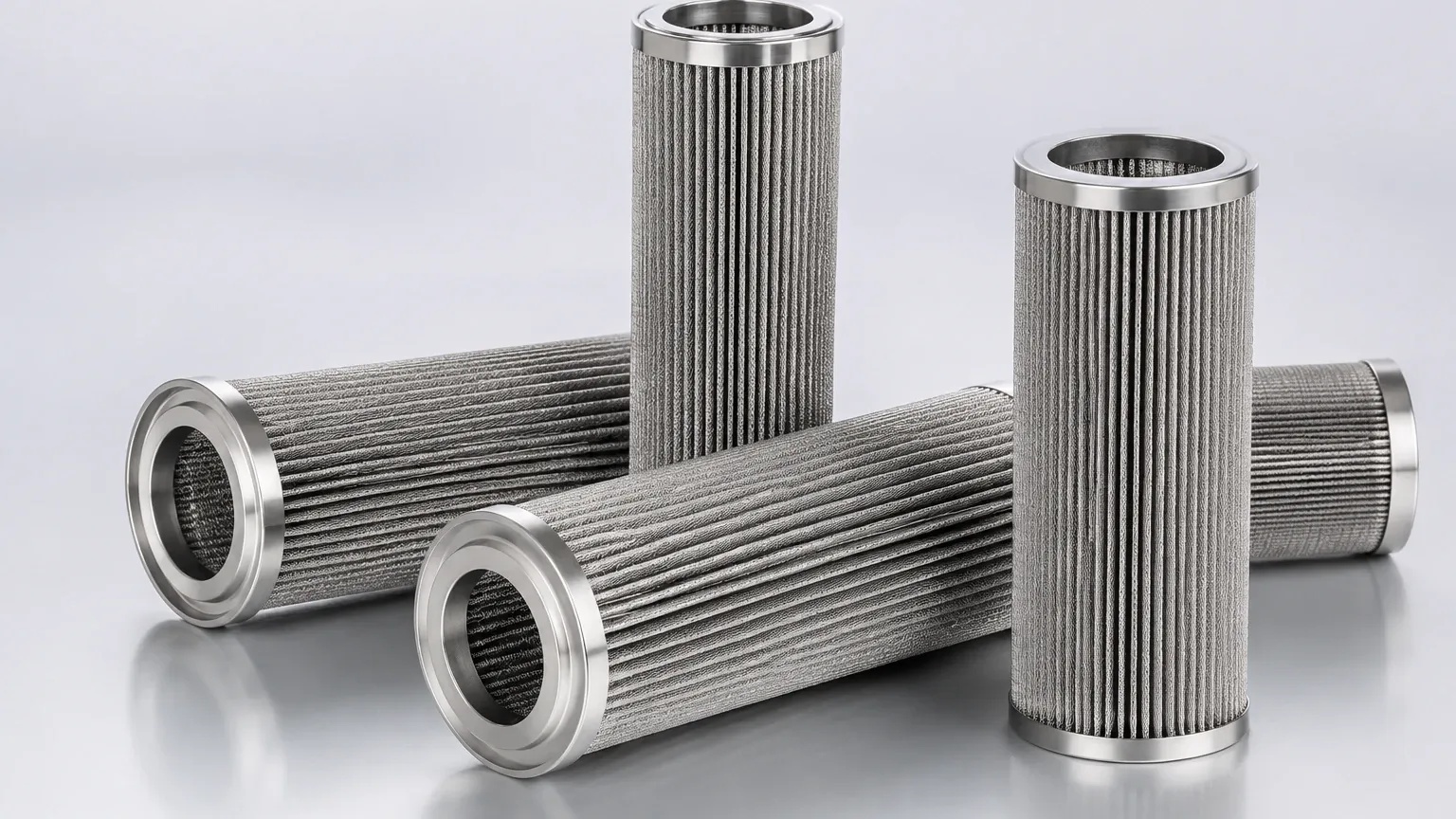
The choice of material for a cartridge filter 320 is dictated by the chemical nature of the fluid, the operating temperature, and the required cleaning cycle. While synthetic media like polyester or cellulose are common in disposable air filters, industrial metal filters offer superior performance in demanding environments.
Stainless Steel Wire Mesh
For high-temperature or corrosive applications, stainless steel (typically 304 or 316L) is the material of choice. Stainless steel Filter Cartridges provide several advantages:
* Temperature Resistance: Capable of operating in environments exceeding 300°C, where polymer-based filters would fail.
* Chemical Compatibility: 316L stainless steel offers excellent resistance to organic solvents, mild acids, and alkalis.
* Mechanical Strength: Metal mesh can withstand high differential pressures without collapsing, making it ideal for hydraulic systems and high-viscosity fluids.
Pleated vs. Cylindrical Designs
The internal geometry of the cartridge filter 320 significantly impacts its service life. Pleated designs increase the surface area within the same 320mm footprint, which lowers the face velocity of the fluid passing through the media. This reduction in velocity minimizes the impact of abrasive particles on the mesh and extends the time between cleaning cycles. Conversely, plain cylindrical (non-pleated) filters are easier to clean and are often used in applications where the contaminant load consists of large, fibrous particles that might clog pleats.
Engineering Considerations for High-Pressure Applications
In hydraulic and high-pressure liquid systems, the cartridge filter 320 must be engineered to resist deformation. The pressure differential ($ΔP$) across the filter increases as contaminants accumulate. If the filter is not structurally sound, this pressure can cause the media to pleat-pinch or the center core to collapse.
Structural Reinforcement
To prevent mechanical failure, high-quality industrial cartridges utilize:
* Inner Support Cores: Perforated stainless steel tubes that provide radial strength.
* Outer Cages: Protect the filter media during handling and prevent pleat expansion under reverse flow conditions.
* End Cap Bonding: In metal filters, end caps are often TIG welded or plasma welded to the media to ensure a leak-proof, permanent bond that can withstand thermal expansion and contraction.
Seal Integrity
The sealing mechanism of a cartridge filter 320 is as important as the media itself. Common seal materials include Viton (FKM), EPDM, and PTFE. The selection depends on the chemical compatibility with the process fluid. For example, EPDM is preferred for steam and water applications, while Viton is required for many hydrocarbon-based oils and chemicals. The seal must maintain its elasticity over the entire operating temperature range to prevent bypass.
Performance Evaluation: Efficiency and Pressure Drop
When integrating a cartridge filter 320 into a system, engineers must balance filtration efficiency with the energy costs associated with pressure drop. A filter with a very fine micron rating will provide cleaner output but will also create a higher initial $ΔP$, requiring more pump or fan power.
Calculating Flow Capacity
The flow capacity of a cartridge filter 320 is a function of the media porosity and the total surface area. For liquid applications, the viscosity of the fluid plays a major role. A higher viscosity fluid (such as heavy lube oil) requires a larger surface area or a coarser mesh to maintain a reasonable flow rate. Engineers use the Clean Pressure Drop calculation to ensure the system’s pump can handle the resistance of a new filter while still having enough head pressure to operate as the filter loads with dirt.
Beta Ratios and Retention
For critical applications, the Beta Ratio (β) provides a more accurate measure of performance than a simple micron rating. A βx = 1000 rating indicates that for every 1000 particles of size 'x' entering the filter, only one passes through. This level of precision is often required in the protection of sensitive downstream equipment like high-pressure nozzles or turbine blades.
Maintenance, Cleaning, and Total Cost of Ownership
One of the primary advantages of utilizing stainless steel Filter Cartridges in the 320mm size class is their cleanability. Unlike disposable paper or polymer filters, metal cartridges can be refurbished multiple times, significantly reducing the total cost of ownership (TCO) and environmental impact.
Cleaning Protocols
Depending on the contaminant, a cartridge filter 320 can be cleaned using several methods:
* Backwashing: Reversing the flow of clean fluid through the filter to dislodge particles from the surface.
* Ultrasonic Cleaning: Using high-frequency sound waves in a chemical bath to remove fine particles embedded deep within the wire mesh.
* Chemical Cleaning: Using surfactants or solvents to dissolve organic build-up or scale.
* Burn-off/Pyrolysis: For polymer-based contaminants, controlled heating can vaporize the blockage without damaging the stainless steel structure.
Determining Replacement Cycles
While metal filters are durable, they are not infinite. Over many cleaning cycles, the wire mesh may suffer from work hardening or chemical thinning. Regular inspection for "pinholes" or mesh distortion is necessary. Monitoring the rate at which the differential pressure rises after each cleaning can help predict when the cartridge filter 320 has reached the end of its functional life and requires replacement.
Customization and OEM Solutions
Many industrial systems require a cartridge filter 320 that deviates from standard off-the-shelf specifications. Customization allows for the optimization of the filter to the specific nuances of the production line. This might include specialized end cap geometries (such as bayonet mounts or threaded connections), the integration of magnetic inserts to capture ferrous particles, or the use of multi-layered sintered mesh for extreme pressure environments.
When sourcing these components, working with a manufacturer that understands the metallurgy and fluid dynamics involved is essential. A custom-engineered solution ensures that the filter not only fits the housing but also meets the specific flux rates and cleaning requirements of the application, ultimately protecting the integrity of the final product and the longevity of the industrial machinery.
By focusing on these technical details—from micron ratings and material selection to structural reinforcement and cleanability—purchasing teams can ensure that their choice of a cartridge filter 320 provides the reliable, long-term performance required in modern industrial environments.
