


Cartridge Filter 40 Inch 5 Micron
In industrial filtration, the selection of a cartridge filter involves balancing flow capacity, filtration efficiency, and mechanical durability. The cartridge filter 40 inch 5 micron is a standard configuration widely utilized in high-volume processing environments. This specific size and rating provide a significant surface area for particle capture while maintaining a manageable footprint within pressure vessels. For engineers and procurement teams, understanding the technical nuances of this specification—ranging from material compatibility to pressure drop dynamics—is essential for optimizing system performance and minimizing downtime.
Industrial Filter Cartridges serve as the primary barrier against contaminants in fluids. When a system specifies a 40-inch length, it typically indicates a high-flow requirement where shorter cartridges would necessitate more complex housing manifolds or frequent change-outs. A 5-micron rating places the filter in the category of fine filtration, capable of removing silt, fine sand, and various suspended solids that could otherwise damage downstream equipment or compromise product purity.
Technical Specifications of 40-Inch 5-Micron Cartridges
The 40-inch length (approximately 1016 mm) is one of the longest standard sizes in the industry. This length is favored in large-scale water treatment, chemical processing, and oil and gas applications because it maximizes the filtration surface area per housing footprint. By using fewer, longer cartridges, operators can reduce the number of seals and potential bypass points within a filter housing.
The "5 micron" designation refers to the pore size of the filter media. However, technical professionals must distinguish between nominal and absolute ratings. A nominal 5-micron filter might capture 60% to 90% of particles at that size, whereas an absolute-rated filter, often constructed from pleated stainless steel wire mesh or high-density polymers, will capture 99.9% or more. In critical applications such as pharmaceutical pre-filtration or hydraulic fluid maintenance, absolute ratings are often required to ensure consistent fluid quality.
Material Selection: Stainless Steel vs. Synthetic Media
While many 40-inch filters are made from polypropylene or glass fiber, industrial environments involving high temperatures, aggressive chemicals, or high pressure often necessitate stainless steel construction. Stainless steel filter cartridges, such as those manufactured by Kaifil, offer several engineering advantages:
1. Temperature Resistance: Unlike synthetic fibers that may soften or degrade at temperatures exceeding 60°C (140°F), stainless steel 304 or 316L can operate effectively at temperatures reaching several hundred degrees Celsius.
2. Chemical Compatibility: Stainless steel is resistant to a wide array of solvents, acids, and alkaline solutions, making it the preferred choice for chemical processing and petrochemical applications.
3. Mechanical Strength: In high-viscosity applications or systems prone to pressure surges, synthetic media can collapse or experience "media migration," where filter fibers enter the filtrate. Stainless steel wire mesh or sintered metal structures maintain their integrity under high differential pressures.
4. Cleanability and Reuse: A primary advantage of metal Filter Cartridges is that they are often cleanable. Through backwashing, ultrasonic cleaning, or chemical soaking, these filters can be restored to near-original differential pressure, significantly reducing the total cost of ownership compared to disposable options.
Flow Dynamics and Pressure Drop Considerations
For a cartridge filter 40 inch 5 micron, the flow rate is a function of the media type, the fluid viscosity, and the available surface area. Pleated designs are frequently used to increase the effective surface area within the 40-inch cylindrical envelope. By increasing the pleat count, manufacturers can lower the "flux" (flow per unit area), which in turn reduces the initial pressure drop (ΔP).
Engineers must calculate the clean pressure drop to ensure the system pump can handle the resistance. As the filter accumulates contaminants, the ΔP will rise. In a 5-micron system, the transition from "clean" to "dirty" can happen rapidly if the particle load is high. It is standard practice to design systems with a maximum allowable differential pressure—typically between 15 and 35 psi for disposable filters, though stainless steel variants can often withstand much higher differentials before structural failure is a concern.
Industrial Applications for 40-Inch 5-Micron Filtration
The versatility of the 40-inch 5-micron configuration makes it a staple in various sectors:
Chemical and Petrochemical Processing
In these industries, the cartridge filter 40 inch 5 micron is used to protect catalysts, prevent nozzle clogging in spray systems, and ensure the purity of intermediate chemicals. The 5-micron rating is particularly effective at removing fine catalysts fines or scale from piping.
Food and Beverage Production
For water used in ingredient mixing or bottle washing, 5-micron filtration acts as a critical stage for removing sediment and protecting downstream carbon filters or RO (Reverse Osmosis) membranes. Stainless steel options are often preferred here for their ability to withstand Clean-in-Place (CIP) sterilization cycles using steam or hot caustic solutions.
Pharmaceutical and Biotechnology
In pharmaceutical manufacturing, these cartridges serve as pre-filters for more expensive sterilizing-grade membranes. By removing the bulk of the 5-micron and larger particulate matter, the 40-inch cartridge extends the life of the final 0.22-micron filters, optimizing the economics of the entire filtration train.
Water Treatment and Desalination
Large-scale RO systems utilize 40-inch cartridges in multi-round housings as a final safety barrier before the high-pressure pumps and membranes. At 5 microns, these filters capture silt and organic debris that could cause rapid membrane fouling.
Engineering Selection Criteria: Beyond the Micron Rating
When specifying a cartridge filter 40 inch 5 micron, engineers should look beyond the basic dimensions. Several critical factors influence the reliability of the filtration system:
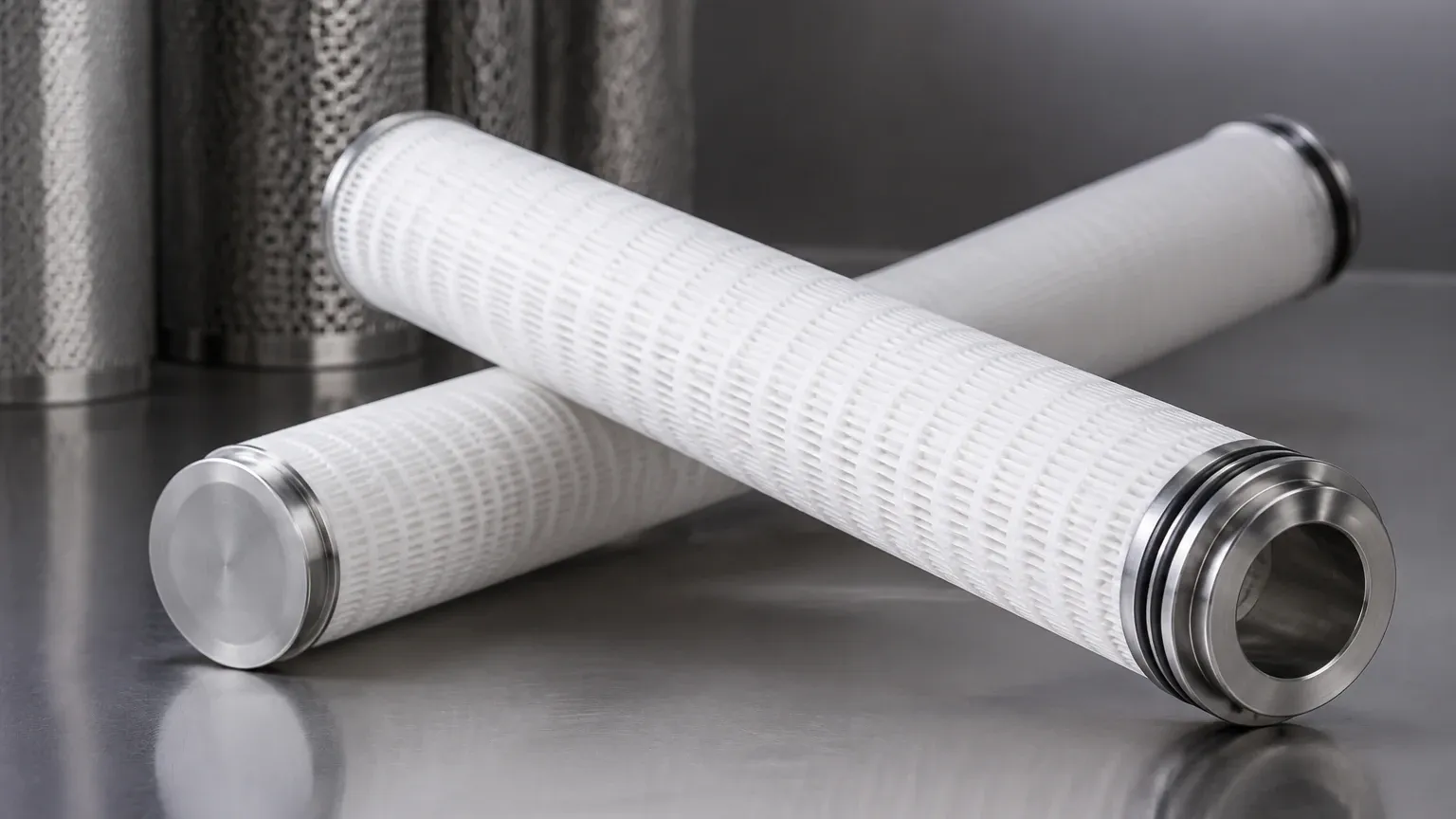
* End Cap Configuration: The method by which the cartridge seals into the housing is vital. Common configurations include Double Open End (DOE), Code 7 (226 O-rings with a locking fin), and Code 3 (222 O-rings). A secure seal is mandatory to prevent bypass, where unfiltered fluid escapes around the cartridge ends.
* Seal Material: O-rings and gaskets must be compatible with the process fluid. Common materials include Buna-N, EPDM, Viton, and PTFE. Selecting the wrong elastomer can lead to seal swelling or degradation, resulting in bypass or contamination.
* Dirt Holding Capacity: This refers to the total mass of contaminants a filter can retain before reaching its terminal differential pressure. Pleated stainless steel mesh often provides a superior dirt-holding capacity for rigid particles compared to depth-style filters.
* Structural Support: For 40-inch lengths, internal support cores and external cages are necessary to prevent the media from bowing or collapsing under the weight of the fluid and the pressure of the flow.
Maintenance and Replacement Cycles
The longevity of a cartridge filter 40 inch 5 micron depends heavily on the solids loading of the influent. In a well-designed system, differential pressure gauges should be installed upstream and downstream of the filter housing. Monitoring these gauges allows operators to replace or clean the Filter Cartridges based on actual performance rather than arbitrary time intervals.
For disposable filters, once the terminal ΔP is reached, the cartridge is removed and discarded. For permanent stainless steel cartridges, the maintenance cycle involves a cleaning protocol. It is important to note that cleaning should be performed before the differential pressure reaches a point where particles are forced through the media or the structure is deformed. In many high-purity applications, ultrasonic cleaning is the preferred method to ensure that fine 5-micron pores are thoroughly cleared of embedded debris.
Customization and OEM Solutions
Standard off-the-shelf filters may not always meet the specific requirements of a unique industrial process. Manufacturers like Kaifil provide customized filtration solutions where the 40-inch length can be adapted with specialized end fittings, reinforced cores for high-viscosity fluids, or specific grades of stainless steel mesh to achieve precise filtration targets. Working with an OEM allows engineering teams to tailor the filtration performance to the exact chemical and thermal profile of their application.
When evaluating a supplier for a cartridge filter 40 inch 5 micron, it is beneficial to confirm their testing capabilities. Verification of filtration efficiency through bubble point testing or multipass testing provides the empirical data necessary for process validation, especially in regulated industries like food, beverage, and pharmaceuticals.
Conclusion
The cartridge filter 40 inch 5 micron is a workhorse of industrial fluid processing. Its ability to handle high flow rates while providing fine particulate removal makes it indispensable for protecting downstream equipment and ensuring product quality. Whether opting for disposable synthetic media or durable, cleanable stainless steel Filter Cartridges, the key to success lies in a thorough understanding of the application's technical demands. By considering material compatibility, seal integrity, and flow dynamics, engineers can select a filtration solution that offers the best balance of performance and long-term cost-efficiency.
