


Cartridge Filter vs Spin on
In the landscape of industrial filtration, selecting the appropriate filter architecture is a critical engineering decision that impacts system reliability, maintenance overhead, and long-term operational costs. The debate of cartridge filter vs spin on is common across sectors such as hydraulic systems, chemical processing, and food and beverage manufacturing. While both designs serve the fundamental purpose of removing contaminants from a fluid stream, their mechanical structures, performance capabilities, and economic profiles differ significantly.
For engineers and procurement teams, understanding these differences is essential for optimizing filtration performance. This guide examines the technical nuances of both systems, focusing on how high-performance Filter Cartridges compare to integrated spin-on units in demanding industrial environments.
Defining the Architectures: Cartridge vs. Spin-on
To evaluate the cartridge filter vs spin on comparison effectively, one must first define the physical components of each system.
Spin-on Filters
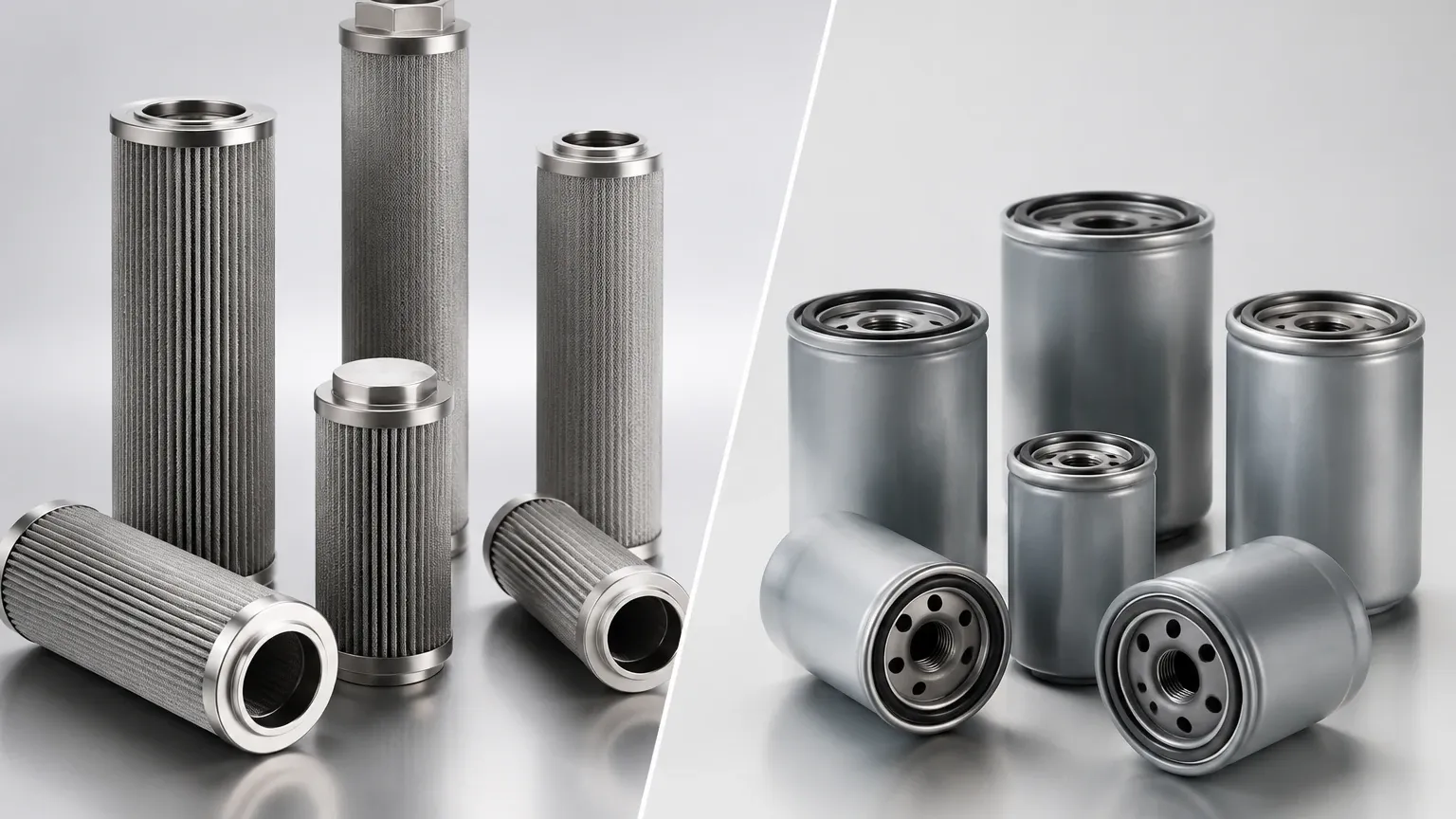
A spin-on filter is a self-contained unit consisting of the filter element, a bypass valve (in many cases), and a sealing gasket, all housed within a thin-walled metal or plastic canister. The entire assembly is threaded onto a fixed filter head. When the filter reaches its dirt-holding capacity, the entire canister is unscrewed, discarded, and replaced with a new one.
Cartridge Filters
A cartridge filter system consists of two distinct parts: a permanent, heavy-duty housing (often made of stainless steel or high-grade polymers) and a replaceable internal element. The Filter Cartridges are inserted into the housing, which is then sealed with a cap or flange. During maintenance, only the internal element is replaced, while the housing remains a permanent fixture of the system. This modularity allows for the use of advanced materials, such as stainless steel wire mesh or sintered metal, which can withstand conditions that would compromise a standard spin-on canister.
Performance Metrics: Filtration Efficiency and Pressure Handling
When comparing cartridge filter vs spin on performance, engineers must look at the specific demands of the application, particularly regarding pressure and filtration fineness.
Pressure Resistance
Spin-on filters are generally designed for low to moderate pressure applications. Because the outer canister must be lightweight enough to be handled and threaded by hand (or with a simple wrench), the wall thickness is limited. Under high-pressure spikes or heavy hydraulic surges, thin-walled spin-on canisters are susceptible to fatigue and eventual bursting.
In contrast, cartridge filter housings are engineered to meet specific pressure vessel standards. Because the housing is permanent, it can be manufactured with thick-walled stainless steel, allowing it to handle extreme pressures and vacuum conditions that would be impossible for a spin-on design. This makes the cartridge approach the standard for heavy-duty industrial hydraulics and high-pressure chemical dosing.
Filtration Precision and Media Variety
Spin-on filters often utilize cellulose or synthetic fiber media. While effective for general-purpose lubrication or fuel filtration, these materials have limitations in terms of chemical compatibility and temperature resistance.
Cartridge systems offer a much wider range of media options. Stainless steel Filter Cartridges can be fabricated with precise micron ratings using woven wire mesh or pleated metal fiber. This allows for superior filtration in high-temperature environments or with aggressive solvents where a standard spin-on's internal adhesives and media would degrade.
Operational Maintenance and System Downtime
The maintenance workflow is a primary factor in the cartridge filter vs spin on decision. Each system offers distinct advantages regarding the speed and cleanliness of the replacement process.
Maintenance Speed
Spin-on filters are widely favored for their "quick-change" capability. In mobile equipment or simple industrial machinery, the ability to spin off a filter and spin on a new one in a matter of minutes minimizes downtime. However, this convenience can be offset by the mess; as the filter is unscrewed, residual oil or fluid often spills from the canister, requiring additional cleanup and potential environmental hazards.
Inspection and Diagnostics
Cartridge systems require more steps to service—typically involving the depressurization of the housing, the removal of a lid, and the extraction of the element. However, this process provides engineers with a significant advantage: the ability to inspect the filter element and the interior of the housing. Observing the type of debris trapped in the pleats of Filter Cartridges can provide early warning signs of component wear elsewhere in the system, such as pump cavitation or seal failure. Furthermore, many industrial cartridge housings include dedicated drain ports, allowing for a cleaner, more controlled maintenance event compared to the "spill-prone" nature of spin-ons.
Material Compatibility and Environmental Resilience
In industries such as pharmaceutical or food processing, material integrity is non-negotiable. This is where the cartridge filter vs spin on comparison leans heavily toward the cartridge design.
Chemical and Thermal Resistance
Spin-on filters often use nitrile or Viton gaskets that are exposed to the environment, and the internal bonding agents (glues) used to secure the media to the end caps may not be compatible with certain industrial chemicals. If a spin-on is used with an incompatible fluid, the media can collapse or the seals can fail, leading to bypass and downstream contamination.
Industrial Filter Cartridges made from 304 or 316L stainless steel are inherently resistant to a vast array of chemicals and can operate at temperatures exceeding 250°C. Because the housing is a separate entity, it can be specified with specialized O-ring materials (such as PTFE or EPDM) to ensure a perfect seal regardless of the fluid being processed.
Structural Integrity
In high-vibration environments, the threaded connection of a spin-on filter can become a point of failure. If the filter is not torqued correctly, it may vibrate loose, leading to catastrophic fluid loss. Cartridge housings, which are typically bolted or clamped into place, offer a more robust mechanical connection that is less susceptible to vibration-induced loosening.
Total Cost of Ownership (TCO) and Sustainability
While the initial purchase price of a spin-on filter is lower than the combined cost of a cartridge housing and element, the long-term economics of the cartridge filter vs spin on choice often favor the cartridge system.
Waste Reduction
Sustainability is an increasing priority in B2B procurement. A spin-on filter is a "multi-material" waste product; it contains metal, contaminated media, and residual fluid, making it difficult and expensive to recycle. Every time a spin-on is changed, the entire metal canister is sent to a landfill.
With a cartridge system, only the internal element is replaced. If the system utilizes cleanable stainless steel Filter Cartridges, the waste is reduced even further. Many metal cartridges can be ultrasonically cleaned and reused multiple times, significantly lowering the volume of hazardous waste generated by the facility.
Long-term Savings
Over the life of a machine, the cost of purchasing hundreds of disposable spin-on canisters often exceeds the cost of a single high-quality housing and the subsequent replacement elements. When factoring in the costs of waste disposal and the potential for system damage due to the lower burst pressure of spin-ons, the cartridge system frequently provides a superior Return on Investment (ROI).
Engineering Selection: Choosing the Right Solution for Your Application
Deciding between a cartridge filter vs spin on requires a systematic evaluation of the application's parameters. Engineers should confirm the following data points before finalizing a filtration specification:
1. Operating Pressure and Surges: If the system experiences frequent pressure spikes above 500 PSI, a cartridge housing is generally required for safety and durability.
2. Fluid Compatibility: For aggressive chemicals, steam, or high-temperature fluids, stainless steel Filter Cartridges are the standard choice.
3. Filtration Target: If the application requires absolute filtration at very fine micron levels (e.g., 1-5 microns), the precision engineering of a cartridge element is typically more reliable than a mass-produced spin-on.
4. Space Constraints: Spin-on filters are compact and can be mounted in tight spaces where a large cartridge housing might not fit. However, side-entry or top-entry cartridge housings offer various configurations to accommodate different piping layouts.
5. Environmental Goals: Facilities aiming to reduce their carbon footprint or hazardous waste output should prioritize cartridge systems with cleanable or low-mass replacement elements.
In summary, while spin-on filters offer convenience and low initial costs for light-duty applications, industrial-grade cartridge systems provide the robustness, precision, and environmental benefits required for critical processing and high-pressure hydraulic systems. By selecting high-quality Filter Cartridges and matching them with the appropriate housing, engineering teams can ensure optimal fluid purity and system longevity.
