


Cartridge Filter vs Sand
In industrial fluid processing and water treatment, selecting the appropriate filtration technology is a critical engineering decision that impacts product quality, operational uptime, and long-term maintenance costs. Two of the most common methods for removing suspended solids from process streams are sand filtration and cartridge filtration. While both systems aim to achieve the same goal—clarifying a liquid—their mechanical principles, performance capabilities, and application suitabilities differ significantly.
When evaluating a cartridge filter vs sand system, engineers must look beyond the initial purchase price. Factors such as filtration fineness (micron rating), flow rate requirements, chemical compatibility, and the physical footprint of the equipment play decisive roles in determining which technology provides the best return on investment for a specific industrial application.
Fundamental Filtration Mechanisms
To understand the differences between these two systems, one must first examine how they trap contaminants.
Sand Filtration: Depth Filtration
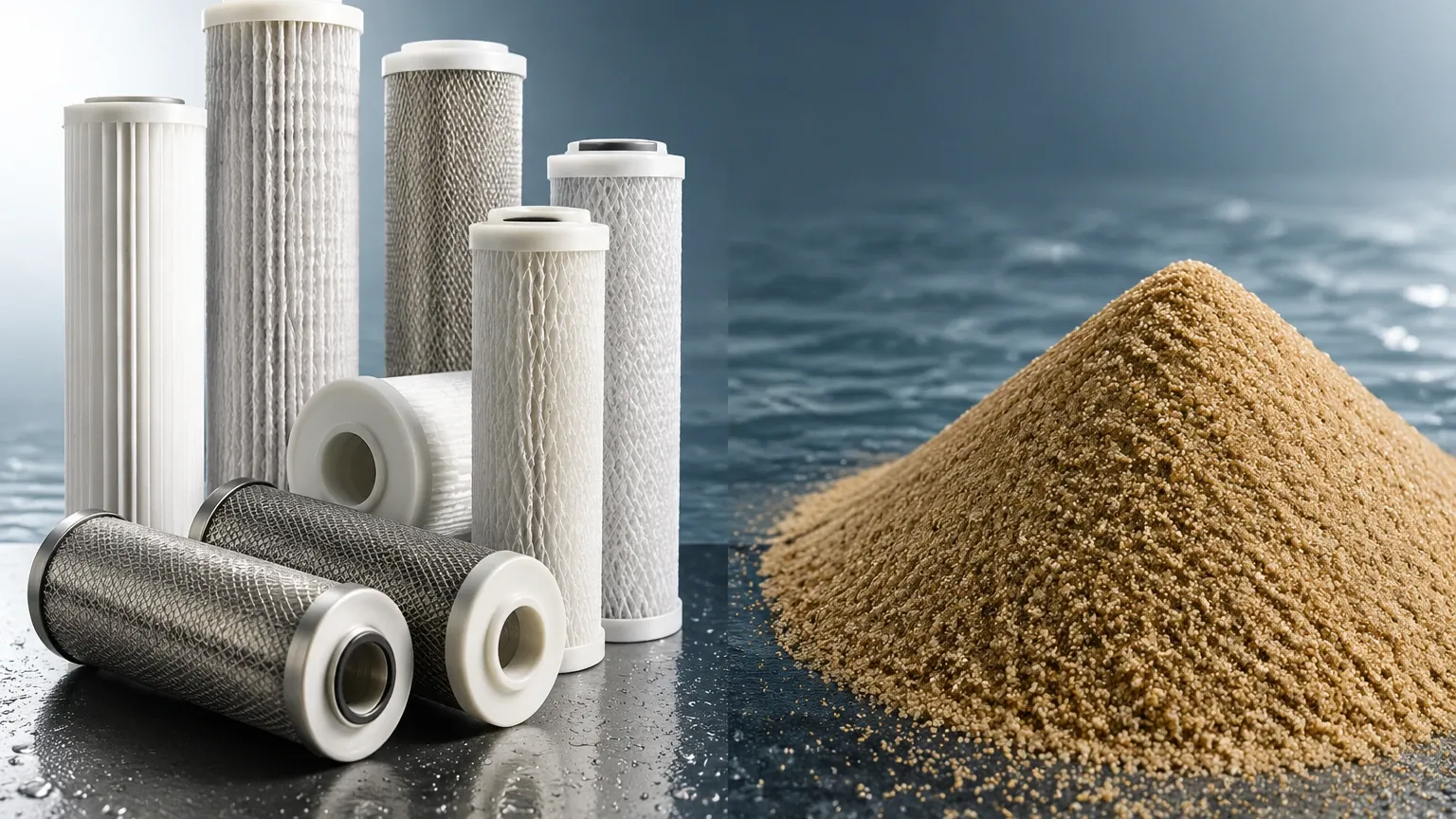
Sand filters utilize a bed of graded silica sand (and sometimes anthracite or garnet) as the filter media. This is known as depth filtration. As the fluid passes through the media bed, particles are trapped within the tiny gaps between the sand grains. Because the entire depth of the bed is used for filtration, sand filters can handle relatively high loads of suspended solids before requiring a cleaning cycle. However, the random nature of the voids in a sand bed means that filtration is not absolute; some larger particles may find a path through the media, especially if the flow rate fluctuates.
Cartridge Filtration: Surface and Depth Precision
Filter Cartridges operate on a different principle, often combining surface and depth filtration. In industrial settings, these are typically housed in a pressure vessel. The fluid is forced through the media—which can be pleated wire mesh, sintered metal, or polymer membranes—where particles are captured on the surface or within the thin layers of the material. Because the pore sizes in a manufactured cartridge are precisely controlled, they offer a much higher level of consistency and a defined "absolute" micron rating compared to the "nominal" rating of sand.
Comparison of Filtration Accuracy (Micron Ratings)
One of the most significant technical differentiators in the cartridge filter vs sand debate is the level of precision achievable.
* Sand Filters: Typically, a standard rapid sand filter is effective at removing particles down to approximately 20 to 40 microns. While multi-media filters (using layers of different materials) can improve this to 10 or 15 microns, they struggle to consistently capture sub-10-micron particles without the heavy use of chemical flocculants or coagulants.
* Filter Cartridges: These systems are designed for high-precision tasks. Depending on the media selected, cartridges can easily achieve filtration levels of 5 microns, 1 micron, or even sub-micron levels. For industrial applications requiring the removal of fine catalysts, microscopic debris, or bacteria, stainless steel or precision polymer cartridges are the standard choice.
For engineers managing sensitive downstream equipment—such as high-pressure pumps or reverse osmosis (RO) membranes—the superior precision of cartridges is often a non-negotiable requirement to prevent equipment damage or fouling.
Operational Footprint and Installation Requirements
In many industrial facilities, floor space is a premium commodity. The physical size of the filtration system can dictate the feasibility of an installation.
The Bulk of Sand Systems
Sand filters are inherently bulky. To achieve a high flow rate, a large surface area of sand is required, leading to massive tanks that are heavy when filled with media and water. These systems often require reinforced concrete pads and significant overhead clearance for media loading and maintenance. Furthermore, sand filters require complex manifold piping to handle the backwash cycles, which further increases the installation footprint.
The Compact Nature of Cartridges
In contrast, cartridge filter housings are remarkably compact. Because pleated cartridges provide a massive surface area within a small cylindrical volume, a single housing can often handle the same flow rate as a sand filter several times its size. This makes them ideal for skid-mounted systems, modular expansions, and facilities where space is limited. The piping for a cartridge system is also simpler, as it typically involves a straightforward inlet and outlet without the need for complex backwash valving.
Maintenance, Backwashing, and Waste Generation
The method of cleaning the filter media is perhaps the most significant operational difference between the two technologies.
Sand Filter Backwashing
Sand filters are cleaned through a process called backwashing, where the flow of fluid is reversed to lift and agitate the sand bed, flushing the trapped contaminants out to a waste drain. While this allows the media to be reused for years, it presents several industrial challenges:
1. Water Waste: Backwashing consumes large volumes of treated water or process fluid.
2. Wastewater Management: The backwash effluent must be treated or disposed of, which can be costly depending on local environmental regulations.
3. Downtime: The filter is offline during the backwash cycle unless a redundant redundant system is installed.
Cartridge Replacement and Cleaning
Cartridge systems do not typically require backwashing. Instead, when the pressure differential (delta P) across the filter reaches a predetermined limit, the cartridges are either replaced or cleaned.
* Disposable Cartridges: Common in pharmaceutical or high-purity water applications, these are swapped out for new units. This eliminates the need for backwash water but creates a solid waste stream.
* Cleanable Stainless Steel Cartridges: In many heavy industrial or chemical processes, manufacturers like Kaifil provide stainless steel wire mesh or sintered metal cartridges. These can be cleaned via ultrasonic baths, chemical cleaning, or back-pulsing with high-pressure air/gas. This provides the precision of a cartridge with the long-term reusability of a sand filter, often making them the most sustainable choice for aggressive industrial environments.
Chemical and Thermal Compatibility
In the chemical processing, oil and gas, and pharmaceutical industries, the fluid being filtered is often far more aggressive than standard water.
Sand filters are generally limited to aqueous solutions at moderate temperatures. The silica sand and the internal linings of the large tanks may not withstand highly acidic or alkaline fluids, and they are certainly not suitable for high-temperature steam or molten polymers.
Filter Cartridges, particularly those constructed from 304 or 316L stainless steel, offer exceptional resistance to a wide range of chemicals and can operate at temperatures exceeding 500°F (260°C). This makes them the only viable option for many specialized industrial processes where sand would simply dissolve or contaminate the process stream.
Total Cost of Ownership (TCO) Considerations
When making a final selection, engineers must calculate the Total Cost of Ownership, which includes initial capital expenditure (CAPEX) and ongoing operational expenditure (OPEX).
| Feature | Sand Filter | Cartridge Filter |
| :— | :— | :— |
| Initial CAPEX | High (Large tanks, complex piping) | Moderate to High (Housing + initial elements) |
| Installation Cost | High (Space, weight, plumbing) | Low (Compact, simple integration) |
| Media Cost | Low (Sand is inexpensive) | Variable (Depends on material and reusability) |
| Operational Labor | Moderate (Monitoring backwash) | Low (Periodic element changes) |
| Water/Fluid Loss | High (Due to backwashing) | Minimal |
| Filtration Quality | Nominal (20-40 microns) | Absolute (1-100+ microns) |
While sand filters have a lower "media cost" per pound, the hidden costs of water waste, wastewater treatment, and the large physical footprint often make them more expensive over a 10-year lifecycle in modern industrial settings. Conversely, the precision and reliability of cartridge filtration often lead to lower costs for downstream equipment maintenance and higher product yields.
Selecting the Right Solution for Your Application
The choice between a cartridge filter vs sand system ultimately depends on the specific parameters of the application.
Choose a Sand Filter if:
* You are treating large volumes of raw water with high turbidity (e.g., cooling tower side-stream or pre-treatment for municipal water).
* Filtration precision below 20 microns is not required.
* You have ample floor space and a robust wastewater disposal system.
Choose a Cartridge Filter if:
* You require precise, absolute filtration to protect sensitive downstream components.
* Space is limited or the system must be portable/skid-mounted.
* You are filtering chemicals, oils, or high-temperature fluids.
* You want to minimize water waste and simplify the mechanical installation.
* The fluid has a relatively low but consistent solids load that requires high-efficiency removal.
Engineering Support for Custom Filtration
In complex industrial environments, a "one size fits all" approach rarely works. Customization is often required to balance flow rates, pressure drops, and filtration efficiency. At Kaifil, we specialize in designing and manufacturing high-performance stainless steel filtration components that bridge the gap between durability and precision.
Whether you are replacing an aging sand system to improve water efficiency or designing a new chemical process that requires high-purity filtration, understanding the technical nuances of your media is the first step toward operational excellence. For more technical data on material selection and housing configurations, you can Review product options and application support to ensure your filtration system meets the rigorous demands of your specific industry.
