


Ccp520 Pool Filter Cartridges
In high-capacity water treatment and commercial pool maintenance, the efficiency of the filtration system is directly tied to the surface area and material integrity of the internal components. The CCP520 system, representing a 520-square-foot filtration capacity, is a standard in large-scale residential and commercial aquatic environments. For engineers and facility managers, understanding the technical specifications of ccp520 pool filter cartridges is essential for maintaining water clarity, optimizing pump performance, and managing long-term operational costs.
While these cartridges are primarily associated with the Pentair Clean & Clear Plus 520 series, the engineering principles governing their performance—such as pleat density, core strength, and media permeability—are relevant across the broader spectrum of industrial Filter Cartridges. This guide examines the technical requirements of these components and provides a framework for evaluating high-performance filtration solutions.
Engineering Specifications of CCP520 Filter Elements
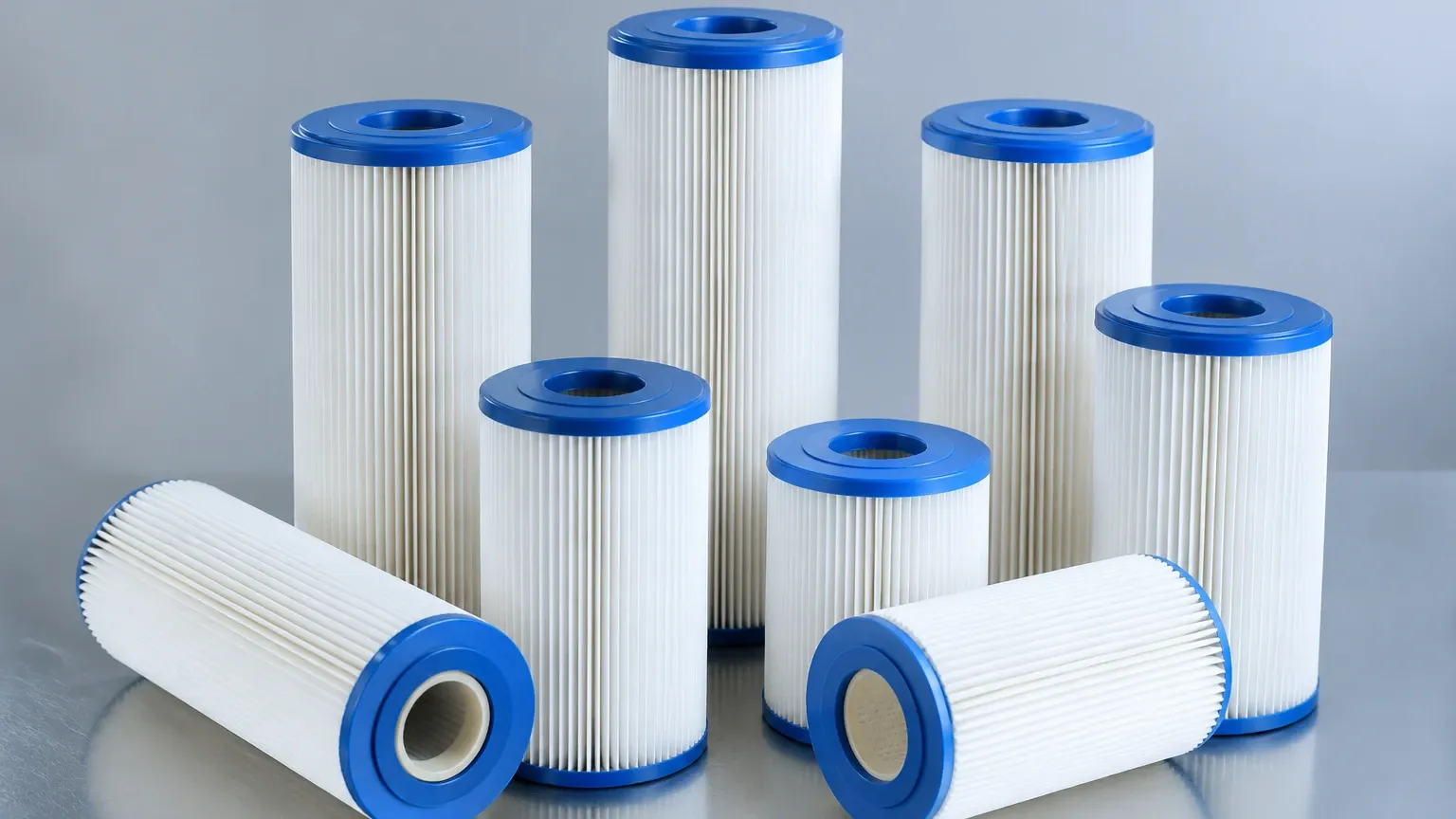
The CCP520 system utilizes a set of four individual cartridges to achieve its total filtration area. Each cartridge must adhere to precise dimensional tolerances to ensure a hydraulic seal within the filter tank. Standard specifications for these elements typically include an outer diameter of 7 inches, a length of 32 inches, and a 3-inch center hole.
From an engineering perspective, the structural integrity of the cartridge is defined by three main components:
1. The End Caps: Usually molded from high-impact polyurethane or reinforced plastic, the end caps must resist chemical degradation from chlorine, bromine, and pH adjusters. They provide the compression seal that prevents bypass—a condition where unfiltered water escapes around the cartridge.
2. The Core: The internal support structure must withstand the differential pressure (ΔP) generated as the media becomes loaded with contaminants. In high-flow applications, a reinforced PVC or polypropylene core with a high open-area percentage is required to minimize flow resistance while preventing the cartridge from collapsing.
3. The Bands: High-tension bands are wrapped around the pleats to maintain uniform spacing. This prevents "pleat bunching," which reduces the effective surface area and increases the local velocity of water through the media, leading to premature wear.
Filtration Media and Micron Ratings
The primary function of ccp520 pool filter cartridges is to remove suspended solids, typically ranging from 20 to 30 microns in size. The media used is almost exclusively non-woven polyester fabric. Unlike depth filtration, which traps particles throughout the thickness of the material, these cartridges rely on surface filtration.
Pleat Count and Surface Area
To achieve the 520-square-foot rating, each of the four cartridges provides 130 square feet of media. This is achieved through dense pleating. However, there is a technical trade-off: increasing the pleat count too far can restrict water flow and make the cartridge difficult to clean. Engineers must balance the total surface area with the "cleanability" of the pleat depth.
Permeability and Flow Resistance
In industrial water treatment, the permeability of the media determines the initial pressure drop. For a CCP520 system, the flow rate is typically rated up to 150 gallons per minute (GPM). If the media is too restrictive, the pump must work harder, increasing energy consumption and potentially leading to cavitation or seal failure in the circulation system.
Performance Evaluation Criteria
When selecting replacement ccp520 pool filter cartridges or evaluating them for commercial use, technical professionals should focus on the following performance metrics:
Dirt-Holding Capacity (DHC)
DHC refers to the total mass of contaminants a cartridge can retain before the differential pressure reaches a critical limit (usually 8–10 PSI above the clean starting pressure). High-quality polyester media with trilobal fibers provides a larger surface area at the microscopic level, allowing for greater DHC compared to standard round-fiber media.
Structural Stability Under Load
As debris builds up, the pressure across the media increases. A well-engineered cartridge will maintain its shape. If the pleats collapse or the core deforms, the filtration efficiency drops significantly, and the risk of "blow-through"—where particles are forced through the media—increases.
Chemical Compatibility
While standard pool chemicals are the primary concern, commercial or light industrial applications may involve higher temperatures or specialized flocculants. It is vital to confirm that the thermally bonded end caps and the adhesive used to secure the media to the core are compatible with the specific water chemistry of the facility.
Comparing Commercial Cartridges with Industrial Metal Filters
While ccp520 pool filter cartridges are effective for standard water clarity, certain demanding environments require a transition to more robust materials. In sectors such as chemical processing or high-temperature water treatment, standard polyester cartridges may fail due to thermal expansion or chemical breakdown.
In these instances, engineers often look toward stainless steel Filter Cartridges. Metal filters offer several advantages over the polyester elements found in CCP520 systems:
* Temperature Resistance: Stainless steel can operate in environments exceeding 200°C, far beyond the limits of thermoplastic components.
* Backwashing Capability: Unlike polyester cartridges, which must be manually removed and hosed down, metal mesh filters can often be cleaned in place (CIP) using back-pulse or ultrasonic cleaning methods.
* Absolute Filtration: While pool cartridges provide nominal filtration (meaning they catch most particles of a certain size), stainless steel wire mesh can be manufactured to provide absolute micron ratings, ensuring 99.9% retention of specific particle sizes.
For facilities managing large volumes of water where downtime is costly, the durability of metal components often justifies the higher initial investment compared to frequent replacements of disposable polyester elements.
Maintenance and Replacement Cycles
The lifespan of ccp520 pool filter cartridges depends heavily on the bather load, water chemistry, and the presence of organic oils (such as sunscreens). In a commercial setting, a standard maintenance cycle involves:
1. Monitoring Differential Pressure: The system should be cleaned when the pressure rises 8–10 PSI above the baseline. Operating beyond this point stresses the pump and reduces filtration quality.
2. Degreasing and Descaling: Simple hosing often fails to remove oils and calcium deposits. Technical operators use specialized soaking solutions to break down organic binders and mineral scale that clog the pores of the polyester media.
3. Inspection for Media Fraying: Over time, the fibers in the non-woven fabric will begin to break down. If the media appears "fuzzy" or frayed, its ability to trap fine particles is compromised, and the cartridge should be replaced.
Typically, in a well-maintained commercial system, these cartridges last 12 to 24 months. However, high-traffic facilities may require replacement every season to ensure optimal hydraulic efficiency.
Customization and OEM Considerations
For original equipment manufacturers (OEMs) and large-scale facility managers, sourcing cartridges that meet specific performance benchmarks is a critical part of procurement. When evaluating suppliers for Filter Cartridges, it is important to confirm the manufacturing standards.
Key questions for technical procurement include:
* Is the media weight consistent? (e.g., 4 oz/yd² vs. 3 oz/yd²).
* What is the burst strength of the center core?
* Are the end caps antimicrobial or reinforced for high-temperature stability?
Customization options are also vital for unique industrial applications. While the CCP520 follows a standard form factor, many industrial processes require custom lengths, specialized diameters, or integrated handles for easier maintenance. Working with a manufacturer that understands the nuances of both synthetic and metal filtration media allows for the development of solutions tailored to specific flow rates and contaminant profiles.
Conclusion: Optimizing Your Filtration Strategy
Selecting the right ccp520 pool filter cartridges involves more than just matching dimensions. It requires an understanding of the hydraulic demands of the system and the physical properties of the filtration media. By focusing on core strength, pleat stability, and the specific needs of the application—whether it is a standard commercial pool or a more demanding industrial water circuit—engineers can ensure long-term system reliability.
For applications that exceed the capabilities of standard polyester elements, exploring high-durability Filter Cartridges made from stainless steel or reinforced polymers can provide the necessary performance bridge. Maintaining a rigorous inspection and cleaning schedule remains the most effective way to protect the filtration infrastructure and achieve the desired water quality standards.
