


Filter Cartridge 0.1 Micron
In the landscape of industrial filtration, the 0.1-micron threshold represents a critical boundary between standard clarification and high-precision separation. A filter cartridge 0.1 micron is engineered to capture sub-micron particles, bacteria, and fine colloidal silica that standard industrial filters often bypass. For engineers and technical procurement teams, selecting the right sub-micron filtration media is not merely about pore size; it involves a complex evaluation of material compatibility, structural integrity under differential pressure, and the total cost of ownership across the equipment's lifecycle.
At this level of precision, the choice of media—whether polymer membranes or advanced stainless steel sintered structures—dictates the performance limits of the entire processing line. Industrial applications in pharmaceutical manufacturing, semiconductor fabrication, and high-purity chemical processing rely on these components to ensure product safety and equipment longevity.
Understanding Sub-Micron Filtration Performance
When discussing a 0.1-micron rating, it is essential to distinguish between "nominal" and "absolute" filtration. A nominal rating refers to a filter's ability to retain a major percentage of particles of a specific size, whereas an absolute rating implies a 99.9% or higher efficiency (often defined by a Beta ratio of 1000 or greater). For a filter cartridge 0.1 micron, the absolute rating is the industry standard for critical applications.
The physical mechanism at 0.1 micron shifts from simple mechanical sieving to a combination of inertial impaction, diffusion, and adsorption. Because the particles are so small, Brownian motion plays a significant role in their capture. Engineers must consider that as the pore size decreases, the resistance to flow (differential pressure) increases exponentially. This necessitates a design that maximizes effective filtration area to maintain viable flow rates without compromising the structural stability of the cartridge.
Material Engineering: Stainless Steel vs. Polymer Membranes
While polymer membranes like Polyethersulfone (PES) or Polytetrafluoroethylene (PTFE) are common for single-use 0.1-micron applications, stainless steel Filter Cartridges offer distinct advantages in demanding industrial environments.
Stainless Steel Sintered Fiber Felt
For a 0.1-micron requirement in high-temperature or high-pressure scenarios, sintered metal fiber felt is often the preferred medium. This material is produced by sintering fine stainless steel fibers into a non-woven, three-dimensional depth matrix. Unlike traditional wire mesh, which is limited by the physical dimensions of the wire weave, sintered fiber felt can achieve sub-micron porosity while maintaining a high void volume (up to 80%). This high porosity ensures lower initial pressure drops and a higher dirt-holding capacity compared to dense ceramic or polymer alternatives.
Chemical and Thermal Resistance
In B2B industrial sectors, the ability to withstand aggressive solvents or temperatures exceeding 200°C is a frequent requirement. Stainless steel (316L) 0.1-micron cartridges are inherently resistant to a wide range of chemicals that would degrade or swell polymer membranes. This stability ensures that the pore structure remains consistent throughout the filtration cycle, preventing "pore bypass" or media migration into the filtrate.
Key Design Considerations: Pleated vs. Sintered Depth Structures
The geometry of the filter element significantly impacts its performance and service life. When selecting a 0.1-micron solution, engineers typically choose between pleated and cylindrical depth designs.
Pleated Configurations
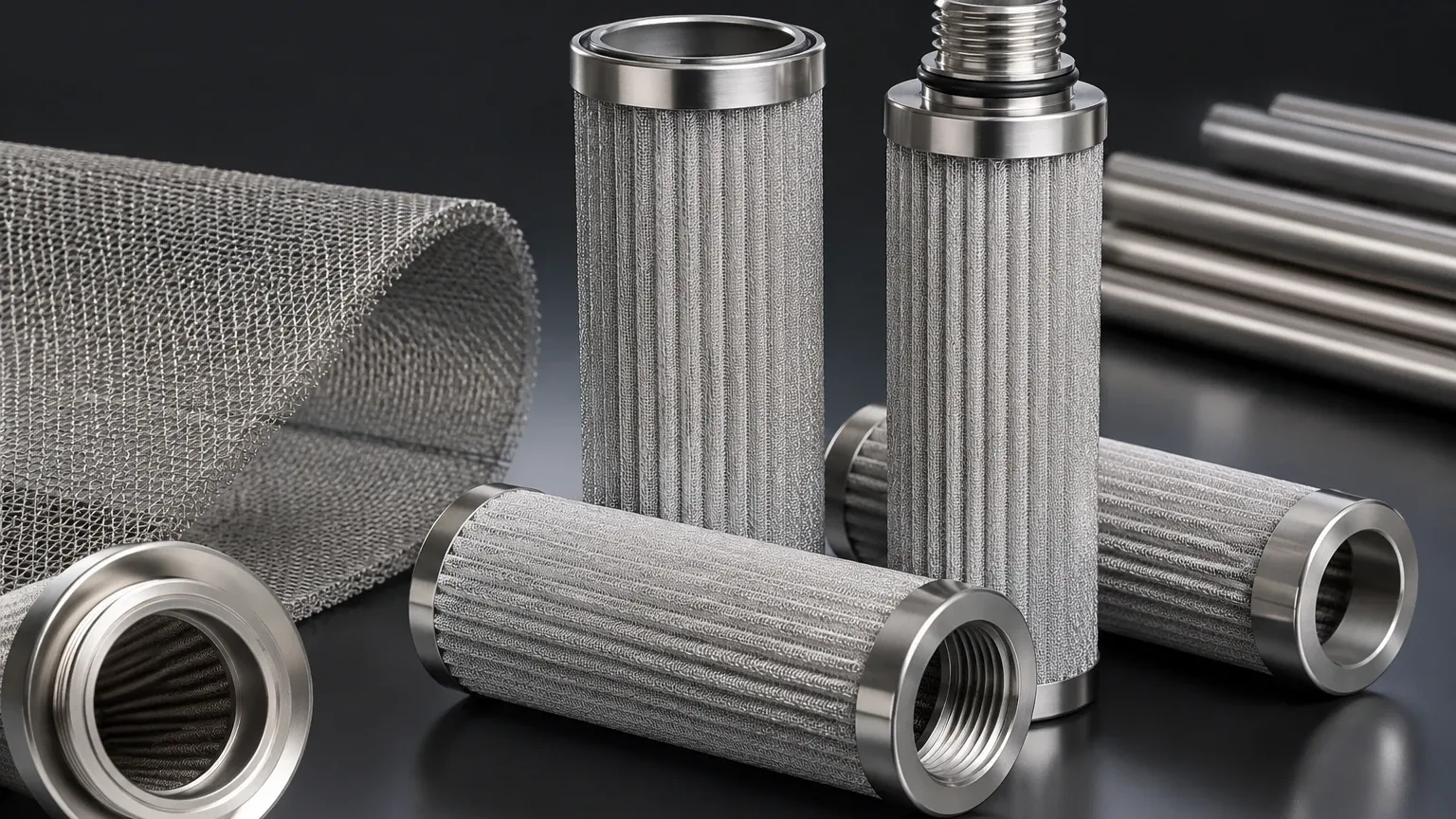
Pleating is used to increase the surface area of the 0.1-micron media within a standard cartridge footprint. By increasing the surface area, the flux (flow per unit area) is reduced, which lowers the pressure drop and extends the time between cleaning or replacement cycles. For high-flow systems, a pleated stainless steel cartridge provides the precision of 0.1-micron filtration without the excessive footprint of multiple standard depth filters.
Structural Integrity and End-Cap Security
At 0.1 micron, even the smallest bypass can compromise the entire process. The method of securing the media to the end caps is vital. In high-performance metal cartridges, plasma welding or specialized adhesive bonding is used to ensure a leak-proof seal. Common end-cap configurations include Double Open End (DOE), Code 7 (226 O-rings with bayonet lock), and Code 3 (222 O-rings), each designed to meet specific housing requirements and prevent bypass under high-pressure differentials.
Critical Applications for 0.1 Micron Filtration
The implementation of a filter cartridge 0.1 micron is usually reserved for the "polishing" or final stage of a multi-stage filtration system.
1. Pharmaceutical and Biotech: Used for the sterile filtration of air and gases, as well as the removal of mycoplasma and other sub-micron contaminants from process liquids. The ability to withstand Steam-in-Place (SIP) sterilization makes stainless steel versions particularly valuable here.
2. Semiconductor Fabrication: Ultra-pure water (UPW) systems require 0.1-micron filtration to remove the finest particulates that could cause defects in microcircuitry.
3. Food and Beverage: In the production of bottled water, beer, and wine, 0.1-micron filtration is used to remove spoilage organisms and achieve biological stability without the use of chemicals or excessive heat.
4. Chemical Processing: Recovery of expensive catalysts and the purification of high-grade reagents often require the durability of metal sub-micron filters to handle corrosive fluids.
Evaluating Flow Dynamics and Differential Pressure
One of the most common challenges engineers face with 0.1-micron filtration is the rapid increase in differential pressure (ΔP). Because the pores are so fine, they bridge quickly if the influent has a high solids load.
To optimize the system, a "graded density" approach is recommended. This involves using pre-filters (e.g., 5-micron followed by 1-micron) before the 0.1-micron cartridge. This strategy ensures that the 0.1-micron filter only handles the particles it was designed for, significantly extending its service life. When designing a system, engineers should aim for a clean pressure drop of less than 2-3 psi (0.14-0.21 bar) to provide sufficient "headroom" for the filter to load with contaminants before reaching the change-out pressure (typically 25-35 psi).
Cleaning and Sterilization Protocols
A primary advantage of using stainless steel for 0.1-micron filtration is the ability to clean and reuse the cartridges. While polymer filters are generally discarded once fouled, metal cartridges can be restored via several methods:
* Backpulsing/Backwashing: Using clean fluid or gas to force contaminants out of the media in the reverse direction of flow.
* Ultrasonic Cleaning: Using high-frequency sound waves in a cleaning solvent to dislodge fine particles from the depth of the sintered fiber.
* Chemical Cleaning: Utilizing acids, caustics, or surfactants to dissolve organic or inorganic fouling, provided the chemicals are compatible with 316L stainless steel.
* Thermal Burn-off: In extreme cases, controlled high-temperature oxidation can be used to remove organic binders or carbonized residues.
For sterile applications, the cartridge must be capable of withstanding repeated Autoclaving or Steam-in-Place (SIP) cycles. Stainless steel 0.1-micron filters are robust enough to handle hundreds of such cycles without losing their integrity or filtration efficiency.
Procurement and Customization: What Engineers Should Confirm
Before finalizing a purchase for a 0.1-micron filtration solution, technical teams should confirm several parameters with the manufacturer to ensure the product meets the specific application requirements:
* Beta Ratio and Efficiency: Request the validation data for the 0.1-micron rating. Is it absolute? What was the test dust or organism used for validation?
* Effective Filtration Area (EFA): Compare the EFA between different brands. A higher EFA usually translates to a longer service life and lower operational costs.
* Seal Compatibility: Ensure the O-ring or gasket material (EPDM, Viton, PTFE, or Silicone) is compatible with the process fluid and the cleaning temperatures.
* Compliance Standards: For food or pharmaceutical use, confirm that the materials meet FDA or USP Class VI requirements for extractables and leachables.
* Customization Options: In many industrial OEM scenarios, standard lengths (10", 20", 30") may not fit. Confirm if the manufacturer can provide custom lengths, diameters, or specialized end-fittings to integrate into existing machinery.
By focusing on these technical benchmarks, purchasing teams can move beyond price-per-unit comparisons and evaluate the total value of the filtration solution. A high-quality stainless steel 0.1-micron cartridge may have a higher initial cost than a plastic alternative, but its durability, cleanability, and consistent performance in harsh environments often result in a lower total cost over the project's duration.
