


Filter Cartridge 20 Micron
In industrial filtration, the selection of a specific micron rating is a critical engineering decision that directly impacts process efficiency, equipment longevity, and product purity. A filter cartridge 20 micron specification represents a versatile middle ground in the filtration spectrum. It is fine enough to capture significant particulate matter that could damage downstream components, yet coarse enough to maintain high flow rates and minimize frequent pressure-drop-related shutdowns. For engineers and procurement teams, understanding the technical nuances of 20-micron filtration—ranging from media selection to structural integrity—is essential for optimizing industrial systems.
Understanding the 20-Micron Specification
A micron (micrometer) is one-millionth of a meter. To put a 20-micron rating into perspective, a human hair is approximately 50 to 70 microns in diameter, and the lower limit of human visibility is roughly 40 microns. Therefore, a 20-micron filter is designed to remove particles that are invisible to the naked eye but substantial enough to cause mechanical wear in hydraulic pumps, clog spray nozzles, or compromise the clarity of industrial fluids.
When evaluating a filter cartridge 20 micron, it is vital to distinguish between nominal and absolute ratings:
* Nominal Rating: This indicates the filter's ability to retain a major percentage (typically 60% to 90%) of particles of the specified size. Nominal filters are often used in pre-filtration stages where the primary goal is to reduce the overall solids load.
* Absolute Rating: This refers to a filter that can remove 99.9% or more of particles at the 20-micron threshold. In critical applications, such as pharmaceutical processing or fine chemical production, an absolute-rated cartridge is required to ensure consistent output quality.
Material Science in 20-Micron Filtration
While 20-micron filters are available in various materials, including polypropylene and cellulose, industrial applications often demand the durability of metal. As a specialist in stainless steel filtration, Kaifil emphasizes the use of SS304 and SS316L for demanding environments.
Stainless Steel Wire Mesh
For a 20-micron requirement, stainless steel wire mesh is a preferred medium. Unlike depth filters made of polymer fibers, wire mesh provides a "surface filtration" mechanism. The precise weaving of the wire creates uniform pore sizes that do not shift or enlarge under pressure. This geometric stability ensures that the 20-micron rating remains constant throughout the filter's service life.
Sintered Metal Media
In high-pressure or high-temperature applications, sintered metal cartridges are used. These are constructed by fusing multiple layers of wire mesh or metal fibers through a thermal-pressure process. Sintering creates a robust, porous structure that can withstand extreme mechanical stress without media migration—the shedding of filter material into the filtrate.
Engineering Considerations for Filter Cartridges
Selecting a Filter Cartridges solution involves more than just picking a micron size. Engineers must account for several variables to ensure the cartridge performs reliably within the specific housing and system parameters.
1. Pressure Drop and Flow Rate
The relationship between pore size and flow resistance is governed by the laws of fluid dynamics. A 20-micron filter offers lower resistance (initial differential pressure) compared to 5 or 1-micron filters. However, as the filter accumulates debris, the pressure drop (ΔP) increases. It is standard practice to design systems where the initial ΔP is less than 2-3 PSI, with a planned replacement or cleaning cycle triggered when ΔP reaches 15-25 PSI.
2. Dirt-Holding Capacity
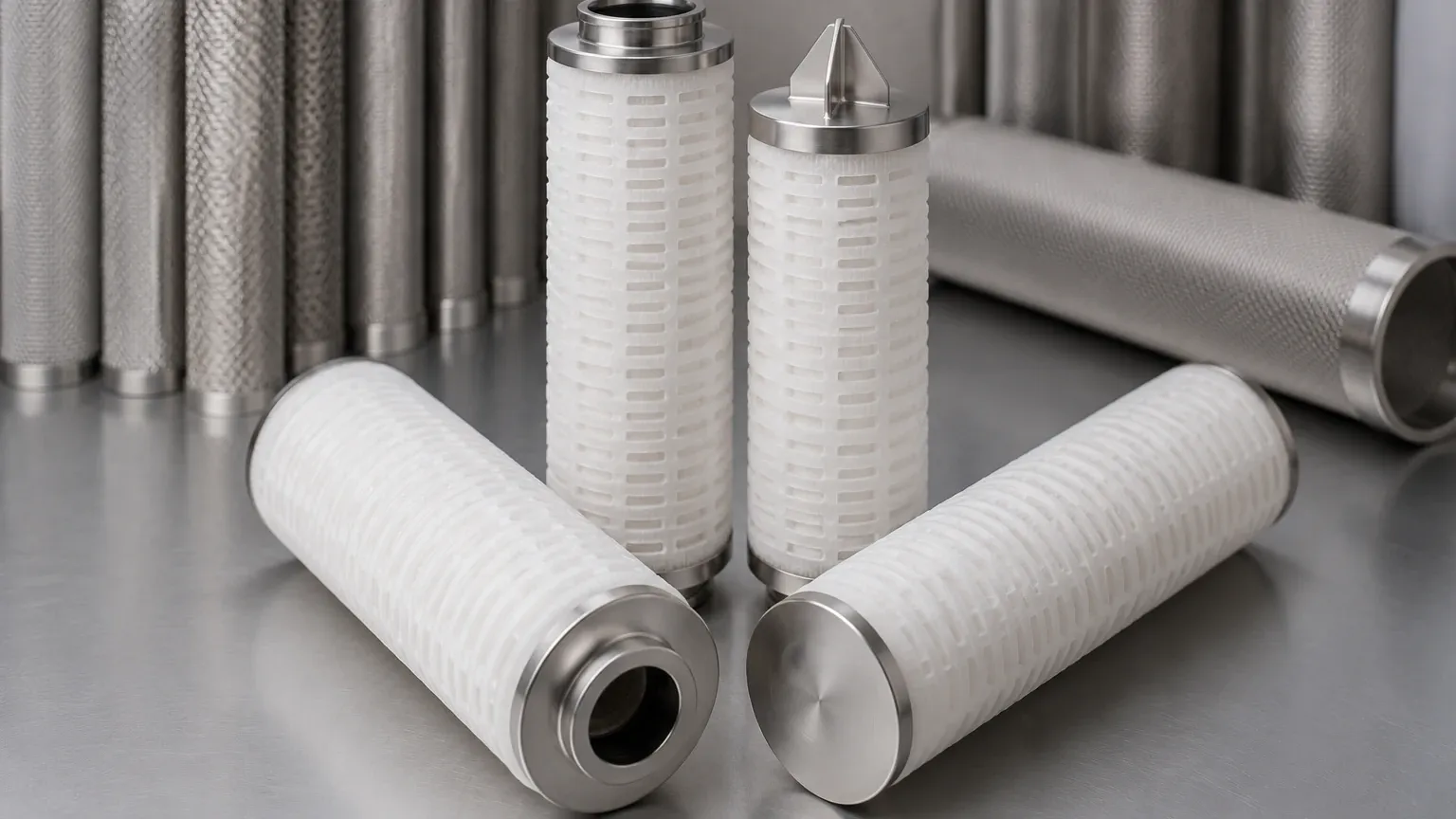
The longevity of a filter cartridge 20 micron depends on its surface area. Pleated designs are frequently employed to maximize the filtration area within a standard cartridge footprint. By increasing the surface area, the flux (flow per unit area) is reduced, which significantly extends the time between cleaning or replacement cycles.
3. Chemical and Thermal Compatibility
In chemical processing, the filter media and the seals (O-rings/gaskets) must be compatible with the process fluid. Stainless steel cartridges are naturally resistant to a wide range of solvents, acids, and bases. Furthermore, while polymer filters may fail at temperatures exceeding 60°C, stainless steel cartridges can operate at temperatures up to 300°C or higher, depending on the alloy and seal material used (such as Viton, PTFE, or EPDM).
Common Applications for 20-Micron Filtration
The 20-micron threshold is a "workhorse" rating across multiple industries due to its balance of protection and throughput.
* Water Treatment: In reverse osmosis (RO) systems, 20-micron cartridges serve as effective pre-filters. They remove silt, sand, and scale that would otherwise foul more expensive membrane elements.
* Food and Beverage: Used for the clarification of syrups, oils, and beverages. The 20-micron rating is sufficient to remove large yeast cells and suspended solids without stripping away essential flavors or colors.
* Hydraulic and Lube Oils: Protecting sensitive hydraulic valves and bearings requires clean oil. A 20-micron filter is often the primary line of defense in industrial power units to prevent abrasive wear.
* Pharmaceuticals: In the early stages of API (Active Pharmaceutical Ingredient) production, 20-micron filters are used to recover catalysts or remove bulk precipitates from reaction vessels.
Customization and OEM Capabilities
Industrial systems are rarely "one size fits all." Customization is often necessary to integrate a filter into existing infrastructure. At Kaifil, we focus on providing tailored solutions that meet specific engineering requirements. Customization options for a filter cartridge 20 micron include:
* End Cap Configurations: Compatibility with various housing types, including Double Open End (DOE), 222 (Code 5), 226 (Code 7), and threaded connections (NPT/BSP).
* Dimensional Adjustments: Standard lengths are typically 10, 20, 30, or 40 inches, but custom diameters and lengths can be manufactured for specialized vessels.
* Reinforced Cores: For high-viscosity fluids or high-pressure differentials, internal support cores can be thickened to prevent structural collapse.
Maintenance: Cleaning vs. Replacement
One of the primary advantages of choosing a stainless steel filter cartridge 20 micron over disposable polymer versions is the ability to clean and reuse the element. This significantly reduces the total cost of ownership (TCO) and minimizes industrial waste.
Cleaning Methods
1. Backwashing: Reversing the flow of clean fluid through the cartridge to dislodge surface contaminants.
2. Ultrasonic Cleaning: Using high-frequency sound waves in a cleaning solution to remove fine particles embedded deep within the mesh or sintered structure.
3. Chemical Cleaning: Soaking the cartridge in specialized solvents or acids to dissolve organic or inorganic scaling, followed by thorough neutralizing and rinsing.
When to Replace
Despite the cleanability of metal filters, they eventually reach a point of "permanent fouling" or mechanical fatigue. If the pressure drop remains high even after a thorough cleaning cycle, or if visual inspection reveals mesh blinding or structural deformation, the cartridge must be replaced to maintain system integrity.
Technical Checklist for Purchasing Teams
Before finalizing an order for 20-micron filtration components, technical professionals should confirm the following data points with their manufacturer:
1. Fluid Characteristics: What is the viscosity and temperature of the fluid? Higher viscosity requires more surface area to maintain flow.
2. Contaminant Type: Is the debris hard/abrasive or soft/deformable? Soft contaminants may require depth filtration, while hard particles are best handled by surface mesh.
3. Maximum Allowable ΔP: What is the structural collapse pressure of the cartridge compared to the system's maximum pump pressure?
4. Regulatory Compliance: Does the application require FDA-compliant materials for food contact or specific certifications for hazardous chemical environments?
Conclusion
The filter cartridge 20 micron is a vital component in the industrial filtration landscape, providing a reliable barrier against particulate contamination while supporting high-demand process flows. By selecting high-quality stainless steel media and ensuring proper structural design, engineers can achieve a balance of performance, durability, and cost-effectiveness.
Whether you are designing a new water treatment plant or optimizing a chemical production line, selecting the right filtration partner is crucial. Kaifil’s expertise in custom stainless steel filtration ensures that every cartridge is engineered to meet the rigorous demands of modern industry. For detailed specifications and engineering support regarding our range of Filter Cartridges, professional teams are encouraged to evaluate their specific application needs against the material and structural advantages of precision-manufactured metal filtration solutions.
