


Filter Cartridge 90304
In the landscape of industrial and commercial maintenance, the filter cartridge 90304 represents a standardized specification widely recognized for its utility in wet and dry filtration systems. While often associated with high-volume commercial vacuum systems and industrial shop equipment, the engineering principles governing this specific cartridge design are central to broader industrial filtration efficiency. For engineers and procurement specialists, understanding the technical nuances of the 90304 format—and when to transition to more robust, customized Filter Cartridges—is essential for maintaining operational uptime and protecting downstream equipment.
Industrial filtration is rarely a one-size-fits-all endeavor. The performance of a filter cartridge 90304 depends heavily on its media composition, structural integrity, and compatibility with the specific contaminants present in the work environment. As industrial processes become more specialized, the demand for high-performance filtration components that exceed standard retail specifications has grown, leading many technical teams to seek out professional manufacturing solutions that offer enhanced durability and precision.
Technical Specifications and Design of the 90304 Format
The filter cartridge 90304 is characterized by its cylindrical, pleated design, which is engineered to maximize surface area within a compact footprint. Typically, this cartridge features an approximate outer diameter of 7.5 inches and a height of 5 inches, though slight variations exist depending on the specific manufacturer and the presence of integrated end caps or gaskets.
Pleat Geometry and Surface Area
The primary advantage of the pleated structure in the 90304 design is the significant increase in effective filtration area (EFA). By folding the media, manufacturers can fit several square feet of material into a small volume. This design reduces the face velocity of the fluid or air passing through the media, which in turn lowers the initial pressure drop and extends the service life of the cartridge. In industrial applications, a higher pleat count often correlates with better dust-holding capacity, provided the pleats are spaced uniformly to prevent "pleat pinching" under high pressure.
Media Composition
Standard versions of the filter cartridge 90304 often utilize cellulose or a cellulose-polyester blend. However, for industrial environments involving fine particulates, moisture, or chemical vapors, specialized media are required:
* HEPA-Rated Media: Designed for capturing 99.97% of particles down to 0.3 microns, essential for pharmaceutical or cleanroom-adjacent maintenance.
* PTFE Membrane: A laminate that provides excellent cake release properties, making the cartridge easier to clean in pulse-jet or manual-shake systems.
* Synthetic Spunbond Polyester: Offers superior moisture resistance compared to cellulose, preventing the media from collapsing when exposed to wet recovery tasks.
Engineering Considerations for Industrial Filtration
When integrating a filter cartridge 90304 into an industrial workflow, engineers must look beyond basic dimensions. The interaction between the filter media and the process stream determines the total cost of ownership (TCO) and the safety of the operating environment.
Micron Ratings and Efficiency
Efficiency is defined by the cartridge's ability to remove particles of a specific size. In B2B contexts, it is vital to distinguish between nominal and absolute micron ratings. A nominal rating indicates the filter can trap a large percentage of particles of a certain size, whereas an absolute rating (often achieved through multi-layered synthetic media or precision wire mesh) guarantees the capture of nearly all particles at that size. For critical industrial processes, relying on the absolute rating of high-quality Filter Cartridges ensures that sensitive machinery is not compromised by bypass leakage.
Pressure Drop and Flow Dynamics
The "Delta P" (differential pressure) is a critical metric for any filtration system. As the filter cartridge 90304 accumulates debris, the resistance to flow increases. If the initial pressure drop is too high due to restrictive media, the system's motor or pump must work harder, leading to premature mechanical failure and increased energy consumption. Engineering a filter with the optimal balance of permeability and retention is a hallmark of professional filtration manufacturing.
Material Selection: Beyond Standard Cellulose
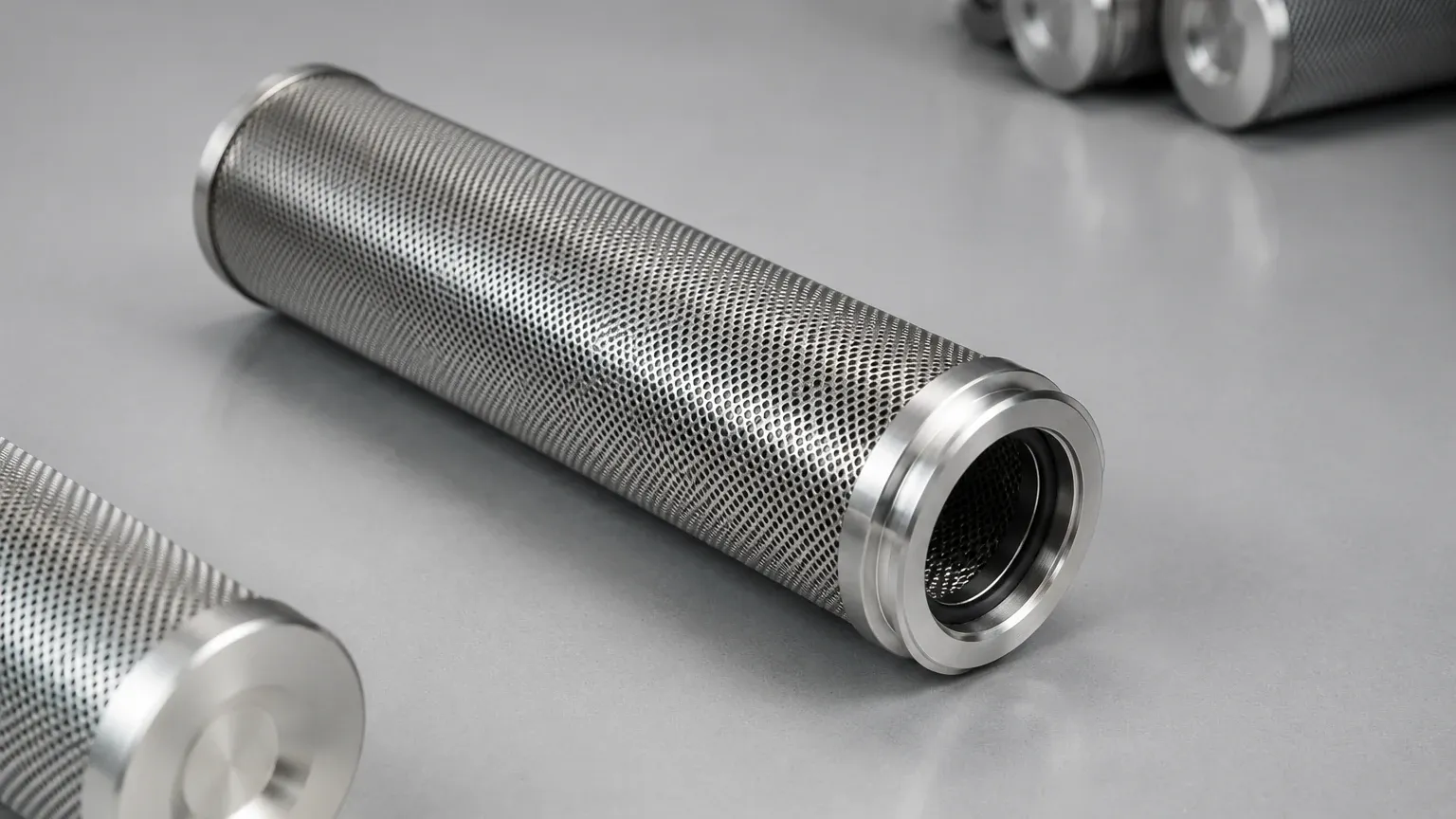
While the standard filter cartridge 90304 is often a disposable item made of paper-based materials, many industrial applications demand a more permanent or chemically resistant solution. This is where the expertise of manufacturers like Kaifil becomes indispensable. For environments involving high temperatures, corrosive chemicals, or high-pressure hydraulics, stainless steel filtration components offer a level of performance that synthetic or cellulose filters cannot match.
Stainless Steel Wire Mesh
In heavy industrial settings, a cartridge with the 90304 form factor can be re-engineered using stainless steel wire mesh (304 or 316L). Stainless steel provides several advantages:
1. Thermal Stability: Operates effectively in temperatures exceeding 500°F (260°C), where standard adhesives and paper media would fail.
2. Chemical Compatibility: Resistant to a wide array of solvents, acids, and alkaline solutions common in chemical processing.
3. Cleanability: Unlike disposable cartridges, stainless steel mesh filters can be cleaned via ultrasonic baths or back-flushing, significantly reducing long-term waste and replacement costs.
Structural Reinforcement
Industrial-grade cartridges often feature internal support cores made of perforated metal or expanded metal. This prevents the cartridge from collapsing under high vacuum or high-pressure differentials. For the filter cartridge 90304 used in heavy-duty recovery, an aluminum or stainless steel end cap provides a more secure seal than the friction-fit rubber gaskets found on consumer-grade equivalents.
Customization and OEM Solutions
For many B2B clients, the standard 90304 specification is merely a starting point. Customization allows for the optimization of the filtration system to meet specific regulatory or operational requirements. Manufacturers specializing in customized filtration can modify the 90304 design in several ways:
* Gasket Material: Substituting standard EPDM gaskets with Viton or Silicone for better chemical or heat resistance.
* Anti-Static Treatments: Incorporating conductive fibers or aluminized coatings to prevent static discharge in explosive dust environments (ATEX compliance).
* Custom Micron Windows: Engineering a graduated density structure where the outer layers catch large debris and the inner layers capture fine silt, effectively doubling the filter's lifespan.
By working with a dedicated manufacturer, companies can develop OEM Filter Cartridges that are tailored to their specific equipment, ensuring a perfect fit and optimized performance that off-the-shelf components cannot provide.
Maintenance, Replacement, and Total Cost of Ownership
A common mistake in industrial procurement is focusing solely on the unit price of a filter cartridge 90304. A comprehensive analysis of the Total Cost of Ownership (TCO) reveals that durability and efficiency are far more impactful than initial cost.
Identifying the Replacement Trigger
Filters should be replaced or cleaned based on differential pressure readings rather than a fixed calendar schedule. In systems without active monitoring, a noticeable drop in suction or flow indicates that the filter cartridge 90304 has reached its terminal pressure drop. Operating beyond this point risks media rupture, which can lead to catastrophic downstream contamination.
The Impact of Filtration Quality on Equipment Longevity
High-quality filtration acts as a safeguard for the most expensive components of a system, such as vacuum motors, hydraulic pumps, and precision nozzles. A sub-standard filter cartridge 90304 may allow fine abrasive dust to pass through, leading to accelerated wear on bearings and seals. Investing in precision-engineered cartridges ensures that the air or fluid returning to the system is truly clean, thereby extending the mean time between failures (MTBF) for the entire installation.
Selection Criteria for Technical Purchasing Teams
When sourcing a filter cartridge 90304 for industrial use, purchasing teams should verify several key factors with their supplier to ensure the product meets the rigors of the application:
1. Certification and Compliance: Does the filter meet ISO, FDA (for food/bev), or HEPA standards where required?
2. Seal Integrity: Is the gasket design sufficient to prevent bypass? In many industrial vacuums, the seal is the most common point of failure.
3. Media Loading Characteristics: Is the media surface-loading (easier to clean) or depth-loading (higher capacity for fine dust)?
4. Vendor Technical Support: Can the manufacturer provide data sheets, pressure drop curves, and material compatibility charts?
Kaifil’s approach to filtration emphasizes these technical details, providing engineers with the data needed to make informed decisions. Whether the requirement is for a standard replacement or a custom-designed stainless steel component, the focus remains on precision and reliability.
Conclusion: The Value of Precision Filtration
The filter cartridge 90304 is a vital component in many industrial maintenance and process systems. However, its effectiveness is entirely dependent on the quality of its construction and the suitability of its materials for the task at hand. By understanding the engineering principles of pleat geometry, media selection, and structural reinforcement, technical professionals can optimize their filtration processes for better efficiency and lower costs.
For organizations looking to upgrade their filtration capabilities or develop specialized components, partnering with a manufacturer that understands the complexities of industrial environments is essential. High-performance Filter Cartridges are more than just consumables; they are critical assets that ensure the safety, purity, and productivity of modern industrial operations.
