


Filter Cartridge Carbon Block
In industrial filtration, the filter cartridge carbon block represents a critical technology for the removal of dissolved organic contaminants, chlorine, and VOCs (Volatile Organic Compounds). Unlike granular activated carbon (GAC) systems, which can suffer from fluid channeling and inconsistent contact time, a carbon block provides a dense, uniform structure that ensures every drop of process fluid passes through a tortuous path of activated media. For engineers and procurement teams in the chemical, pharmaceutical, and food and beverage sectors, understanding the technical nuances of carbon block construction and performance is essential for optimizing process efficiency and ensuring product purity.
The Engineering Behind Carbon Block Technology
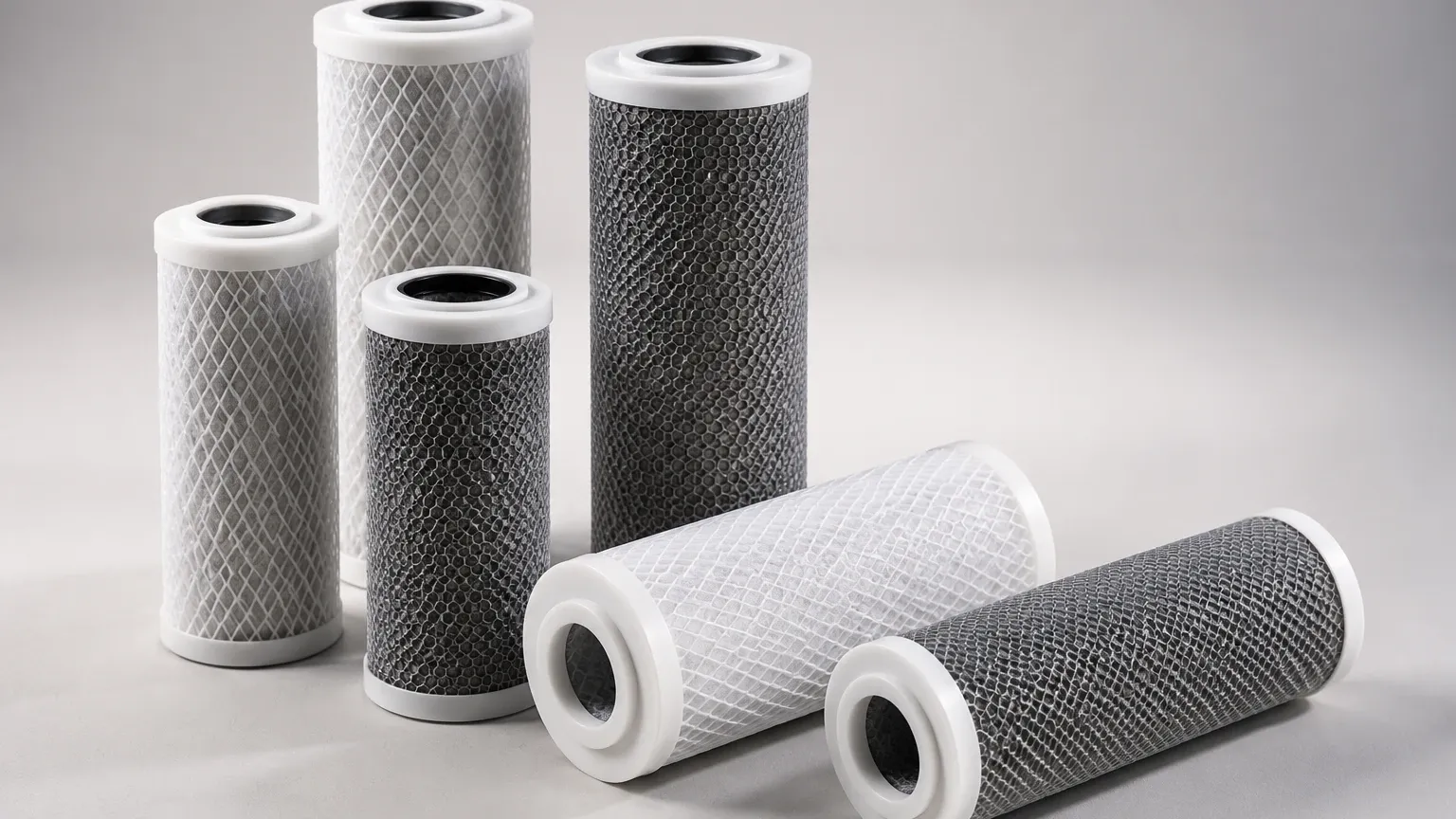
A filter cartridge carbon block is manufactured by combining fine activated carbon powder with a thermoplastic binder. This mixture is then either extruded or compression-molded into a solid, cylindrical shape. The result is a porous structure that provides significantly higher surface area and contact time compared to loose-fill carbon filters.
From a technical perspective, the performance of a carbon block is dictated by its porosity and the quality of the carbon source. The manufacturing process allows for precise control over the micron rating, typically ranging from 0.5 to 20 microns. This dual-functionality—acting as both a mechanical sediment filter and a chemical adsorbent—makes the carbon block an efficient component in multi-stage filtration systems. The binder used must be carefully selected to ensure it does not "blind" or cover the pores of the carbon, which would decrease the adsorption capacity.
Adsorption Kinetics and Surface Area
The primary mechanism of a filter cartridge carbon block is adsorption. This is a surface-based phenomenon where molecules of a gas or liquid adhere to the internal pores of the carbon. Activated carbon is chosen for its immense internal surface area; a single gram of high-quality activated carbon can have a surface area exceeding 1,000 square meters.
In industrial applications, the choice of carbon source is vital:
* Coconut Shell Carbon: Known for its high microporosity, making it ideal for removing small organic molecules, chlorine, and disinfection byproducts.
* Coal-Based Carbon: Contains a mix of micro and mesopores, suitable for a broader range of contaminant sizes, often used in wastewater treatment.
* Wood-Based Carbon: Highly macroporous, effective for removing large color molecules and larger organic compounds.
For high-purity requirements, coconut shell carbon is often preferred due to its cleanliness and high density of small pores, which are particularly effective at removing trace contaminants that can affect the taste, odor, or chemical stability of the final product.
Comparing Carbon Blocks and Granular Activated Carbon (GAC)
When selecting Filter Cartridges, engineers must decide between carbon blocks and GAC. While GAC is often less expensive upfront, the filter cartridge carbon block offers several technical advantages in a B2B industrial context:
1. Elimination of Channeling: In GAC filters, the fluid can create "channels" or paths of least resistance, bypassing the majority of the media. The solid structure of a carbon block forces uniform flow, ensuring consistent effluent quality.
2. Reduced Carbon Fines: GAC particles can rub against each other during transport or operation, creating "fines" (small carbon dust) that can migrate downstream. Carbon blocks are bonded, significantly reducing the release of fines.
3. Mechanical Filtration: Because of its dense structure, a carbon block provides a nominal micron rating for sediment removal, whereas GAC provides almost no mechanical filtration.
4. Compact Footprint: Due to the higher density of active media per unit of volume, carbon blocks can achieve the same level of contaminant removal in a smaller housing compared to GAC.
Key Performance Metrics for Selection
To ensure the longevity and effectiveness of a filter cartridge carbon block, several engineering parameters must be evaluated during the procurement phase.
Flow Rate and Pressure Drop
Every filter cartridge introduces a pressure drop ($ΔP$) into the system. Carbon blocks, being denser than sediment filters, typically exhibit a higher initial pressure drop. Engineers must calculate the required flow rate against the maximum allowable $ΔP$ to ensure the pump system can handle the resistance. Operating at a flow rate higher than the manufacturer’s recommendation reduces Empty Bed Contact Time (EBCT), which directly correlates to a decrease in adsorption efficiency.
Chlorine and VOC Reduction Capacity
Manufacturers provide capacity ratings in gallons or liters, usually based on a specific influent concentration (e.g., 2 ppm of free chlorine). In industrial settings, it is critical to confirm if these ratings are based on continuous or intermittent flow, as carbon requires time to regenerate its adsorption sites in some chemical applications.
Micron Rating: Nominal vs. Absolute
Most carbon blocks are rated nominally. A 5-micron carbon block will remove a significant percentage of 5-micron particles but is not a 100% barrier. If absolute filtration is required for microbial control or sensitive downstream equipment protection, a carbon block should be followed by an absolute-rated membrane or pleated filter cartridge.
Industrial Applications and Compatibility
The versatility of the filter cartridge carbon block allows it to be utilized across diverse industrial sectors. However, chemical compatibility must be verified for the end caps, netting, and gaskets.
* Food and Beverage: Used for dechlorinating ingredient water and removing off-flavors. It is essential that the materials are FDA-compliant and NSF-certified to ensure no leaching of binders or additives.
* Pharmaceutical and Biotech: Carbon blocks are used to remove organic impurities and trace chlorine that could interfere with sensitive fermentation processes or chemical synthesis. High-purity blocks with low extractables are required here.
* Chemical Processing: Used for the purification of organic solvents or the removal of catalysts from a process stream. In these cases, the chemical resistance of the thermoplastic binder is a limiting factor.
* Pre-treatment for Reverse Osmosis (RO): Chlorine is a strong oxidant that can permanently damage thin-film composite RO membranes. A carbon block is the standard defense mechanism to neutralize chlorine before it reaches the membrane surface.
Maintenance, Replacement Cycles, and Troubleshooting
Unlike sediment filters, which are replaced when the pressure drop becomes too high, a filter cartridge carbon block may need replacement even if the pressure drop is stable. This is because the adsorption sites can become saturated (exhausted), leading to "breakthrough," where contaminants pass through the filter untouched.
Signs of Exhaustion
1. Analytical Detection: Regular testing of the effluent for chlorine or the target organic contaminant is the most reliable method.
2. Odor or Color Breakthrough: In water treatment or beverage production, a change in the sensory profile of the effluent indicates the carbon is no longer effective.
3. Pressure Drop Increase: If the process fluid contains high levels of suspended solids, the carbon block may act as a mechanical filter and clog prematurely. This is why pre-filtration (using a melt-blown or string-wound cartridge) is highly recommended to protect the carbon media.
To maximize the total cost of ownership, industrial operators should implement a dual-gauge system to monitor differential pressure and a sampling port to check for chemical breakthrough. Replacing the carbon block on a scheduled basis, rather than waiting for failure, prevents downstream contamination and equipment damage.
Customization and OEM Considerations
Many industrial systems require non-standard dimensions or specific performance characteristics that off-the-shelf products cannot meet. Customization options for a filter cartridge carbon block include:
* Custom Lengths and Diameters: Fitting existing proprietary housings.
* Specialized Carbon Blends: Incorporating catalytic carbon for chloramine removal or lead-reduction media for specific heavy metal targets.
* End-Cap Configurations: Options like DOE (Double Open End), Code 7 (fin and 226 locking tabs), or threaded connections to ensure a bypass-free seal.
* Reinforced Structures: For high-pressure or high-temperature applications where a standard polypropylene-bonded block might fail.
When sourcing these components, working with a manufacturer that understands the intersection of material science and mechanical engineering is vital. By specifying the exact nature of the fluid, the flow requirements, and the target contaminants, engineers can secure a filtration solution that balances performance with operational longevity.
In conclusion, the filter cartridge carbon block is a high-performance tool for industrial purification. Its ability to provide consistent chemical adsorption while simultaneously offering mechanical filtration makes it a staple in modern process engineering. By focusing on technical specifications such as carbon source, micron rating, and EBCT, purchasing teams can ensure they select a solution that maintains the integrity of their industrial processes.
