


Filter Cartridge Cleaner
In industrial filtration systems, the efficiency of a process is often dictated by the maintenance and longevity of the filtration media. For engineers and facility managers, the choice between disposable and cleanable systems is a critical decision that impacts both operational downtime and total cost of ownership. When utilizing high-performance stainless steel Filter Cartridges, the implementation of a proper cleaning protocol is essential. Selecting the right filter cartridge cleaner—whether it be a chemical agent, a mechanical system, or an ultrasonic process—determines how effectively the filter’s original flow characteristics and pressure differential capabilities are restored.
Industrial filtration environments, particularly those in chemical processing, pharmaceutical manufacturing, and food production, demand rigorous standards for cleanliness and integrity. This guide examines the technical aspects of filter cartridge cleaning, the chemistry involved, and the engineering considerations required to maintain metal filtration components.
Understanding Industrial Filter Cartridge Cleaning
Cleaning an industrial filter cartridge is the process of removing accumulated contaminants from the filter media to restore its permeability. Unlike disposable polymer filters, which are discarded once they reach a terminal pressure drop, stainless steel wire mesh and sintered metal cartridges are designed for multiple cleaning cycles.
The effectiveness of a filter cartridge cleaner depends largely on the nature of the "filter cake" or the depth-loaded contaminants. In surface filtration, such as that found in plain square weave wire mesh, contaminants are trapped on the upstream side of the media, making them relatively easy to remove. In depth filtration, where particles are trapped within the complex paths of sintered metal fibers or multi-layered mesh, the cleaning process requires more sophisticated methods to ensure that internal blockages are cleared.
Engineers must evaluate the "cleanability" of a filter based on its material construction and the specific particulates it encounters. For instance, a filter used in oil and gas applications may face heavy hydrocarbon buildup, requiring a different filter cartridge cleaner than a filter used in a beverage plant where organic proteins and sugars are the primary concern.
Chemical Filter Cartridge Cleaner Selection
Chemical cleaning is one of the most common methods for restoring metal filter cartridges. This involves the use of specialized solvents, acids, or alkaline solutions to dissolve or emulsify contaminants that cannot be removed by mechanical means alone.
1. Alkaline Cleaners
Alkaline solutions, often containing sodium hydroxide (caustic soda), are highly effective at removing organic matter, oils, fats, and proteins. These are frequently used in the food and beverage industry. When using an alkaline filter cartridge cleaner, it is vital to monitor the concentration and temperature, as excessive heat can sometimes lead to the polymerization of certain organic residues, making them harder to remove.
2. Acidic Cleaners
Acidic cleaners, such as phosphoric, citric, or nitric acid, are typically employed to remove inorganic scales, mineral deposits, and metal oxides. In stainless steel applications, nitric acid is often preferred because it also aids in the passivation of the metal surface, enhancing its corrosion resistance. However, engineers must ensure that the acid concentration does not lead to pitting or intergranular corrosion, particularly if the cartridge is made of 304 rather than 316L stainless steel.
3. Solvent-Based Cleaners
For resins, waxes, and heavy hydrocarbons, solvent-based cleaners are necessary. These chemicals break down the molecular bonds of the contaminants. Due to environmental and safety regulations, the choice of solvent must be carefully balanced between cleaning power and volatile organic compound (VOC) compliance.
Ultrasonic Cleaning Systems for Metal Filters
For precision metal filters, chemical soaking is often insufficient. Ultrasonic cleaning is widely regarded as the most effective method for deep-cleaning stainless steel wire mesh and sintered components.
An ultrasonic filter cartridge cleaner works through the process of cavitation. High-frequency sound waves create millions of microscopic bubbles in a cleaning liquid. When these bubbles collapse (implode), they release high-energy jets that penetrate deep into the pores of the filter media. This action dislodges particles that are wedged in the complex geometry of the mesh or sintered fibers—areas that are inaccessible to manual scrubbing or pressurized sprays.
From an engineering perspective, the frequency of the ultrasonic system is critical. Lower frequencies (around 20-25 kHz) produce larger, more aggressive bubbles suitable for heavy-duty cleaning of robust components. Higher frequencies (40 kHz and above) provide a gentler, more thorough cleaning for fine, delicate meshes. Over-exposure to high-intensity ultrasonics can, in rare cases, cause fatigue in extremely fine wire mesh, so cycle times must be optimized.
Mechanical Cleaning and Backwashing
Mechanical cleaning involves the physical removal of contaminants using fluid dynamics or manual intervention.
* Backwashing (Backpulsing): This is an automated process where the flow of fluid is reversed through the filter. The reverse pressure forces the contaminants out of the media. This is highly effective for surface-loading filters. When designing a system, engineers must ensure the filter cartridge can withstand the reverse pressure without deforming the mesh or compromising the structural support core.
* High-Pressure Water Jetting: This can be used for external surface cleaning. However, it carries the risk of pushing contaminants deeper into the media or damaging the precision weave of the wire mesh if the pressure is too high or the angle is incorrect.
While mechanical methods are excellent for routine maintenance, they often leave behind a "residual heel" of contaminants. Therefore, they are frequently used in conjunction with a chemical or ultrasonic filter cartridge cleaner for a complete restoration.
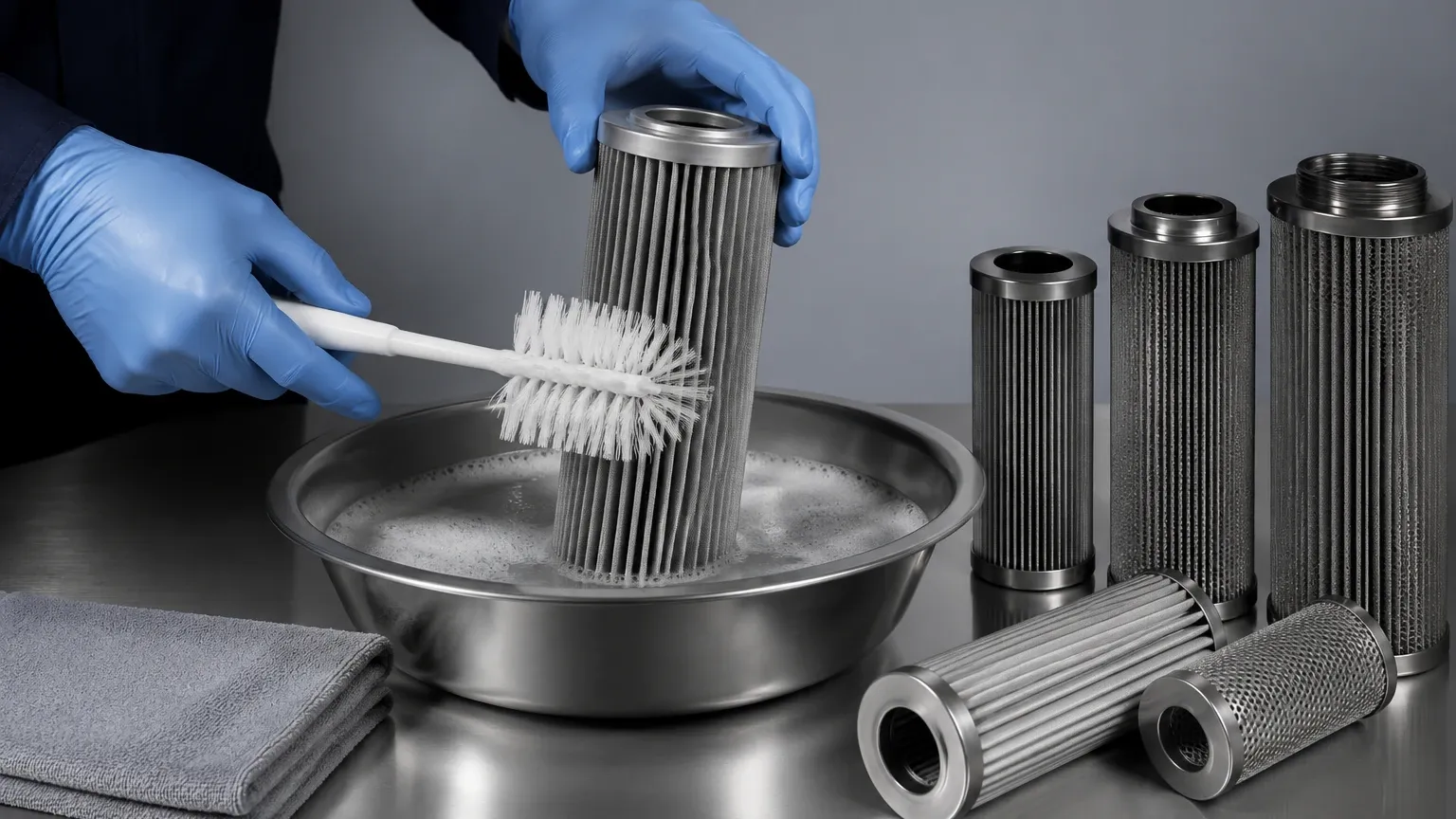
Engineering Considerations: Material Compatibility
The most critical factor when selecting a filter cartridge cleaner is the compatibility between the cleaning agent and the filter materials. While the primary media may be 316L stainless steel, the cartridge assembly often includes other materials:
1. O-Rings and Gaskets: Many chemical cleaners that are safe for stainless steel will degrade elastomers like Viton, EPDM, or Buna-N. If the seals cannot be removed during cleaning, the cleaner must be compatible with both the metal and the polymer.
2. Adhesives and Potting Compounds: In some cartridge designs, the media is bonded to the end caps using epoxy or other adhesives. Strong solvents or high temperatures can soften or dissolve these bonds, leading to bypass and filter failure.
3. Structural Support: The inner core and outer cage provide the mechanical strength to resist pressure. If a cleaner causes even minor surface corrosion, it can weaken these structures over multiple cycles, leading to a catastrophic collapse under operating loads.
Validating the Cleaning Process
How do you know if a filter is truly clean? In industrial B2B applications, visual inspection is rarely sufficient. Engineering teams should use quantitative methods to validate the effectiveness of their filter cartridge cleaner and process.
Pressure Differential ($ΔP$) Testing
After cleaning, the filter should be tested under controlled flow conditions. The pressure drop across the clean filter should return to near-original "clean" values. If the $ΔP$ remains high, it indicates that internal pores are still blocked, and the cleaning cycle was unsuccessful.
Bubble Point Test
The bubble point test is a non-destructive method used to verify the integrity of the filter and ensure that the cleaning process has not damaged the media. By submerging the cartridge in a liquid and slowly increasing air pressure inside it, the pressure at which the first stream of bubbles appears (the bubble point) can be used to calculate the maximum pore size. If the bubble point is lower than the manufacturer's specification, it suggests the mesh has been compromised or enlarged during cleaning.
Weight Verification
For heavy-duty industrial filters, weighing the cartridge before and after cleaning can provide a rough estimate of how much contaminant mass was removed. This is particularly useful in applications involving heavy resins or plastics.
When to Replace vs. Clean
While stainless steel Filter Cartridges are designed for reuse, they do not last forever. Every cleaning cycle, especially those involving aggressive chemicals or ultrasonics, subjects the material to minor stress.
A technical evaluation for replacement should be triggered if:
* The "clean" pressure drop increases steadily over successive cleaning cycles (permanent fouling).
* The bubble point test fails, indicating a breach in the media.
* There is visible deformation of the pleats or the support core.
* The cost of the filter cartridge cleaner, labor, and downtime exceeds the amortized value of a new unit.
In many high-purity applications, such as pharmaceutical sterile filtration, the number of allowable cleaning or sterilization cycles is strictly limited by validated protocols to ensure absolute process safety.
Optimizing the Total Cost of Ownership (TCO)
Investing in high-quality stainless steel filtration from a professional manufacturer like Kaifil allows for a significantly lower TCO compared to disposable options, provided a proper maintenance strategy is in place. The choice of a filter cartridge cleaner is not just about removing dirt; it is about preserving a precision-engineered asset.
By understanding the chemical and mechanical interactions between the cleaner and the filter media, engineers can extend the service life of their components, maintain consistent product quality, and reduce the environmental impact of their operations. Whether you are dealing with high-viscosity fluids in a chemical plant or maintaining sanitary standards in a food processing line, a disciplined approach to filter cleaning is a cornerstone of operational excellence.
