


Filter Cartridge Keurig
In the realm of beverage preparation and small-scale liquid processing, the efficiency of filtration directly dictates the quality of the final product. While many recognize the term in the context of household coffee systems, the engineering behind a filter cartridge keurig system represents a specific intersection of material science, fluid dynamics, and food-grade compliance. For industrial engineers and OEM procurement teams, understanding the technical specifications of these small-format filtration components is essential when designing or maintaining equipment that requires precise sediment removal and chemical balancing.
Industrial-grade filtration solutions often mirror the functional requirements of consumer-facing units but demand significantly higher durability and more stringent material tolerances. Whether the application involves a commercial brewing station or a specialized laboratory water dispenser, the selection of the correct filtration media determines the longevity of the equipment and the consistency of the output.
Engineering Principles of Small-Scale Liquid Filtration
The fundamental goal of any liquid filter cartridge is the removal of impurities—ranging from physical particulates like silt and rust to chemical constituents like chlorine and organic compounds. In systems utilizing a filter cartridge keurig, the filtration process typically involves a multi-stage approach.
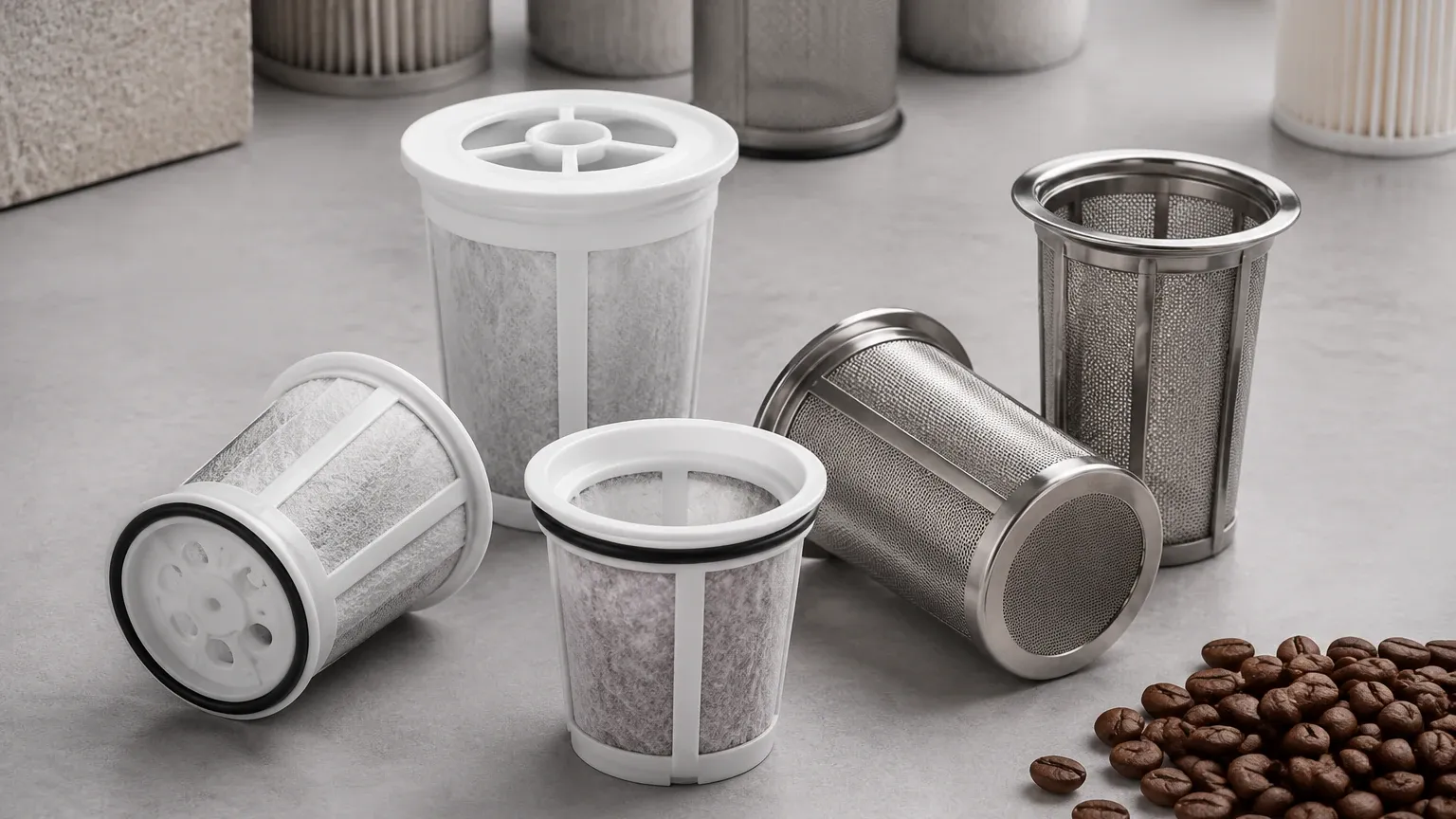
1. Mechanical Filtration: This stage uses a physical barrier to trap suspended solids. In industrial contexts, this is often achieved through precision-woven stainless steel wire mesh or non-woven fiber matrices. The micron rating is the critical metric here; a rating that is too high allows sediment to pass through, potentially damaging internal valves and heating elements, while a rating that is too low causes premature clogging and excessive pressure drop.
2. Adsorption: Many small-format cartridges incorporate activated carbon. This material has an incredibly high surface area-to-volume ratio, allowing it to chemically bond with and remove chlorine, volatile organic compounds (VOCs), and odors that affect the sensory profile of the water.
3. Ion Exchange: To prevent scale buildup—a primary cause of mechanical failure in heating systems—some cartridges utilize ion-exchange resins. These resins replace calcium and magnesium ions (which cause hardness) with sodium or potassium ions, effectively softening the water before it reaches the boiler.
For B2B applications, the challenge lies in balancing these three functions within a compact form factor that maintains a high flow rate. Engineers must calculate the "contact time" required for chemical adsorption against the desired output speed of the machine.
Material Selection for Food and Beverage Compliance
When manufacturing or sourcing components for beverage filtration, material integrity is non-negotiable. Industrial manufacturers like Kaifil emphasize the use of 304 or 316L stainless steel for structural components and high-performance polymers for housings.
In the context of a filter cartridge keurig, the materials must be FDA-compliant and resistant to the thermal stresses of the brewing environment. While consumer versions often rely on BPA-free plastics, industrial-scale beverage equipment frequently transitions to stainless steel filtration media for several reasons:
* Thermal Stability: Stainless steel maintains its structural integrity at high temperatures, ensuring that the pore size of the filter does not distort during hot water cycles.
* Corrosion Resistance: Constant exposure to water and cleaning agents can degrade inferior metals. 316L stainless steel, in particular, offers superior resistance to pitting and crevice corrosion.
* Cleanability: Unlike disposable synthetic filters, metal filtration components can often be cleaned and sterilized, reducing the total cost of ownership and environmental impact in high-volume commercial settings.
For procurement teams, verifying the material certifications (such as NSF/ANSI standards) is a critical step in the vetting process. Ensuring that the filter cartridge does not leach chemicals or particulates into the fluid stream is the baseline for any food-service application.
Customization and OEM Manufacturing Considerations
One of the primary requirements for industrial clients is the ability to customize filtration components to fit proprietary equipment. A standard filter cartridge keurig might work for a home unit, but a commercial-grade espresso machine or a high-capacity vending kiosk requires a bespoke solution.
OEM manufacturing allows for the adjustment of several variables:
* End-Cap Configurations: Custom fittings (such as bayonet mounts, threaded connections, or O-ring seals) ensure a leak-proof interface with the machine’s manifold.
* Media Density: Depending on the local water quality of the target market, the density of the activated carbon or the weave of the stainless steel mesh can be adjusted to provide either higher flow or finer filtration.
* Structural Reinforcement: In high-pressure hydraulic or pumping systems, the internal core of the cartridge must be reinforced to prevent collapse under pressure spikes.
By working with a specialized manufacturer, engineers can develop Filter Cartridges that are specifically tuned to the pump curves and pressure limits of their specific hardware, rather than relying on off-the-shelf components that may underperform.
Performance Criteria: Micron Rating and Flow Rate
In technical terms, the performance of a filter is defined by its Beta Ratio and its pressure drop (ΔP). For small-scale beverage filtration, the "nominal" micron rating is often sufficient, but for critical industrial processes, an "absolute" rating is required.
An absolute rating implies that the filter will trap 99.9% of particles at the specified micron size. For a filter cartridge keurig application, a 5-micron to 20-micron range is typical for sediment removal. However, if the goal is to protect precision spray nozzles or micro-valves within a commercial machine, a finer 1-micron absolute filter might be necessary.
Flow rate is the other side of the equation. Every filter introduces resistance into the system. If the resistance is too high, the pump must work harder, leading to increased energy consumption and a shorter mean time between failures (MTBF). Engineers must use Darcy’s Law to calculate the permeability of the filter media and ensure that the system can deliver the required volume of water within the specified time window without exceeding the pump's operational envelope.
Maintenance, Replacement Cycles, and Total Cost of Ownership
While the initial purchase price of a filter cartridge is a factor, the total cost of ownership (TCO) is driven by the replacement frequency and the protection the filter provides to the rest of the system. In a commercial environment, a clogged filter doesn't just mean poor-tasting coffee; it means downtime and potential service calls.
Key factors influencing the replacement cycle include:
* Inlet Water Turbidity: Higher levels of suspended solids will load the filter surface more quickly.
* Total Gallonage: Chemical media like activated carbon have a finite capacity for adsorption. Once the active sites are saturated, "breakthrough" occurs, and contaminants pass through the filter.
* Pressure Monitoring: In industrial setups, differential pressure gauges are used to monitor the health of the filter. A rise in pressure across the cartridge indicates that it is reaching its loading capacity.
For many B2B operations, transitioning from disposable plastic cartridges to cleanable stainless steel elements can significantly reduce long-term operational costs. Even if the initial investment is higher, the ability to backwash or ultrasonically clean the filter media extends its lifespan from months to years.
Selecting the Right Filtration Partner
Choosing a supplier for industrial filtration components requires more than just looking at a catalog. It requires a partner who understands the nuances of fluid dynamics and material compatibility. When evaluating a manufacturer for components related to a filter cartridge keurig or similar liquid systems, engineers should confirm the following:
* Testing Capabilities: Does the manufacturer have the facilities to test for bubble point, pressure decay, and flow fatigue?
* Quality Control: Are there rigorous inspections for weld integrity (in the case of metal filters) and pore size consistency?
* Scalability: Can the supplier move from a prototype phase to high-volume OEM production without compromising on tolerances?
Kaifil provides a range of high-performance Filter Cartridges designed to meet these exact industrial standards. By focusing on precision engineering and durable materials, these solutions ensure that even the smallest filtration components contribute to the overall reliability and efficiency of the larger industrial system.
In conclusion, while the consumer market focuses on the convenience of the filter cartridge keurig, the industrial sector must focus on the technical realities of filtration. By prioritizing material quality, precise micron ratings, and robust structural design, engineers can ensure their systems deliver consistent performance, whether they are brewing a single cup of coffee or processing thousands of liters of liquid in a commercial facility.
