


Filter or Cartridge
In the field of industrial fluid processing, the terminology used to describe separation equipment can often lead to confusion during the procurement and engineering phases. Professionals frequently encounter the question of whether they require a "filter" or a "cartridge." While these terms are sometimes used interchangeably in casual conversation, they represent distinct concepts in engineering documentation and system design. Understanding the relationship between the filter assembly and the cartridge element is essential for optimizing filtration efficiency, ensuring chemical compatibility, and managing the total cost of ownership in demanding industrial environments.
Understanding the Terminology: Filter or Cartridge?
To clarify the distinction, a "filter" generally refers to the complete assembly or the entire system designed to remove contaminants from a fluid stream. This includes the pressure vessel (housing), the internal support structures, the inlet and outlet ports, and the filtration media itself. Conversely, a "cartridge" specifically refers to the replaceable, modular component that performs the actual separation.
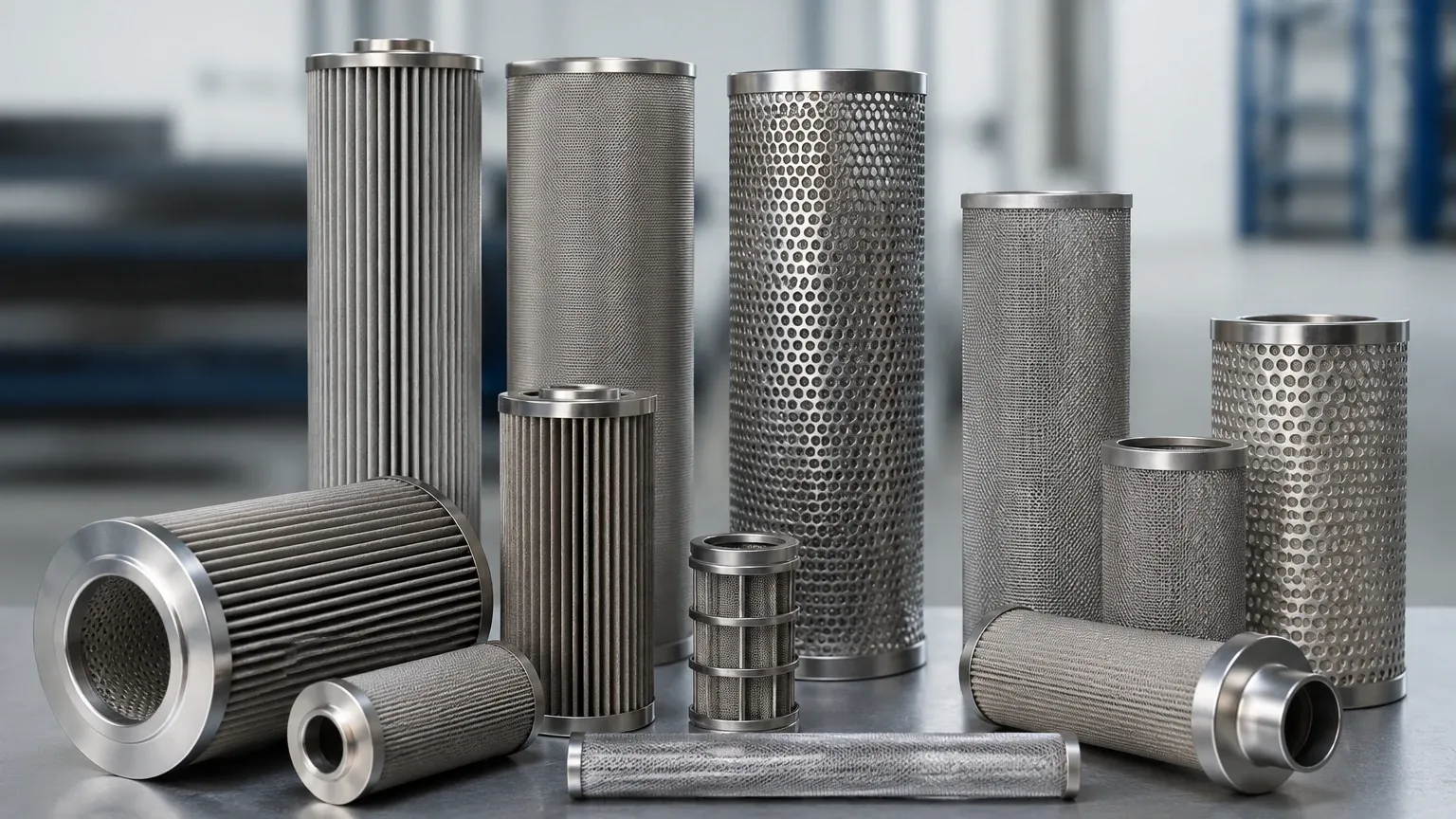
In most industrial applications, Filter Cartridges are the functional core of the system. They are designed to be inserted into a housing, where they intercept particles as fluid passes through the media. Whether an engineer specifies a filter or cartridge depends on the stage of the project: the housing is a capital expense (CAPEX) item intended for long-term use, while the cartridge is an operational expense (OPEX) item that requires periodic replacement or cleaning.
For technical teams, the focus is often on the cartridge because it dictates the filtration accuracy, flow resistance, and material compatibility of the process. Selecting the right media—whether it is a pleated wire mesh, a sintered metal fiber, or a cylindrical screen—determines the success of the entire filtration unit.
Engineering Considerations for Industrial Filter Cartridges
When evaluating a filter or cartridge for industrial use, engineering specifications must take precedence over generic descriptions. Industrial filtration often involves extreme temperatures, high pressures, and corrosive chemicals that would degrade standard polymer-based media. This is where stainless steel filtration solutions become critical.
Material Selection
Stainless steel, specifically grades 304, 316, and 316L, is the industry standard for high-performance cartridges. These materials offer superior mechanical strength and resistance to oxidation. In chemical processing or pharmaceutical applications, 316L is often preferred due to its lower carbon content and enhanced resistance to pitting and crevice corrosion.
Structural Integrity
Unlike disposable filters used in light commercial applications, industrial cartridges must withstand significant differential pressure ($ΔP$). As contaminants accumulate on the surface of the media, the pressure drop across the cartridge increases. A well-engineered cartridge must feature a robust inner core and, in many cases, an outer support cage to prevent the media from collapsing or bursting under these stresses.
Filtration Media Types
There are several ways to construct the media within a cartridge:
1. Wire Mesh: Ideal for surface filtration where precise pore sizing is required. It is easily cleaned and reused.
2. Sintered Metal Fiber: Provides depth filtration with high porosity, allowing for lower initial pressure drops and higher dirt-holding capacity.
3. Sintered Wire Cloth: Multiple layers of mesh bonded through heat and pressure to create a rigid, highly durable filtration plate or cylinder.
Key Selection Criteria: Performance Expectations
Selecting between a standard filter or cartridge configuration requires a deep dive into performance metrics. Engineers must look beyond the "nominal" micron rating and evaluate the absolute performance of the media.
Micron Rating: Absolute vs. Nominal
A nominal rating indicates that the cartridge can trap a major percentage of particles of a given size, but it does not guarantee 100% efficiency. In critical applications, such as pharmaceutical sterile filtration or high-precision hydraulic systems, an absolute rating is required. This ensures that no particles larger than the specified micron size can pass through the media under defined test conditions.
Flow Rate and Pressure Drop
The relationship between flow rate and pressure drop is a primary design constraint. A cartridge with a very fine micron rating will naturally offer higher resistance to flow. Engineers must balance the need for high-purity output with the energy costs associated with pumping fluid through a restrictive filter. Increasing the surface area—often achieved through pleating the stainless steel mesh—allows for higher flow rates while maintaining a compact cartridge footprint.
Dirt-Holding Capacity
This refers to the amount of contaminant a cartridge can retain before the pressure drop reaches a terminal point, necessitating a change-out or cleaning cycle. Cartridges with depth-filtration characteristics (like sintered fibers) generally offer higher dirt-holding capacity than simple surface-filtration screens.
Material Compatibility and Industrial Environments
The choice of filter or cartridge is heavily influenced by the operating environment. Each industry presents unique challenges that dictate the construction of the filtration element.
Chemical Processing
In the chemical industry, cartridges are exposed to solvents, acids, and bases. Stainless steel is often the only viable option because it does not leach chemicals into the process stream and maintains its structural integrity when exposed to aggressive fluids. Compatibility with seals and gaskets (such as Viton, PTFE, or EPDM) must also be verified to ensure a leak-proof bypass-free fit within the housing.
Food and Beverage
Filtration in the food and beverage sector requires hygienic designs. Cartridges must be capable of withstanding Clean-in-Place (CIP) or Steam-in-Place (SIP) sterilization processes. Stainless steel wire mesh is particularly valued here because it does not shed fibers and can be ultrasonically cleaned to meet strict sanitary standards.
Hydraulic and Lubrication Systems
High-pressure hydraulic systems require cartridges that can handle rapid pressure fluctuations and high-viscosity fluids. In these cases, the mechanical bond between the end caps and the filter media is a critical failure point. Specialized welding or bonding techniques are used to ensure the cartridge remains intact during cold starts or surge conditions.
Evaluating Total Cost of Ownership (TCO)
One of the most significant decisions a purchasing team faces is whether to invest in a permanent, cleanable stainless steel cartridge or a lower-cost disposable polymer filter. While the initial price of a stainless steel cartridge is higher, the Total Cost of Ownership (TCO) often favors the metal solution in industrial contexts.
Cleanability vs. Disposal
Disposable cartridges create a recurring cost and a waste disposal burden. In contrast, stainless steel Filter Cartridges can be cleaned via backwashing, ultrasonic baths, or chemical cleaning. This longevity reduces the frequency of procurement cycles and minimizes system downtime. For processes that run 24/7, the ability to clean and reuse a cartridge can result in significant annual savings.
Energy Efficiency
A high-quality metal cartridge often maintains a more stable pressure drop over its lifespan compared to depth filters that can compress or deform. By maintaining a lower average $ΔP$, the system requires less pump energy, contributing to lower utility costs.
Risk Mitigation
The durability of metal filtration components reduces the risk of "media migration"—where bits of the filter itself break off and contaminate the downstream product. In high-value industries like pharmaceuticals, the cost of a single contaminated batch far outweighs the investment in a premium stainless steel cartridge.
Customization and OEM Filtration Solutions
Standard off-the-shelf filters rarely meet the specific needs of complex industrial machinery. Customization is often necessary to ensure the filter or cartridge fits perfectly within existing spatial constraints or meets unique flow dynamics.
Customized filtration solutions involve tailoring several parameters:
* End Cap Configurations: Adapting the cartridge to fit various housing styles (e.g., Code 7, 222, 226, or threaded connections).
* Layered Media: Combining different mesh sizes to create a multi-stage filtration effect within a single cartridge.
* Dimensions: Adjusting length and diameter to maximize surface area within a specific housing volume.
Working with a manufacturer that understands these engineering nuances allows for the development of OEM components that are optimized for the specific fluid, temperature, and contaminant profile of the application.
Information to Confirm Before Procurement
Before finalizing the selection of a filter or cartridge, engineers and purchasing agents should confirm the following technical details with their supplier:
1. Operating Temperature: What are the minimum and maximum temperatures the cartridge will encounter, including during cleaning cycles?
2. Fluid Chemistry: Are there specific corrosive agents that require a higher grade of stainless steel or specific gasket materials?
3. Particle Distribution: What is the nature of the contaminant? Is it hard, abrasive, deformable, or gelatinous?
4. Flow Dynamics: Is the flow steady, or are there frequent pressure pulses and start-stop cycles?
5. Regulatory Compliance: Does the cartridge need to meet FDA, 3-A, or other industry-specific certifications?
By addressing these factors, technical teams can move beyond the simple "filter or cartridge" terminology and implement a filtration strategy that enhances process reliability and product quality. Whether the goal is protecting sensitive downstream equipment or ensuring the purity of a final product, the precision and durability of stainless steel filtration components provide a dependable solution for the most demanding industrial environments.
