


Ge Water Filter Cartridges
In the landscape of industrial and commercial water treatment, the term "GE water filter cartridges" has long been synonymous with reliable, standardized filtration. Originally developed under the General Electric brand and now integrated into specialized global water technology portfolios, these cartridges serve as a benchmark for many engineering specifications. For procurement teams and facility engineers, selecting the right cartridge involves more than just matching a part number; it requires a deep understanding of fluid dynamics, material compatibility, and the specific demands of the industrial environment.
Industrial filtration systems often rely on these cartridges for pre-filtration in reverse osmosis (RO) units, cooling tower water treatment, and food and beverage processing. However, as process requirements become more stringent—involving higher temperatures, aggressive chemicals, or the need for reusable components—the choice between standard polymer-based cartridges and specialized metal alternatives becomes a critical engineering decision. This guide explores the technical parameters of water filtration cartridges, the specific niches filled by GE-style solutions, and the criteria for selecting high-performance alternatives.
Understanding the Technology Behind GE Water Filter Cartridges
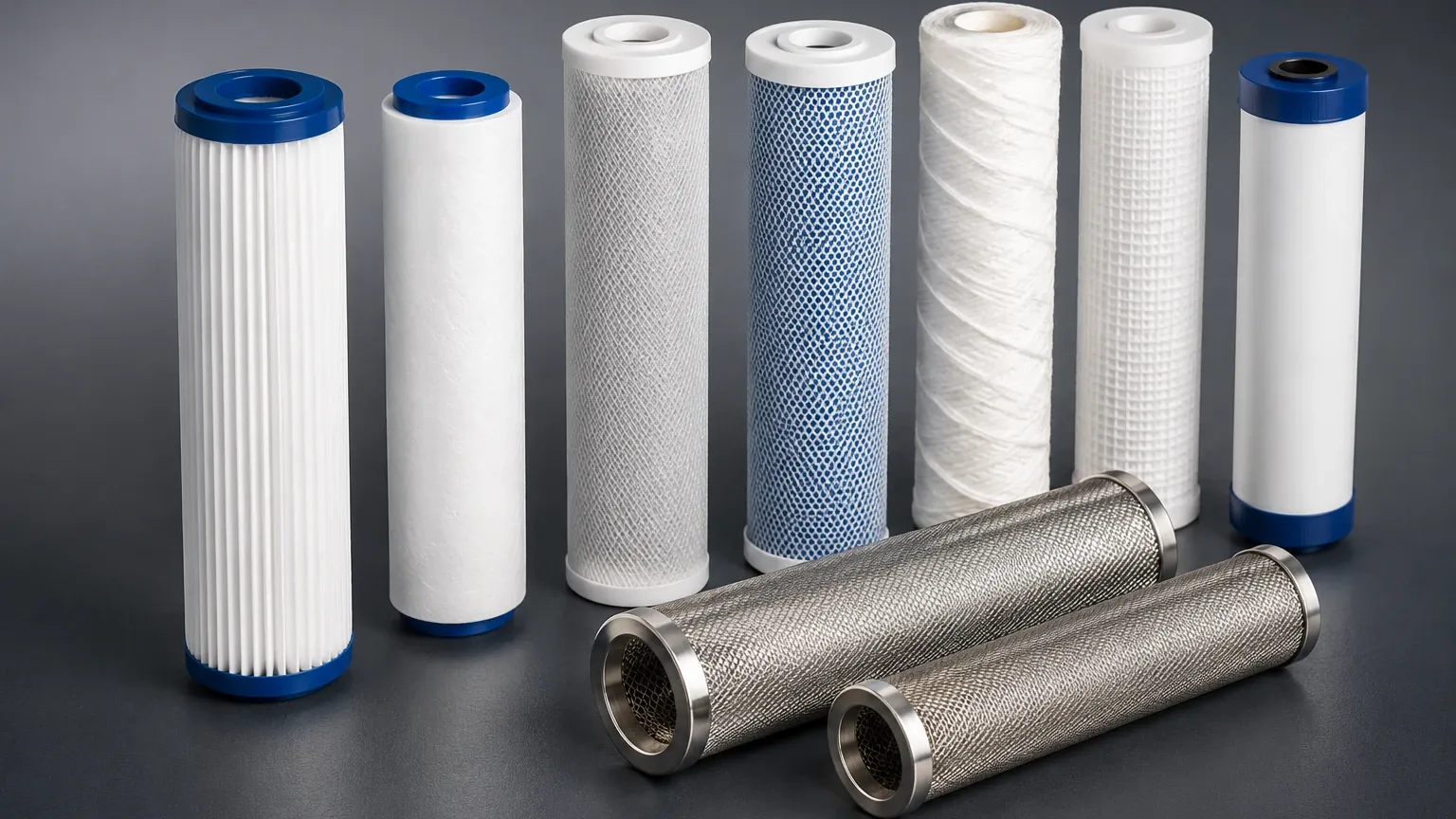
GE water filter cartridges are typically categorized by their filtration mechanism and the specific contaminants they are designed to remove. In an industrial context, three primary technologies dominate the market:
1. Depth Filtration (Melt-Blown and Spun-Bonded)
Depth filters, such as the widely recognized Purtrex or Hytrex lines, utilize a graded density structure. The outer layers trap larger particles, while the inner core captures finer solids. This construction provides a high dirt-holding capacity and a long service life. These are primarily used for sediment removal where the particle size distribution is broad.
2. Surface Filtration (Pleated Media)
Pleated cartridges offer a significantly higher surface area compared to depth filters. This design allows for higher flow rates with lower initial pressure drops. They are ideal for applications requiring precise micron ratings and high-efficiency particle removal, such as the final stages of water purification before sensitive equipment.
3. Adsorption (Carbon Block and Granular Activated Carbon)
For the removal of chlorine, volatile organic compounds (VOCs), and بهبود (improvement) of taste and odor, carbon-based cartridges are essential. In industrial pre-treatment, these protect RO membranes from chlorine degradation, which is vital for maintaining the longevity of expensive membrane elements.
Industrial vs. Commercial Performance Standards
When engineers evaluate ge water filter cartridges for industrial use, they must distinguish between "nominal" and "absolute" micron ratings. Many standard commercial cartridges carry a nominal rating, meaning they will filter out a large percentage of particles at a given size, but not 100%. In contrast, critical industrial processes often require absolute-rated Filter Cartridges to ensure that no particles above a specific threshold pass through the system.
Furthermore, the structural integrity of the cartridge is paramount. In high-pressure systems, a cartridge must resist bypassing—where fluid flows around the filter media rather than through it. This is often managed by the end-cap design, which may include DOE (Double Open End) gaskets or SOE (Single Open End) configurations with O-ring seals (such as 222 or 226 styles) to ensure a leak-proof fit within the housing.
Key Engineering Metrics for Selection
To optimize a filtration system, technical professionals must analyze several performance metrics beyond the simple micron size. These factors directly influence the total cost of ownership (TCO) and system uptime.
Flow Rate and Flux
Flux refers to the flow rate per unit of filter area. Overloading a cartridge by exceeding its recommended flux leads to premature clogging and increased energy costs as pumps work harder to overcome the resistance. Engineers should size the system based on the "clean pressure drop" ($ΔP$) and the "terminal pressure drop," which is the point at which the cartridge must be replaced or cleaned.
Chemical and Thermal Compatibility
Standard polymer cartridges, such as those made from polypropylene or polyester, have definite thermal limits—usually around 60°C to 80°C (140°F to 176°F). If a process involves steam cleaning, hot water sanitization, or exposure to solvents, these materials may soften, lose their pore structure, or leach extractables into the filtrate. In such cases, moving toward stainless steel filtration components is often the only viable engineering path.
Dirt Holding Capacity (DHC)
DHC determines the frequency of maintenance cycles. A filter with a high DHC can operate longer before reaching its terminal pressure drop. This is particularly important in continuous processes where downtime for filter changes results in significant production losses.
When to Transition to Stainless Steel Filter Cartridges
While ge water filter cartridges made of synthetic fibers are cost-effective for many water-based applications, certain industrial environments demand the robustness of metal. As a manufacturer specializing in custom filtration, Kaifil often assists engineers in transitioning from disposable polymer filters to permanent or semi-permanent stainless steel solutions.
High-Temperature Operations
In applications like boiler feed water or chemical processing where temperatures exceed 100°C, stainless steel cartridges maintain their structural integrity and filtration accuracy. Unlike plastic media, they do not suffer from thermal expansion that could alter the micron rating.
Chemical Aggression
For the filtration of caustic cleaning solutions, acids, or industrial solvents, 304 or 316L stainless steel offers superior corrosion resistance. This ensures that the filter itself does not become a source of contamination through material degradation.
Cleanability and Sustainability
One of the primary drawbacks of standard disposable cartridges is the waste generated. Stainless steel wire mesh or sintered metal cartridges can be cleaned via backwashing, ultrasonic cleaning, or chemical baths. This not only reduces the environmental footprint but also lowers the long-term procurement costs for high-volume operations.
Compatibility and Retrofitting in Existing Housings
A common concern for maintenance teams is whether a new cartridge will fit into an existing GE or third-party housing. Most industrial housings are designed around standard lengths (10, 20, 30, or 40 inches) and diameters (typically 2.5 or 4.5 inches for "Big Blue" styles).
When sourcing replacements or upgrades, it is essential to confirm:
1. Length and Diameter: Ensuring the physical dimensions match the housing's internal clearance.
2. End-Cap Configuration: Whether the system requires a flat gasket, a fin, or specific O-ring codes (e.g., Code 7 or Code 3).
3. Seal Material: Selecting the right O-ring material (EPDM, Viton, or Silicone) based on the fluid's chemical profile.
By matching these specifications, engineers can often upgrade their system performance without needing to replace the entire pressure vessel or housing infrastructure.
Total Cost of Ownership (TCO) Analysis
In the B2B sector, the initial purchase price of a filter cartridge is only a fraction of the total cost. A comprehensive TCO analysis should include:
* Replacement Frequency: How often do the ge water filter cartridges need to be changed?
* Labor Costs: The man-hours required for system shutdown, filter replacement, and restart.
* Disposal Costs: Especially relevant if the filters are saturated with hazardous materials.
* Energy Consumption: The cost of pumping fluid through a partially clogged filter versus a clean, high-surface-area alternative.
In many high-demand industrial scenarios, a more expensive, high-efficiency pleated cartridge or a cleanable stainless steel unit provides a much lower TCO over a 24-month period compared to cheap, frequently replaced melt-blown filters.
Conclusion: Making an Informed Procurement Decision
Selecting the appropriate water filter cartridge requires a balance between technical necessity and economic reality. While GE-style polymer cartridges remain the industry standard for general-purpose water treatment and pre-filtration, they are not a universal solution. Engineers must evaluate the specific stressors of their application—temperature, pressure, chemical load, and required purity levels—to determine if a standard disposable unit is sufficient or if a custom-engineered metal solution is required.
For those managing complex industrial processes, consulting with a manufacturer that understands both the standard market offerings and the capabilities of custom metal fabrication is invaluable. Whether you are looking for standard replacements or specialized high-durability components, the goal remains the same: achieving consistent, reliable filtration that protects your downstream equipment and ensures the quality of your final product.
To explore how advanced material selection and custom designs can optimize your specific filtration process, technical teams are encouraged to evaluate their current pressure drop data and maintenance intervals to identify opportunities for system improvement.
