


Industrial Filter Cartridges
In modern industrial processing, the efficiency and reliability of filtration systems are critical to maintaining product quality, protecting downstream equipment, and ensuring operational continuity. Industrial filter cartridges serve as the primary functional component in these systems, tasked with removing contaminants from liquids and gases under varying conditions of pressure, temperature, and chemical exposure. For engineers and procurement professionals, selecting the appropriate Filter Cartridges requires a deep understanding of material science, fluid dynamics, and the specific mechanical requirements of the application.
Unlike standard commercial filters, industrial filter cartridges are engineered to withstand rigorous environments, including high-viscosity fluids, corrosive chemicals, and extreme thermal fluctuations. This guide examines the technical parameters, material considerations, and engineering criteria essential for optimizing filtration performance in industrial settings.
Understanding the Engineering Principles of Filter Cartridges
The performance of a filter cartridge is defined by its ability to capture particles of a specific size while maintaining an acceptable flow rate and pressure drop. To select the right component, it is necessary to distinguish between the two primary mechanisms of filtration: surface filtration and depth filtration.
Surface vs. Depth Filtration
Surface filtration occurs when particles are trapped on the upstream side of the filter medium. This is typical of wire mesh or thin-layer membranes. The advantage of surface filtration is the precision of the pore size and the ease of cleaning through backwashing or ultrasonic methods. Conversely, depth filtration utilizes a thicker medium—such as sintered metal fiber felt—where contaminants are trapped within the tortuous path of the material's internal structure. Depth filtration offers a higher dirt-holding capacity, making it ideal for fluids with a high concentration of fine particles.
Micron Ratings: Absolute vs. Nominal
A common point of confusion in filter selection is the distinction between nominal and absolute micron ratings. A nominal rating is an indicative value, often representing the filter's ability to retain a major percentage (e.g., 60% to 90%) of particles at a given size. An absolute rating, however, implies a retention efficiency of 99.9% or higher. In critical applications such as pharmaceutical processing or fine chemical production, absolute-rated cartridges are mandatory to prevent bypass and ensure consistent output quality.
Material Selection for Demanding Industrial Environments
The choice of material is perhaps the most significant factor in determining the longevity and compatibility of a filter cartridge. Stainless steel is the industry standard for high-performance applications due to its mechanical strength and resistance to degradation.
Stainless Steel 304 vs. 316L
While both materials offer excellent durability, the specific environment dictates the choice. Stainless steel 304 is suitable for general industrial use, providing good corrosion resistance and structural integrity. However, for applications involving chlorides, high acidity, or pharmaceutical-grade requirements, 316L is preferred. The "L" denotes low carbon content, which improves weldability and resistance to intergranular corrosion, while the addition of molybdenum enhances its resistance to pitting in harsh chemical environments.
Specialty Alloys and High-Temperature Resistance
In environments where standard stainless steel may fail—such as highly concentrated acids or extreme temperatures exceeding 500°C—specialty alloys like Hastelloy, Monel, or Inconel may be utilized. These materials maintain their structural properties under thermal stress that would cause polymer-based filters to melt or deform. Metal filter cartridges are inherently fire-resistant and do not off-gas, making them safer for high-temperature gas filtration.
Structural Designs and Their Functional Advantages
The geometry of a filter cartridge significantly impacts its surface area, which in turn affects the flow velocity and the frequency of required maintenance. Industrial designs typically fall into several categories based on the construction of the filter media.
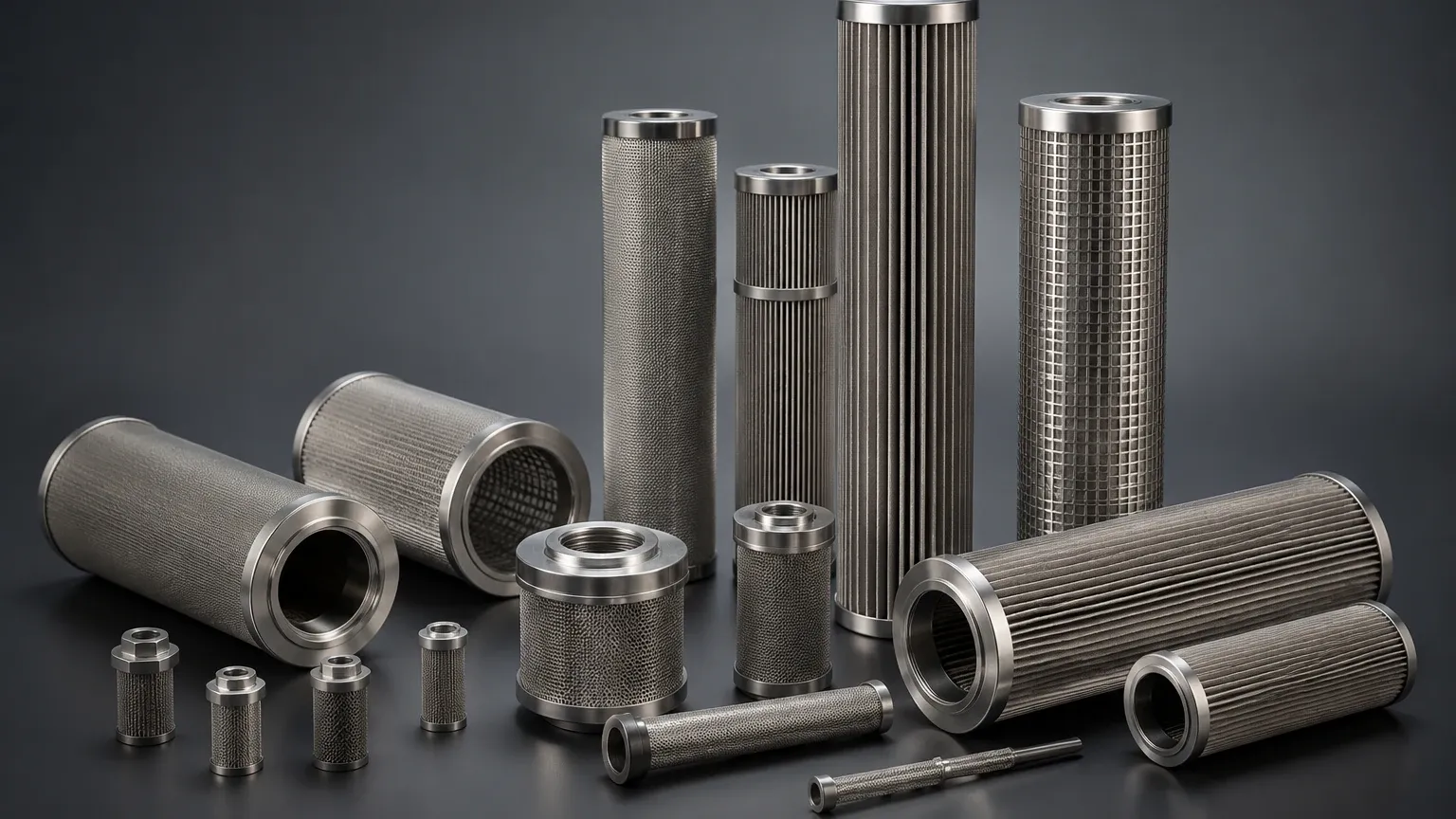
Pleated Metal Filter Cartridges
Pleating the filter media—whether it is sintered mesh or fiber felt—dramatically increases the effective filtration area within the same footprint. This design reduces the "flux" (flow per unit area), which lowers the initial pressure drop and extends the service life of the cartridge. Pleated designs are particularly effective in hydraulic systems and high-flow liquid processing where space is limited but high efficiency is required.
Sintered Wire Mesh and Wedge Wire
Sintered wire mesh consists of multiple layers of woven wire cloth bonded together through a diffusion-bonding process. This creates a robust, integrated structure that does not migrate or shed fibers. For heavy-duty applications involving high-solids loading or abrasive particles, wedge wire (V-wire) cartridges provide exceptional mechanical strength and are highly resistant to clogging, often used in primary water treatment and large-scale industrial intake systems.
Operational Parameters: Pressure, Temperature, and Flow
When specifying industrial filter cartridges, engineers must account for the dynamic forces at play during the filtration cycle. Failure to align cartridge specifications with operational reality can lead to structural collapse or media migration.
Managing Pressure Differential (ΔP)
The pressure differential is the difference between the upstream and downstream pressure. As the filter accumulates contaminants, the ΔP increases. Every cartridge has a maximum allowable differential pressure (collapse pressure). It is vital to monitor this value; typically, cartridges are scheduled for cleaning or replacement when the ΔP reaches a predetermined set point, often between 15 and 25 psi, depending on the housing and pump capabilities.
Thermal Stability and Chemical Compatibility
Unlike plastic or paper filters, stainless steel cartridges do not swell or weaken when exposed to most industrial solvents. However, the seals and gaskets (O-rings) are often the weak point. Engineers must ensure that the seal material—whether Viton, EPDM, PTFE, or Silicone—is compatible with both the process fluid and the operating temperature. For example, while EPDM is excellent for steam applications, it will degrade rapidly if exposed to petroleum-based oils.
Maintenance and Regeneration Strategies
One of the primary advantages of stainless steel industrial filter cartridges is their ability to be cleaned and reused, which offers a significant sustainability and cost advantage over disposable alternatives.
Cleaning Methods for Reusable Cartridges
Depending on the nature of the contaminant, several cleaning protocols can be employed:
* Backwashing: Reversing the flow of fluid to dislodge surface-level particles.
* Ultrasonic Cleaning: Using high-frequency sound waves in a cleaning solvent to remove fine particles embedded deep within sintered media.
* Chemical Cleaning: Utilizing acids, alkalis, or surfactants to dissolve organic or inorganic scaling.
* Thermal Burn-off: Used primarily for polymer removal, where the cartridge is heated in a controlled environment to carbonize organic contaminants.
Properly maintained metal cartridges can undergo dozens of cleaning cycles before their structural integrity or filtration efficiency is compromised, provided that the cleaning process itself does not damage the pore structure.
Economic and Operational Efficiency
While the initial purchase price of stainless steel industrial filter cartridges is higher than that of disposable polypropylene or fiberglass options, the Total Cost of Ownership (TCO) is often lower in the long run.
Total Cost of Ownership (TCO) Considerations
When evaluating costs, procurement teams should consider:
1. Replacement Frequency: Metal cartridges last years, whereas disposables may need replacement weekly or even daily.
2. Disposal Costs: Hazardous waste disposal fees for contaminated disposable filters can be substantial.
3. Downtime: Each filter change-out requires system shutdown. Reducing the frequency of these events increases overall equipment effectiveness (OEE).
4. Product Loss: High-quality metal filters provide more consistent retention, reducing the risk of off-spec batches and wasted raw materials.
Customization and OEM Integration
Every industrial facility has unique requirements based on legacy equipment or proprietary processes. Standard off-the-shelf solutions may not always provide the optimal balance of flow and retention. Customization options for filter cartridges include:
* End-Cap Configurations: Matching specific housing requirements such as Code 7 (226 O-ring with locking tab), Code 3 (222 O-ring), or Double Open End (DOE) with flat gaskets.
* Reinforced Cores: For high-viscosity fluids or high-pressure surges, internal support cores can be thickened to prevent buckling.
* Custom Dimensions: Tailoring the length and diameter to fit non-standard filter vessels.
By working closely with a manufacturer that understands these technical nuances, engineering teams can develop filtration solutions that are precisely tuned to their specific operational constraints. This collaborative approach ensures that the selected Filter Cartridges provide the necessary protection for sensitive downstream components like high-pressure pumps, spray nozzles, and analytical instruments.
In conclusion, the selection of industrial filter cartridges is a technical decision that impacts the safety, efficiency, and profitability of an industrial operation. By focusing on material compatibility, micron accuracy, and the long-term benefits of cleanable metal media, organizations can achieve superior filtration performance while minimizing environmental impact and operational costs.
