


Jug Water Filter Cartridges
In the landscape of point-of-use water treatment, jug water filter cartridges represent one of the most accessible and widely utilized technologies for improving water quality. While often associated with residential use, the underlying principles of these cartridges—adsorption, ion exchange, and mechanical filtration—are foundational to broader industrial filtration processes. For engineers and procurement professionals, understanding the technical specifications and limitations of these small-scale components provides a baseline for evaluating more complex filtration systems used in laboratory, food service, and light industrial applications.
Jug water filter cartridges are designed to operate under gravity-fed conditions, distinguishing them from high-pressure industrial systems. However, the material science involved in their construction and the chemical interactions they facilitate are critical to achieving specific water purity standards. This guide examines the mechanics, material composition, and performance evaluation of these cartridges, while contrasting them with the robust Filter Cartridges required for demanding industrial environments.
Understanding the Mechanics of Jug Water Filter Cartridges
The primary function of jug water filter cartridges is to reduce common tap water contaminants, such as chlorine, heavy metals, and organic compounds that affect taste and odor. Unlike industrial filtration that may utilize pump-driven pressure to force liquid through a dense medium, jug filters rely on the weight of the water to pass through the filtration bed. This necessitates a specific balance between media density and flow rate.
Gravity-Fed Filtration Principles
In a gravity-fed system, the contact time—the duration the water remains in contact with the filtration media—is significantly higher than in pressurized systems. This extended contact time is essential for the chemical processes of adsorption and ion exchange to occur effectively. If the media is packed too tightly, the flow rate becomes impractical for the user; if it is too loose, the water may "channel," bypassing the media and resulting in poor filtration efficiency.
Multi-Stage Filtration Layers
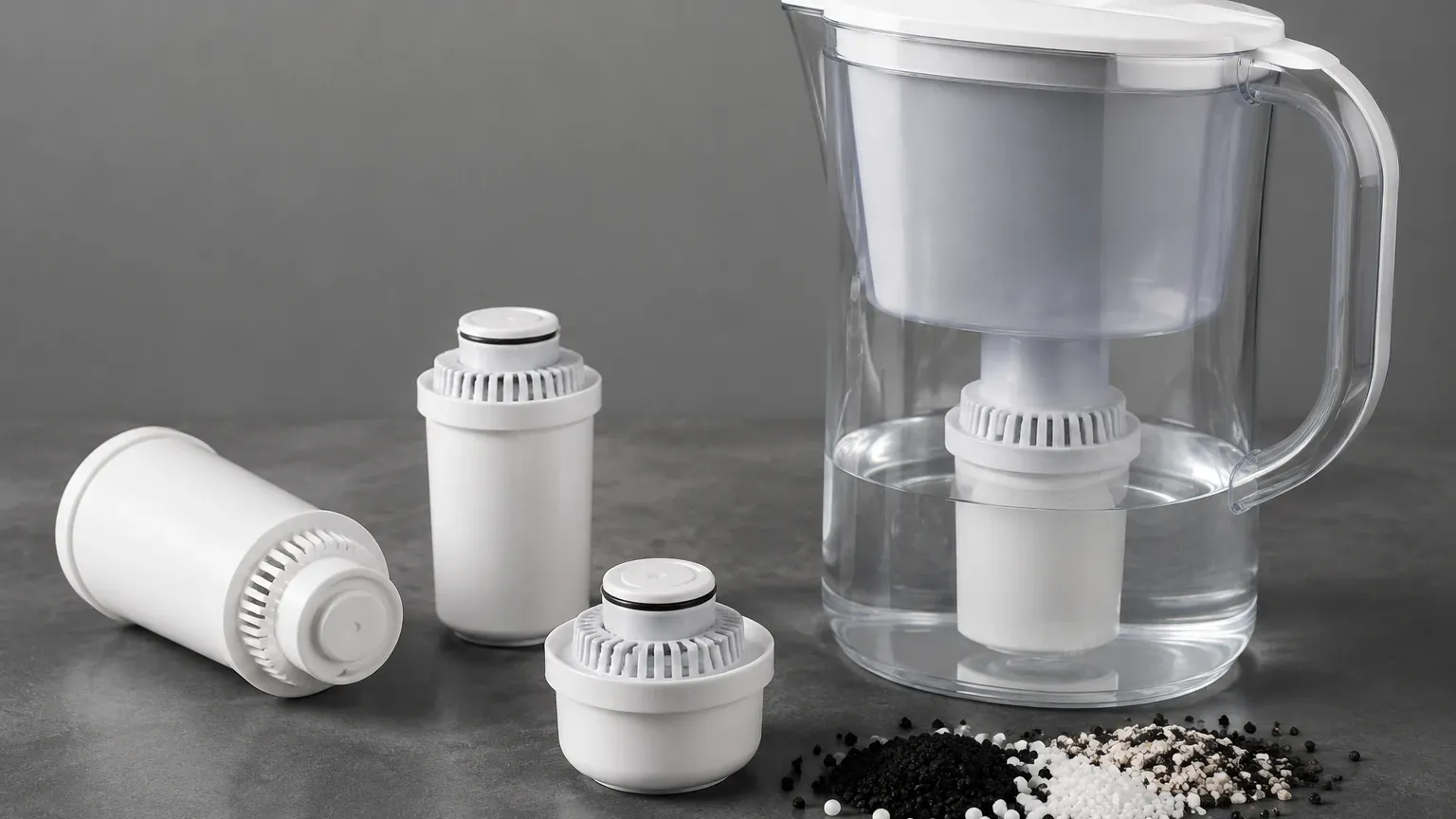
Most modern jug water filter cartridges utilize a multi-stage approach within a single housing:
1. Particle Mesh: A fine mesh (often polyester or stainless steel in high-end versions) at the top and bottom to prevent media migration and trap large sediment.
2. Activated Carbon: Usually derived from coconut shells, this layer adsorbs chlorine and organic pollutants.
3. Ion Exchange Resin: This layer targets dissolved ions, such as lead, copper, and calcium, replacing them with less harmful ions like sodium or hydrogen to soften the water and reduce scale.
Material Science and Filtration Media Efficiency
The effectiveness of jug water filter cartridges is dictated by the quality and surface area of the media used. From an engineering perspective, the porosity and pore size distribution are the most critical metrics.
Activated Carbon Adsorption
Activated carbon is the workhorse of the jug filter. Through the process of activation, carbon develops a vast network of micropores, creating an enormous surface area—often exceeding 1,000 square meters per gram. This surface area allows for the physical and chemical bonding of contaminants. In B2B applications, such as pre-filtration for laboratory equipment, the iodine number of the carbon is often used to measure its adsorption capacity, a metric that can also be applied to evaluate the quality of consumer-grade cartridges.
Ion Exchange Resins
Ion exchange (IX) resins are small, spherical beads that facilitate the exchange of ions between the liquid phase and the solid resin phase. In the context of jug water filter cartridges, these are typically used to reduce carbonate hardness (temporary hardness). The resin contains functional groups that have a higher affinity for multivalent ions like $Ca^{2+}$ and $Mg^{2+}$. As water passes through, these ions are trapped, and an equivalent amount of $H^+$ or $Na^+$ is released. This process is sensitive to the pH of the incoming water and the flow velocity.
Key Performance Indicators for Small-Scale Cartridges
When evaluating jug water filter cartridges for professional or light-commercial use, such as in office breakrooms or small laboratories, several performance indicators must be considered to ensure the output meets the required specifications.
Contaminant Reduction Rates
Standardized testing, such as NSF/ANSI 42 (Aesthetic Effects) and NSF/ANSI 53 (Health Effects), provides a benchmark for performance. Engineers should look for specific reduction percentages for:
* Chlorine: Typically targeted at >90% reduction.
* Heavy Metals: Lead and copper reduction are critical for older infrastructure.
* VOCs: Volatile organic compounds that may be present in trace amounts.
Flow Rate and Throughput
The flow rate of a jug filter is measured in liters per minute (L/min). While low compared to industrial Filter Cartridges, it must remain consistent throughout the cartridge's lifespan. A sudden drop in flow rate often indicates sediment blinding of the outer mesh or the internal carbon fines settling too tightly.
Capacity and Lifespan
The capacity is the total volume of water a cartridge can treat before its media is exhausted. For jug filters, this is usually between 100 and 150 liters. In a B2B context, calculating the "Total Cost of Ownership" (TCO) requires looking at the cost per liter of treated water, which includes the replacement frequency and the initial cost of the cartridge.
Challenges and Risks in Cartridge Maintenance
Despite their simplicity, jug water filter cartridges are subject to several operational risks that can compromise water safety if not managed correctly.
Biofilm Growth and Microbial Proliferation
Because these cartridges are often kept at room temperature and contain organic matter (trapped contaminants), they can become a breeding ground for bacteria. Unlike industrial stainless steel filters that can be steam-sterilized or chemically cleaned, jug filters are disposable. To mitigate microbial growth, many manufacturers incorporate silver-impregnated carbon, which acts as a bacteriostatic agent to inhibit growth within the filter bed.
Media Channeling
Channeling occurs when the water finds a path of least resistance through the media, usually along the walls of the cartridge. When this happens, the water spends very little time in contact with the carbon or resin, drastically reducing filtration efficiency. This is often a result of poor cartridge design or physical shock to the jug that shifts the media.
Saturation and Desorption
Once the adsorption sites on the activated carbon are full, the cartridge is saturated. If used beyond this point, there is a risk of "dumping," where previously trapped contaminants are released back into the water stream at higher concentrations than the influent. This makes strict adherence to replacement cycles mandatory.
From Consumer Jugs to Industrial Filtration Systems
While jug water filter cartridges serve a specific niche, they are often insufficient for industrial processes that require high durability, high flow rates, and precise micron ratings. Professionals in the chemical, pharmaceutical, and food processing industries must transition to more robust solutions.
Material Durability: Plastic vs. Stainless Steel
Consumer cartridges are almost exclusively housed in polypropylene or other food-grade plastics. In contrast, industrial Filter Cartridges are frequently constructed from 304 or 316L stainless steel. Stainless steel offers superior resistance to high temperatures, high pressures, and corrosive chemicals, making it the standard for industrial liquid filtration.
Filtration Precision
Jug filters typically offer nominal filtration, meaning they trap a percentage of particles at a certain size. Industrial applications often require "absolute" filtration, where 99.9% of particles above a specific micron rating are removed. For instance, in hydraulic systems or pharmaceutical manufacturing, a 1-micron or 5-micron absolute-rated stainless steel mesh filter is necessary to protect sensitive equipment and ensure product purity.
Reusability and Sustainability
A significant drawback of standard jug water filter cartridges is their disposable nature, contributing to plastic waste. Industrial stainless steel filters, such as those manufactured by Kaifil, are often cleanable and reusable. Through ultrasonic cleaning or backwashing, these cartridges can be restored to near-original performance, offering a more sustainable and cost-effective long-term solution for high-volume applications.
Selecting the Right Filter Cartridges for Professional Applications
For engineers and purchasing teams, selecting the appropriate filtration component requires a deep dive into the application's specific parameters. Whether you are dealing with small-scale water treatment or large-scale industrial processing, the following criteria are essential:
1. Chemical Compatibility: Ensure the filter media and housing material can withstand the chemicals in the fluid stream. While jug filters are limited to water, industrial cartridges must handle oils, solvents, and acids.
2. Micron Rating: Define the required level of clarity. Are you removing visible sediment or microscopic bacteria? This will determine whether you need a depth filter, a pleated cartridge, or a wire mesh screen.
3. Operating Pressure and Temperature: Jug filters operate at atmospheric pressure. If your system involves pumps, you must select cartridges rated for the maximum system pressure to prevent structural failure.
4. Certification Requirements: For food and beverage or pharmaceutical use, ensure the cartridges meet FDA or CE standards for food contact materials.
By understanding the technical nuances of jug water filter cartridges, professionals can better appreciate the engineering required for more advanced filtration tasks. While the jug filter is a marvel of consumer convenience, industrial-grade Filter Cartridges provide the precision and reliability needed for the world's most demanding manufacturing environments. Whether you require custom dimensions, specific alloy constructions, or high-precision filtration ratings, choosing a manufacturer with deep technical expertise is the key to optimizing your filtration performance.
