


Jacuzzi Filter Cartridges
In the realm of commercial hydrotherapy, industrial water treatment, and high-capacity spa systems, the efficiency of filtration components is paramount. While often associated with residential leisure, the engineering behind jacuzzi filter cartridges involves complex fluid dynamics and material science. For engineers and facility managers, selecting the appropriate filtration media is not merely a maintenance task but a critical decision affecting water chemistry, pump longevity, and operational safety.
Industrial-grade filtration systems require components that can withstand continuous flow, chemical exposure, and varying thermal loads. Understanding the technical nuances of these cartridges ensures that water quality meets stringent health standards while minimizing the total cost of ownership through optimized replacement cycles and energy efficiency.
Understanding the Role of Filter Cartridges in High-Use Water Systems
Filter cartridges serve as the primary mechanical barrier against particulate matter in recirculating water systems. In a commercial or industrial jacuzzi setting, the filtration demand is significantly higher than in residential applications due to increased bather load, higher temperatures, and the constant introduction of organic contaminants and minerals.
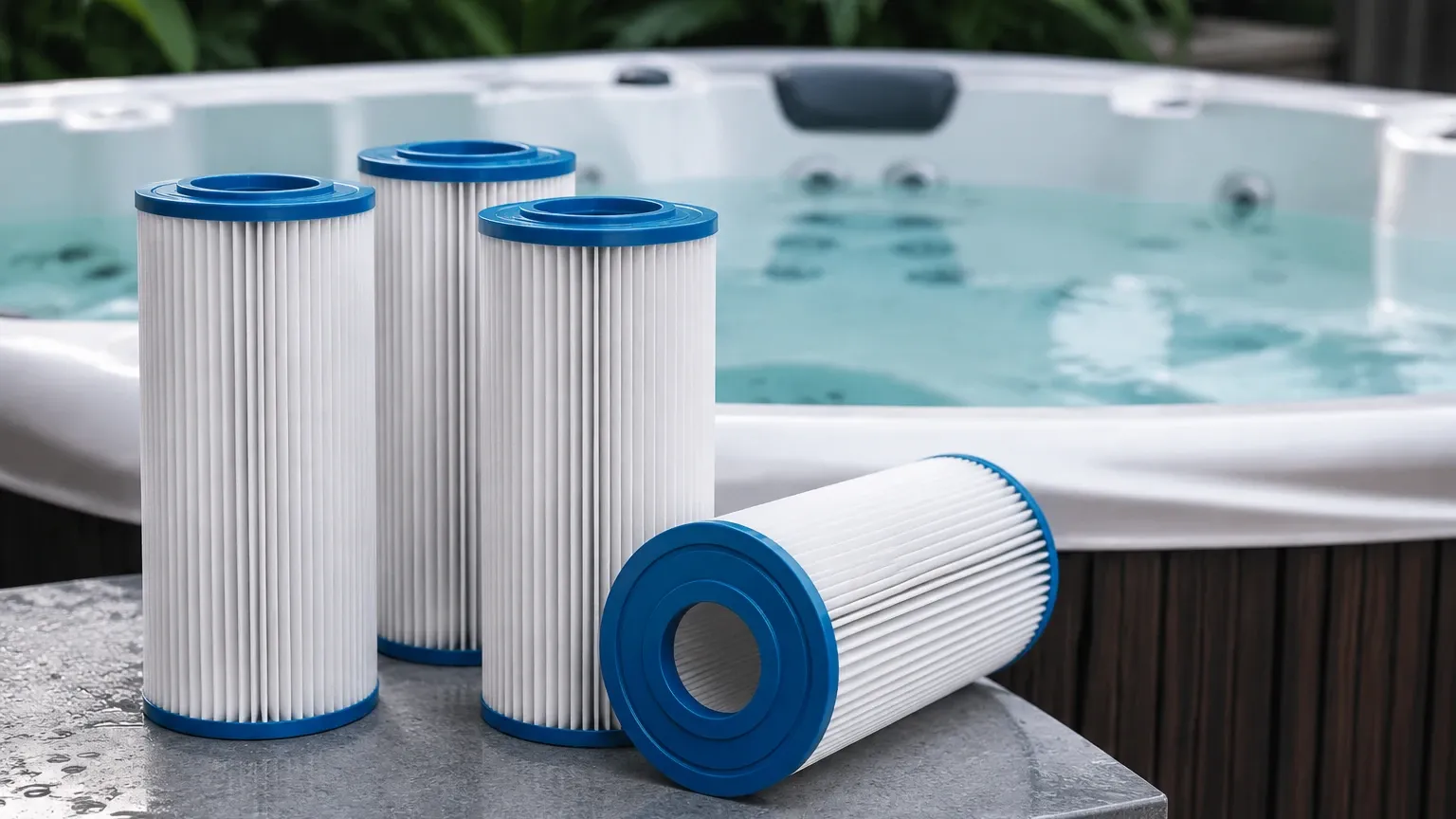
The filtration process typically relies on surface or depth filtration. Most Filter Cartridges utilize a pleated design to maximize the available surface area within a compact footprint. This design allows for a lower face velocity—the speed at which water passes through the media—which enhances the capture of fine particles and reduces the rate of pressure increase across the filter. For technical professionals, the goal is to balance filtration fineness (measured in microns) with the hydraulic requirements of the circulation pump to prevent cavitation or excessive energy consumption.
Key Evaluation Criteria for Industrial-Grade Cartridge Selection
When specifying jacuzzi filter cartridges for large-scale applications, several engineering parameters must be evaluated beyond simple dimensions.
Micron Rating and Filtration Accuracy
Filtration accuracy is defined by the micron rating, which indicates the size of particles the media can effectively trap. For most spa applications, a nominal rating of 10 to 20 microns is standard. However, in specialized medical or high-purity industrial environments, absolute-rated cartridges may be required. It is essential to distinguish between nominal ratings (an estimate of particles retained) and absolute ratings (a laboratory-verified efficiency, often 99.9%).
Effective Filtration Area (EFA)
The EFA is determined by the number of pleats, the depth of each pleat, and the total length of the cartridge. A common misconception is that more pleats always result in better filtration. In reality, if pleats are packed too tightly (over-pleating), the water cannot access the full surface area, leading to "bridging" where debris clogs the outer edges of the pleats prematurely. Engineers must look for cartridges with consistent pleat spacing and robust support cores that maintain geometry under high flow rates.
End Cap Configuration and Sealing
The integrity of the seal between the cartridge and the filter housing is a frequent point of failure. Common configurations include Double Open End (DOE) or Single Open End (SOE) with various O-ring or gasket interfaces. For industrial systems, a high-quality polyurethane or plastisol end cap is preferred for its chemical resistance and ability to provide a leak-proof seal, preventing "bypass"—the phenomenon where unfiltered water escapes around the edges of the cartridge.
Material Engineering: Synthetic Fabrics vs. Metal Mesh Solutions
The material composition of the filter media dictates its compatibility with sanitizing chemicals and its physical durability.
1. Polyester (Reemay): The industry standard for most jacuzzi filter cartridges. It offers a good balance of durability and filtration efficiency. It is resistant to most pool chemicals but can degrade over time when exposed to high levels of ozone or extreme pH fluctuations.
2. Cellulose: Often used in disposable applications, though less common in high-end industrial systems due to its tendency to break down when saturated for long periods.
3. Stainless Steel Wire Mesh: In demanding industrial filtration scenarios, stainless steel cartridges (such as those manufactured by Kaifil) provide a superior alternative. While the initial cost is higher, stainless steel filters are cleanable, reusable, and virtually immune to chemical degradation and high temperatures. For facilities looking to reduce waste and ensure long-term structural integrity, transitioning to precision metal filtration components is a strategic engineering move.
Performance Metrics and Flow Dynamics
The performance of a filtration system is largely governed by the relationship between flow rate and pressure drop ($\Delta P$). As the filter captures debris, the resistance to flow increases, leading to a rise in the system's pressure.
Engineers must monitor the "clean pressure drop"—the resistance measured when a new cartridge is installed. A high initial $\Delta P$ suggests that the filter media may be too restrictive for the pump's capacity, which can lead to reduced turnover rates and poor water quality. Conversely, a sudden drop in pressure often indicates a ruptured cartridge or a seal failure, allowing water to bypass the media entirely.
For optimal performance, the system should be designed so that the maximum flow rate does not exceed the manufacturer’s recommended gallons per minute (GPM) per square foot of media. Exceeding these limits can force contaminants through the media (breakthrough) or cause the cartridge core to collapse.
Common Risks and Operational Failures in Filtration Systems
Identifying potential failure modes is essential for maintaining a reliable filtration circuit. In the context of jacuzzi filter cartridges, several risks are prevalent:
* Core Collapse: Under high-pressure differentials, the internal plastic core of a low-quality cartridge may buckle. This usually happens when the filter is heavily fouled and the pump continues to operate. Industrial-grade cartridges often feature reinforced polypropylene or stainless steel cores to prevent this.
* Biofilm Accumulation: Because jacuzzis operate at elevated temperatures, they are breeding grounds for biofilms. If the filter media is not treated with antimicrobial agents or cleaned regularly, bacteria can colonize the pleats, creating a slimy barrier that is difficult to remove and poses a health risk.
* Chemical Embrittlement: Continuous exposure to high concentrations of chlorine or bromine can make plastic components and synthetic fibers brittle. This leads to cracking in the end caps or tearing of the fabric, necessitating premature replacement.
* Bypass via Compression Set: Over time, gaskets and O-rings can lose their elasticity (compression set), especially in hot water. This results in a poor seal, allowing unfiltered water to return to the pool.
Total Cost of Ownership (TCO) and Maintenance Cycles
For purchasing teams, the unit price of a filter cartridge is only one component of the TCO. A comprehensive analysis must include:
* Cleaning Labor: The time required for staff to remove, chemically soak, and rinse cartridges.
* Water and Chemical Loss: The amount of treated water lost during the cleaning or replacement process.
* Energy Consumption: The additional electricity required to push water through a partially fouled filter.
* Replacement Frequency: Higher-quality Filter Cartridges may last 12-24 months in a commercial setting, whereas budget options may fail within months.
Implementing a scheduled maintenance program based on pressure differential (typically cleaning when the pressure rises 8-10 PSI above the clean starting pressure) is the most effective way to extend the life of the media and ensure consistent water clarity.
Customization and OEM Solutions for Specialized Equipment
Many industrial and commercial spa manufacturers utilize proprietary filter housing designs that require specific cartridge dimensions or mounting hardware. In these instances, off-the-shelf consumer products are often inadequate.
Customization options provided by manufacturers like Kaifil allow engineers to specify precise lengths, diameters, and end-cap geometries. Furthermore, for applications involving corrosive chemicals or extreme temperatures, the ability to manufacture cartridges using specialized materials like 316L stainless steel or specific synthetic polymers ensures that the filtration system is perfectly matched to the operational environment.
When sourcing custom solutions, technical teams should provide detailed specifications, including:
* Fluid Properties: Temperature, pH, and chemical composition.
* Contaminant Profile: Type of solids being removed and expected loading.
* Mechanical Constraints: Maximum allowable pressure drop and housing dimensions.
By focusing on these technical parameters, procurement professionals can move beyond generic replacements and invest in filtration solutions that enhance system reliability and performance.
