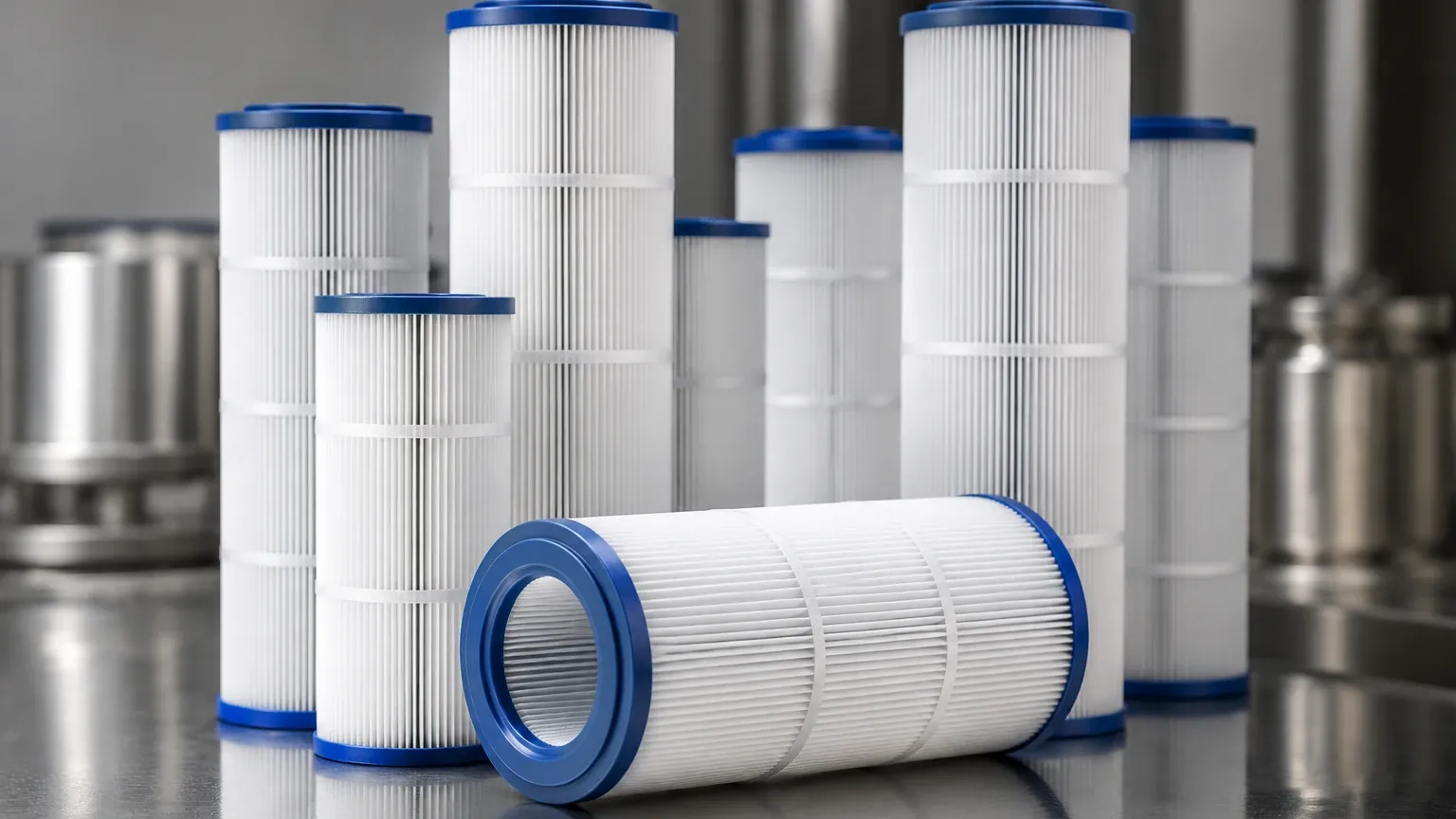
Leslie Pool Filter Cartridges
In the realm of commercial water management and light industrial cooling loops, the efficiency of a filtration system is often dictated by the quality and specification of the media used. Leslie pool filter cartridges represent a widely utilized standard for high-flow, low-pressure water treatment. For facility engineers and procurement professionals, understanding the technical nuances of these cartridges—ranging from material composition to hydraulic performance—is essential for maintaining water clarity and system longevity. While these cartridges are common in recreational water applications, their design principles provide a foundation for understanding broader industrial Filter Cartridges used in more demanding environments.
The Engineering Behind Cartridge Filtration
Cartridge filtration is a mechanical process designed to remove suspended solids from a liquid stream. Unlike sand or DE (diatomaceous earth) filters, which utilize a deep bed of media, cartridge filters rely on surface or near-surface filtration. Leslie-compatible cartridges typically utilize a pleated design to maximize the available surface area within a compact cylindrical footprint.
The primary advantage of this design is the high surface-area-to-volume ratio. By increasing the square footage of the filtration media, the system can achieve lower face velocities. This reduction in velocity allows for finer particle capture and prevents the "driving" of contaminants through the media pores, which is a common failure mode in undersized systems. From a B2B perspective, selecting the correct cartridge involves more than matching dimensions; it requires an analysis of the specific gravity of the contaminants, the required micron rating, and the anticipated flow rates.
Material Science: Spun-Bond Polyester vs. Industrial Media
The vast majority of Leslie pool filter cartridges are manufactured using spun-bond polyester, often referred to by the trade name Reemay. This material is chosen for its chemical resistance to chlorine and other sanitizers, as well as its structural integrity when wet. The fibers are thermally bonded, creating a fixed-pore structure that resists unloading under pressure surges.
However, in industrial applications where temperatures exceed standard ambient ranges or where aggressive chemicals are present, polyester may reach its limit. In such cases, engineers often look toward stainless steel Filter Cartridges which offer superior thermal stability and the ability to be cleaned and reused multiple times. While polyester cartridges are generally considered semi-disposable, the transition to metal mesh or sintered metal media is a common upgrade path for industrial processes that require higher durability and precise filtration accuracy.
Key Evaluation Criteria for Replacement Cartridges
When sourcing replacement cartridges for large-scale facilities, several technical specifications must be verified to ensure compatibility and performance.
1. Square Footage and Pleat Count
Total filtration area is the most critical metric. A higher pleat count generally indicates more surface area, but there is a point of diminishing returns. If pleats are packed too tightly, the "bridge" between them can become clogged quickly, effectively reducing the usable area and increasing the pressure drop. Professional-grade cartridges maintain consistent pleat spacing through the use of external bands or specialized center cores.
2. Micron Rating and Efficiency
Standard pool cartridges typically offer a nominal micron rating between 10 and 20 microns. It is important to distinguish between "nominal" and "absolute" ratings. A nominal rating suggests the filter will capture a majority of particles at that size, whereas an absolute rating (more common in industrial stainless steel filters) guarantees capture efficiency. For high-traffic commercial pools or industrial pre-filtration, maintaining a consistent micron rating is vital to protecting downstream components like heat exchangers or UV sterilizers.
3. Structural Integrity (The Center Core)
Under the stress of a high-head pump, a poorly constructed cartridge can collapse. Quality Leslie-style cartridges feature a reinforced PVC or copolymer center core. In industrial settings where pressure differentials are higher, these cores may be replaced with perforated stainless steel to prevent deformation. The integrity of the end caps—the parts that seal the cartridge against the housing—is also paramount. Any bypass at the end cap renders the entire filtration process moot.
Hydraulic Performance and Pressure Drop
For any engineer, the relationship between flow rate and pressure drop ($ΔP$) is a primary concern. Every filter media introduces a degree of resistance to the flow. As the cartridge collects debris, the effective pore size decreases, and the $ΔP$ increases.
Monitoring the pressure gauge is the standard method for determining the cleaning cycle. Typically, a cartridge should be cleaned or replaced when the pressure rises 8-10 PSI above the "clean" starting pressure. Operating beyond this point not only reduces the flow rate (potentially affecting chemical distribution and turnover rates) but also places undue stress on the pump motor, leading to increased energy consumption and premature mechanical failure. For facilities focused on sustainability and total cost of ownership (TCO), maintaining clean Filter Cartridges is a simple yet effective way to optimize energy use.
Maintenance Cycles and Cleaning Protocols
Unlike backwashable media filters, cartridge filters require manual cleaning. This process involves removing the element and washing away the accumulated debris. However, simple rinsing is often insufficient for removing oils, scales, and biofilms.
* Degreasing: In high-load environments, body oils and lotions can coat the polyester fibers, creating a waterproof barrier that drastically increases pressure. Specialized degreasing agents are required to break down these organic loads.
* Acid Washing: If the water chemistry is not perfectly balanced, calcium scale can form within the pleats. A mild acid soak can dissolve these deposits. It is critical to degrease *before* acid washing, as the acid can set the oils into the fabric, permanently blinding the filter.
* Replacement Indicators: Eventually, the fibers of the polyester media will stretch and lose their ability to capture fine particles. If the time between cleaning cycles shortens significantly despite thorough cleaning, or if the water fails to clear after a cycle, the media has reached the end of its functional life.
Transitioning to Industrial Filtration Solutions
While Leslie pool filter cartridges are excellent for their intended use, certain industrial or heavy-duty commercial applications demand a more robust solution. Many facilities that start with standard pool-grade filtration eventually move toward custom-engineered metal filtration systems.
Stainless steel wire mesh filters offer several advantages in B2B environments:
* High Temperature Resistance: Unlike polyester, stainless steel can withstand boiling temperatures and steam cleaning.
* Chemical Compatibility: Metal filters are suitable for a wider range of pH levels and solvent exposures.
* Backwashability: Many industrial metal Filter Cartridges are designed for automated backwashing, reducing the labor costs associated with manual cleaning.
* Precision Engineering: For applications requiring exact particle size exclusion (e.g., pharmaceutical or food processing), the fixed-pore geometry of a metal mesh is superior to the random fiber orientation of spun-bond media.
Conclusion for Purchasing Teams
Selecting the right filtration component requires a balance of initial cost, operational efficiency, and maintenance requirements. For standard water treatment, Leslie-compatible cartridges provide a reliable and cost-effective solution. However, it is the responsibility of the technical team to ensure that the selected cartridge meets the specific hydraulic and chemical demands of the system.
When evaluating suppliers, engineers should confirm dimensions (outer diameter, inner diameter, and length), media weight (typically measured in ounces per square yard), and the material of the end caps. By focusing on these factual parameters rather than marketing claims, procurement professionals can ensure they are receiving a product that will maintain water quality and protect the facility's infrastructure. For those managing more complex industrial processes, exploring the capabilities of specialized Filter Cartridges may provide the durability and precision necessary for optimized performance.