


Vyair Water Filter Cartridges
In the landscape of industrial and commercial water treatment, the selection of appropriate filtration media is a critical engineering decision that impacts equipment longevity, process efficiency, and end-product quality. Vyair water filter cartridges have become a recognizable name in the market, particularly for applications involving reverse osmosis (RO) systems, sediment removal, and chemical adsorption. For procurement managers and system engineers, understanding the technical specifications, material compatibility, and performance boundaries of these components is essential for maintaining operational uptime.
This article provides a technical overview of water filtration cartridges, focusing on the specifications common to the Vyair range while contrasting these with industrial-grade alternatives required for more demanding environments.
The Role of Water Filter Cartridges in Industrial Systems
Water filtration is rarely a single-stage process. In most industrial configurations, filter cartridges serve as either pre-filtration stages to protect sensitive membranes or as final polishing stages to ensure specific purity levels. Vyair water filter cartridges are frequently utilized in light industrial, laboratory, and commercial settings where standard sizing and ease of replacement are prioritized.
Standardized cartridges typically follow industry-standard dimensions, such as 10-inch and 20-inch lengths with Slimline (2.5-inch) or Big Blue (4.5-inch) diameters. This standardization allows engineers to integrate these filters into a wide variety of housing units. However, the efficacy of the filtration system depends less on the brand and more on the specific media type and the micron rating selected for the fluid dynamics of the system.
Technical Classifications of Vyair Water Filter Cartridges
To make an informed selection, it is necessary to categorize cartridges based on their primary filtration mechanism. Vyair offers several types of media, each designed to address specific contaminants:
1. Sediment and Particulate Filtration
Sediment filters are designed to remove physical particles such as sand, silt, rust, and scale. These are typically constructed from polypropylene (PP) using a melt-blown or string-wound process. Melt-blown cartridges often feature a graded density structure, where the outer layers catch larger particles and the inner core captures finer debris. This design maximizes the dirt-holding capacity and extends the service life of the cartridge.
2. Carbon Block and Granular Activated Carbon (GAC)
For the removal of chlorine, volatile organic compounds (VOCs), and unpleasant tastes or odors, carbon-based cartridges are utilized. Carbon block filters are manufactured by extruding or compression-molding activated carbon into a solid cylinder. This provides a large surface area for chemical adsorption. In contrast, GAC cartridges contain loose carbon granules, which allow for higher flow rates but may be more susceptible to "channeling," where water finds a path of least resistance and bypasses the media.
3. Specialized Resin and Ceramic Filters
Beyond standard sediment and carbon, specialized cartridges are available for deionization (DI), scale inhibition (using polyphosphate), or ultra-fine ceramic filtration. Ceramic filters are particularly valued for their ability to be cleaned and reused, as well as their high effectiveness against bacterial contaminants.
Engineering Criteria for Filter Selection
When evaluating vyair water filter cartridges or any comparable filtration component, engineers must look beyond the brand name and focus on the following performance metrics:
Micron Rating: Absolute vs. Nominal
A critical distinction in filtration is the difference between nominal and absolute micron ratings. A nominal rating indicates that the filter will trap a large percentage of particles of a given size (e.g., 85% of 5-micron particles). An absolute rating implies that 99.9% or more of particles at that size are retained. For critical pharmaceutical or chemical processes, absolute-rated Filter Cartridges are often required to ensure consistency.
Flow Rate and Differential Pressure
Every filter cartridge introduces a pressure drop (ΔP) into the system. As the filter accumulates contaminants, the differential pressure increases. Engineers must calculate the initial clean pressure drop to ensure the pump system can maintain the required flow rate. Over-specifying a filter (choosing a 1-micron filter when 20 microns would suffice) can lead to premature clogging and excessive energy consumption due to high pressure requirements.
Chemical and Thermal Compatibility
Standard polypropylene or carbon cartridges have limitations regarding temperature and chemical exposure. In environments involving high-temperature steam sterilization, aggressive solvents, or high-pressure hydraulic fluids, polymer-based cartridges may fail. In such instances, transitioning from standard commercial cartridges to industrial stainless steel filtration components is necessary.
Comparing Polymer and Stainless Steel Filter Cartridges
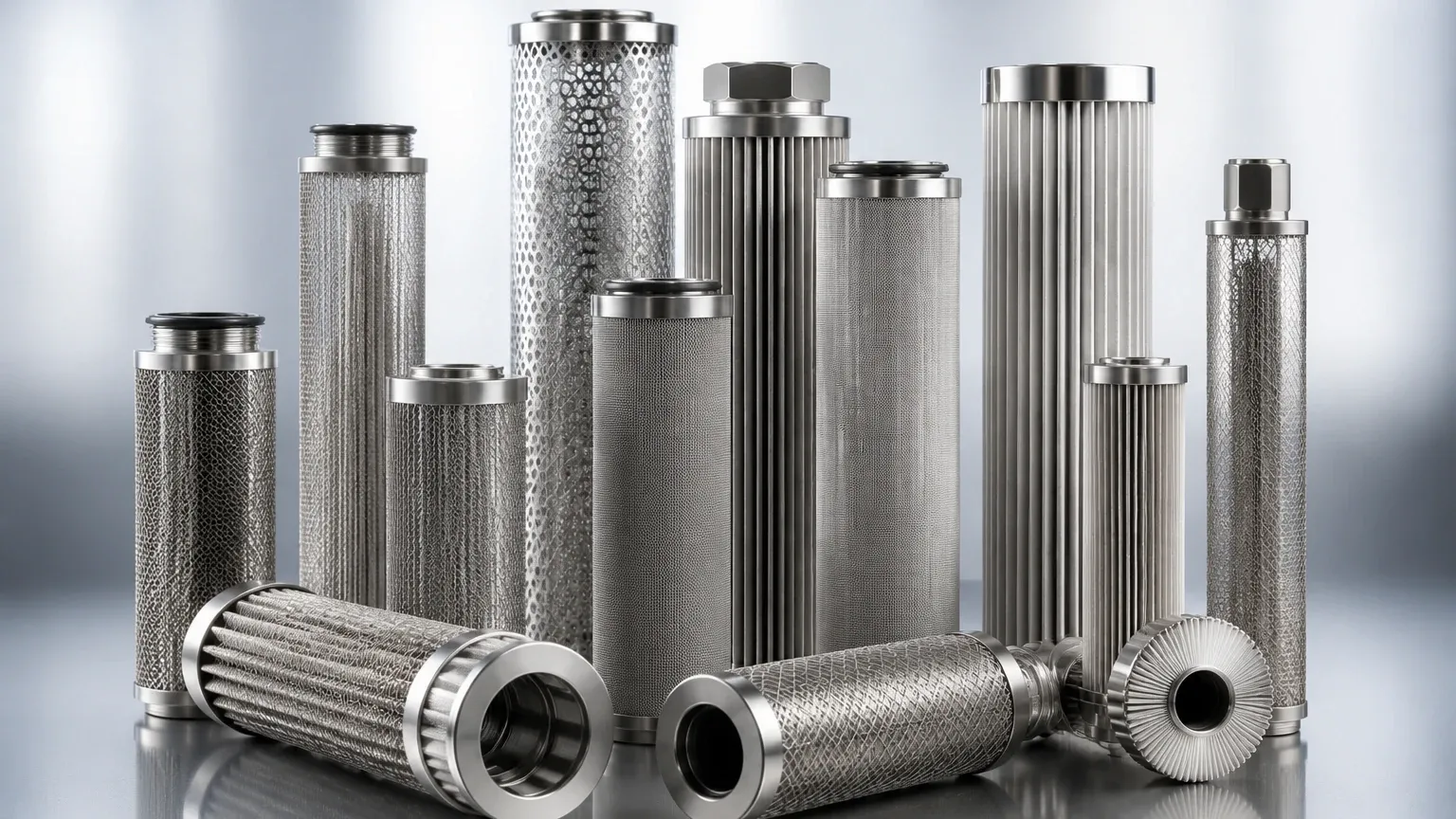
While Vyair water filter cartridges are excellent for standard water treatment, certain industrial applications demand the durability of metal. At Kaifil, we specialize in the manufacturing of stainless steel filtration solutions that address the limitations of disposable polymer filters.
| Feature | Polypropylene/Carbon Cartridges | Stainless Steel Filter Cartridges |
| :— | :— | :— |
| Temperature Resistance | Typically limited to < 60°C | Up to 500°C+ (depending on alloy) |
| Pressure Capability | Moderate; prone to deformation | High; resistant to pressure surges |
| Chemical Resistance | Limited to specific acids/bases | Broad resistance (304, 316L, Hastelloy) |
| Reusability | Disposable | Cleanable and reusable |
| Filtration Accuracy | 0.5 to 100+ microns | 1 to 200+ microns (precise mesh) |
For engineers managing high-viscosity fluids or high-temperature processes, the total cost of ownership (TCO) often favors stainless steel. While the initial investment is higher than a standard disposable cartridge, the ability to clean the media via backwashing or ultrasonic cleaning significantly reduces long-term waste and replacement costs.
Operational Maintenance and Replacement Cycles
The service life of vyair water filter cartridges is highly dependent on the influent water quality. In municipal water applications, a carbon block may last six months, whereas, in a high-silt industrial well-water application, a sediment filter might clog in weeks.
Monitoring Performance
Industrial systems should be equipped with pressure gauges before and after the filter housing. A common rule of thumb is to replace or clean the cartridge when the differential pressure reaches 10-15 psi over the initial clean pressure. Waiting beyond this point can result in "bypass," where the pressure forces contaminants through the media or causes the cartridge structure to collapse.
Storage and Handling
Cartridges should be stored in a cool, dry environment in their original packaging to prevent contamination. For carbon filters, exposure to air can lead to the adsorption of ambient odors, reducing their effective capacity before they are even installed.
Customization and OEM Solutions in Filtration
Many technical professionals find that off-the-shelf vyair water filter cartridges do not meet the specific geometric or performance requirements of custom-built machinery. This is where OEM (Original Equipment Manufacturer) capabilities become vital. Customization options typically include:
* Non-standard Dimensions: Custom lengths and diameters to fit proprietary housings.
* End-Cap Configurations: Options such as Code 7 (226 O-rings/fin), Code 3 (222 O-rings/flat), or Double Open End (DOE) with specialized gaskets (EPDM, Viton, Silicone).
* Reinforced Cores: Adding internal stainless steel supports to prevent collapse in high-viscosity or high-pressure applications.
By working with a manufacturer like Kaifil, engineering teams can develop bespoke filtration components that integrate seamlessly into their systems while ensuring the precise filtration accuracy required for their specific process.
Common Risks in Cartridge Procurement
When sourcing water filter cartridges, there are several risks that can lead to system failure or increased operational costs:
1. Media Migration: In low-quality carbon or fiber filters, bits of the filter media itself can break off and enter the downstream flow. This is unacceptable in food, beverage, and pharmaceutical applications.
2. Seal Failure: If the gasket or O-ring material is not compatible with the fluid, it may swell or degrade, leading to bypass. Always verify the elastomer type (e.g., Buna-N vs. PTFE).
3. Inaccurate Micron Ratings: Some budget-friendly cartridges use "nominal" ratings that are poorly defined. For critical applications, always request technical data sheets or third-party validation of filtration efficiency.
Conclusion: Selecting the Right Filtration Path
Vyair water filter cartridges provide a reliable solution for many standard water treatment needs, offering a balance of affordability and performance for commercial and light industrial use. However, for engineers operating in demanding industrial environments—where high temperatures, corrosive chemicals, and extreme pressures are the norm—standard polymer cartridges may not suffice.
Achieving optimal filtration performance requires a deep understanding of the fluid characteristics and the mechanical stresses involved. Whether you are looking for standard replacements or specialized, high-performance Filter Cartridges, the priority should always be on technical compatibility and long-term reliability. By evaluating the specific needs of your application against the material properties of the filter, you can ensure a cost-effective and efficient filtration process that protects your equipment and ensures the quality of your output.
