


20mm Synthetic Filter Discs
In industrial and laboratory filtration, the selection of small-format media requires a precise balance of chemical resistance, mechanical strength, and filtration efficiency. The 20mm synthetic filter disc is a standardized size frequently utilized in specialized venting, small-scale chemical processing, and medical device manufacturing. While often viewed as a simple component, the engineering specifications behind these discs—ranging from polymer selection to pore structure—determine the reliability of the entire filtration system.
For engineers and procurement professionals, understanding the technical nuances of Filter Discs & Packs is essential for ensuring process uptime and product purity. This guide examines the technical properties, application environments, and selection criteria for 20mm synthetic filtration media.
Material Science: Choosing the Right Polymer
The performance of a 20mm synthetic filter disc is primarily dictated by its base polymer. Unlike stainless steel mesh, synthetic membranes offer specific chemical affinities and hydrophobicity levels that are critical for volatile or high-purity fluids.
Polytetrafluoroethylene (PTFE)
PTFE is the industry standard for aggressive chemical environments. It is naturally hydrophobic, making it an excellent choice for air venting and gas filtration where moisture must be excluded. In its hydrophilic form, it is used for aqueous solutions and organic solvents. PTFE discs can withstand high temperatures (up to 260°C) and exhibit near-universal chemical compatibility.
Polyvinylidene Fluoride (PVDF)
PVDF is favored in the pharmaceutical and food industries due to its low protein-binding characteristics. It offers high mechanical strength and resistance to abrasion, which is vital when the 20mm disc is subjected to high-pressure pulses within a housing.
Nylon (Polyamide)
Nylon filter discs are naturally hydrophilic and are commonly used for filtering aqueous and organic solvent mixtures. However, engineers must be cautious with Nylon in acidic environments, as it is susceptible to hydrolysis. It is often selected for its high dirt-holding capacity and cost-effectiveness in general-purpose industrial filtration.
Polyethersulfone (PES)
PES is characterized by its high flow rates and low extractables. In a 20mm format, PES discs are frequently used in sterile filtration applications where rapid throughput is required without compromising the integrity of the filtrate.
Engineering Considerations for 20mm Form Factors
When specifying a 20mm synthetic filter disc, the physical dimensions are only the starting point. Engineers must evaluate how the disc interacts with the fluid dynamics of the system.
Effective Filtration Area (EFA)
While the nominal diameter is 20mm, the Effective Filtration Area is typically smaller due to the sealing requirements of the filter holder or housing. If a 2mm rim is required for a gasket or ultrasonic weld, the actual filtration diameter reduces to 16mm. This reduction significantly impacts the flow rate and pressure drop calculations. Engineers should always calculate the EFA to ensure the disc can handle the intended flux.
Pore Size and Distribution
Synthetic discs are available in precise micron ratings, often ranging from 0.02μm to 10μm. Unlike woven wire mesh, which has a geometric pore structure, synthetic membranes often have a tortuous path structure. This provides depth filtration characteristics, allowing the disc to trap particles smaller than the nominal pore size through adsorption and entrapment.
Pressure Differential (ΔP)
Small-diameter discs are more susceptible to high pressure differentials. As the surface area is limited, the accumulation of solids can lead to a rapid increase in ΔP. It is critical to select a media thickness and support structure that can withstand the maximum system pressure without rupturing or deforming (media migration).
Integration and Structural Support
In many industrial applications, a standalone synthetic disc lacks the structural integrity to withstand high-pressure flow. This is where the integration into Filter Discs & Packs becomes necessary.
Multi-Layer Configurations
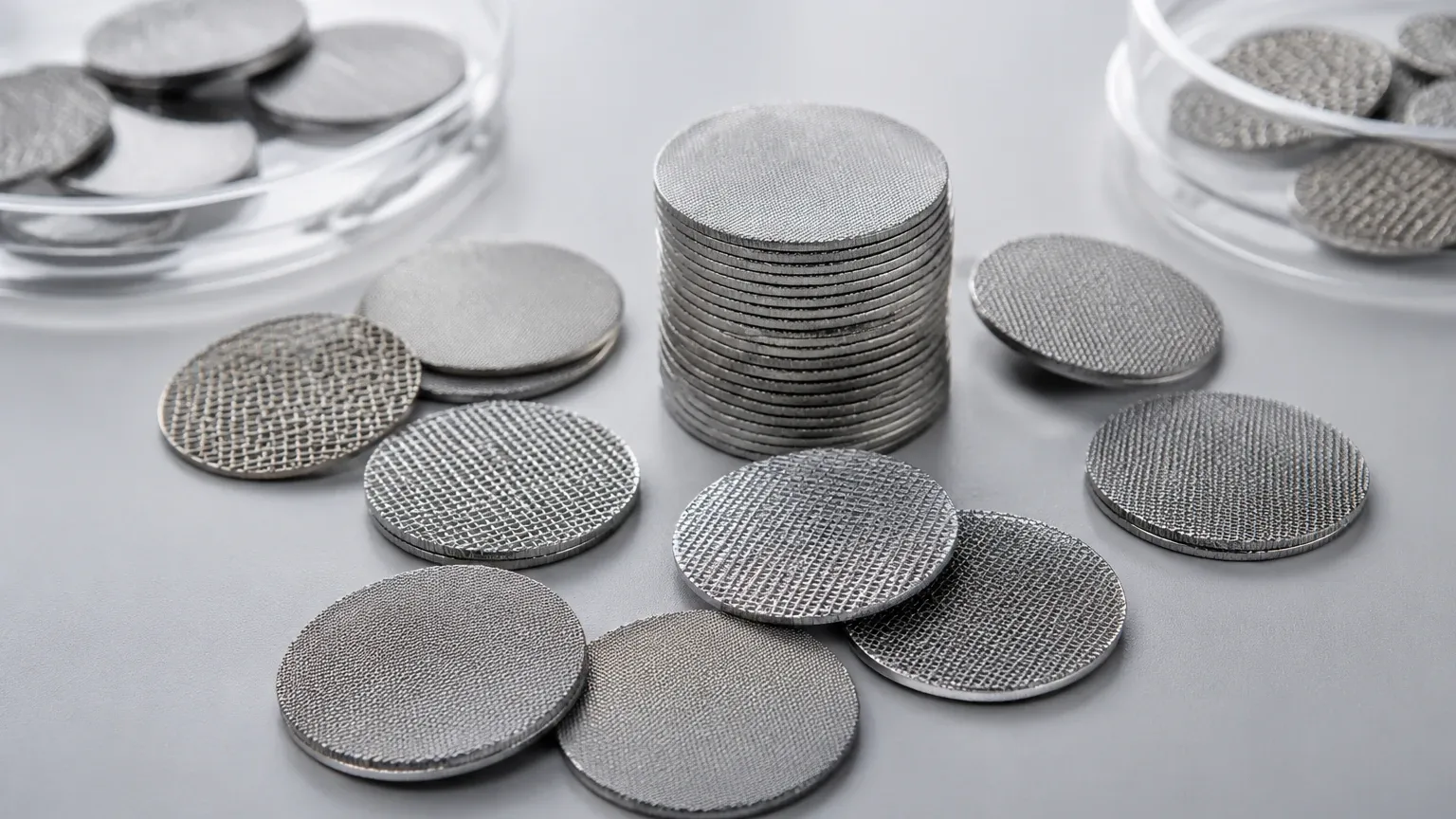
To prevent the synthetic membrane from tearing, it is often sandwiched between layers of stainless steel wire mesh or non-woven plastic support layers. This "pack" construction provides the following benefits:
* Mechanical Support: The outer layers protect the delicate synthetic membrane from physical damage during installation and operation.
* Flow Distribution: Support layers help distribute the fluid evenly across the surface of the 20mm disc, preventing localized blinding.
* Sealing Integrity: Metal or plastic rims can be added to the circumference of the disc to ensure a leak-proof fit within the housing.
Edge Treatment
For 20mm discs, edge leakage is a common failure point. Depending on the application, edges may be ultrasonically sealed, heat-staked, or encapsulated in a polymer ring. In high-temperature industrial settings, the synthetic disc may be crimped into a stainless steel frame to maintain a mechanical seal that bypasses the temperature limitations of organic adhesives.
Industrial and Laboratory Applications
The 20mm synthetic filter disc serves diverse roles across various sectors, each with unique performance requirements.
Chemical Processing and Dosing
In chemical dosing pumps, 20mm discs act as the final barrier to prevent particulate matter from entering sensitive valve mechanisms. PTFE discs are preferred here for their resistance to corrosive reagents.
Laboratory Filtration and HPLC
In analytical chemistry, 20mm discs are used in syringe filters and vacuum manifolds. The precision of the 20mm diameter ensures compatibility with standard labware, while the variety of synthetic materials allows for the filtration of diverse mobile phases without introducing contaminants.
Mushroom Cultivation and Biotechnology
In the biotech industry, specifically in cultivation and fermentation, 20mm synthetic discs are used as breathable vent patches. These discs allow for gas exchange (CO2 and O2) while maintaining a sterile barrier against contaminants like mold spores and bacteria. Hydrophobic PTFE is the standard for this application to prevent wetting-out, which would block gas flow.
Medical Device Components
Small-format synthetic discs are integrated into IV sets, transducer protectors, and suction canisters. These applications require strict compliance with USP Class VI biological reactivity tests and ISO 10993 standards.
Evaluation Criteria for Procurement
When sourcing 20mm synthetic filter discs for industrial use, purchasing teams should move beyond price-per-unit and evaluate the total cost of ownership and technical reliability.
1. Lot Traceability: In regulated industries (Pharma, Food, Aerospace), each batch of discs must be traceable to the raw material source. Ensure the supplier provides Certificates of Conformance (CoC).
2. Bubble Point Testing: This is a non-destructive test used to verify the integrity of the pore size. For critical applications, ensure the discs have been validated via bubble point testing to meet the specified micron rating.
3. Sterilization Compatibility: If the discs are used in sterile environments, they must be compatible with the intended sterilization method, whether it is Autoclave, Gamma Irradiation, or Ethylene Oxide (EtO). For instance, certain grades of PES may yellow under Gamma radiation, while Nylon may absorb moisture during autoclaving.
4. Extractables and Leachables: Engineers should request data on what substances might migrate from the synthetic disc into the process fluid, especially in high-purity water or pharmaceutical applications.
Common Risks and Mitigation Strategies
Operating 20mm synthetic discs involves specific risks that can be mitigated through proper engineering design:
* Media Migration: If the synthetic fibers are not properly bonded, they can shed into the filtrate. Selecting high-quality, thermally bonded membranes or using downstream support mesh can mitigate this.
* Chemical Incompatibility: Using a Nylon disc with a strong acid will lead to premature failure. Always cross-reference the fluid's chemical composition with the polymer compatibility charts.
* Premature Blinding: If the fluid has a high solids content, a single 20mm disc will clog quickly. Implementing a graduated pre-filtration stage (using a coarser mesh or depth media) can extend the life of the final synthetic disc.
Conclusion
The 20mm synthetic filter disc is a critical component in precision filtration systems. Whether used as a standalone membrane in a laboratory setting or integrated into complex Filter Discs & Packs for industrial processing, its performance depends on the correct alignment of material properties and mechanical design. By focusing on chemical compatibility, effective filtration area, and structural support, engineers can ensure that these small-diameter components provide reliable, long-term service in demanding environments.
