


5 Filter Cartridge
In industrial filtration, the term "5 filter cartridge" typically refers to one of two critical specifications: a cartridge with a 5-inch physical length or a cartridge designed with a 5-micron filtration rating. In many high-performance industrial environments, these two specifications often intersect, particularly when dealing with stainless steel filtration media. Unlike disposable polymer filters, a stainless steel 5 filter cartridge is engineered for durability, high-temperature resistance, and the ability to withstand significant differential pressures.
Selecting the correct filtration component requires a deep understanding of the fluid dynamics, chemical compatibility, and the specific mechanical constraints of the housing. Whether used in hydraulic systems, chemical processing, or steam filtration, these compact yet robust components play a vital role in protecting downstream equipment and ensuring product purity.
Understanding the Specifications of a 5 Filter Cartridge
When an engineer specifies a 5 filter cartridge, the first step is clarifying the dimension versus the performance rating. In many compact industrial housings, a 5-inch (approximately 127mm) length is standard. These are frequently used in point-of-use applications where space is limited but high-efficiency filtration is required.
On the performance side, a 5-micron rating indicates the size of the particles the filter is designed to capture. In stainless steel media, this is achieved through precise wire weaving or sintering processes.
Nominal vs. Absolute Ratings
It is essential to distinguish between nominal and absolute 5-micron ratings. A nominal 5-micron filter might capture 60% to 80% of particles at that size, whereas an absolute-rated stainless steel cartridge, often constructed from sintered metal felt or multi-layered wire mesh, can achieve 99.9% efficiency. For critical applications like pharmaceutical processing or fine chemical catalyst recovery, absolute ratings are the industry standard to prevent bypass and ensure consistent results.
Material Selection and Engineering Durability
The performance of a 5 filter cartridge is largely dictated by its material of construction. While plastic or pleated paper filters are common in light-duty water treatment, industrial-grade filtration requires materials that can survive aggressive solvents, high temperatures, and mechanical stress.
Stainless Steel 304 vs. 316L
Stainless steel is the material of choice for most industrial cartridges.
* SS 304: Suitable for general industrial use, offering good corrosion resistance and mechanical strength at a cost-effective price point.
* SS 316L: The "L" stands for low carbon, which provides superior resistance to intergranular corrosion after welding. This alloy is preferred in marine environments, acidic chemical processing, and food-grade applications where pitting corrosion is a concern.
Construction Methods
Industrial cartridges are typically manufactured using two primary methods:
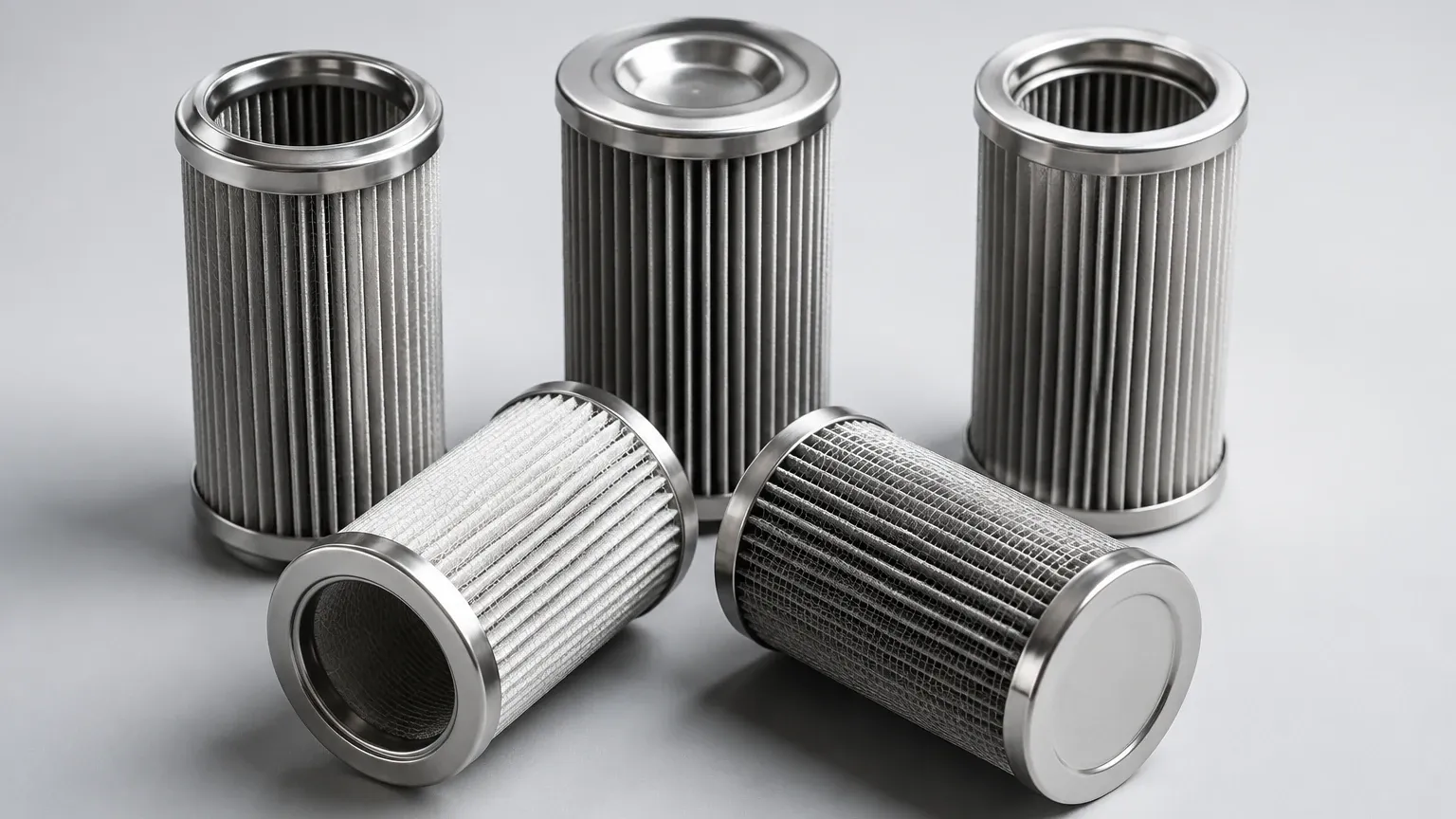
1. Pleated Design: This maximizes the surface area within the 5-inch footprint, allowing for higher flow rates and lower initial pressure drops. It is ideal for fluids with a high dirt-loading capacity.
2. Cylindrical (Wrap) Design: This involves layers of wire mesh wrapped around a perforated core. While it has less surface area than a pleated design, it is easier to clean and offers higher structural integrity under extreme pressure pulses.
Integrating Filter Discs & Packs for Enhanced Performance
In many complex filtration systems, the cartridge is only one part of a multi-stage strategy. In specialized machinery, such as polymer extrusion or high-pressure hydraulic manifolds, engineers often utilize Filter Discs & Packs in conjunction with or as an alternative to standard cartridges.
Filter discs and multi-layered packs provide a unique advantage in precision filtration. They can be integrated into the end caps of a 5 filter cartridge to provide a final safety barrier or used as pre-filtration stages to extend the life of the primary cartridge. By combining different mesh counts within a single pack, manufacturers can create a depth-filtration effect that captures a wide range of particle sizes without prematurely blinding the filter surface. This synergy between various metal filtration components allows for a more customized approach to fluid management, ensuring that even the most demanding purity standards are met.
Key Performance Indicators: Flow Rate and Pressure Drop
For any engineering team, the two most critical metrics for a 5 filter cartridge are the flow rate and the clean pressure drop (Delta P). Because a 5-inch cartridge has a smaller surface area compared to standard 10-inch or 20-inch versions, managing the flow velocity is paramount.
Calculating Differential Pressure
As fluid passes through the 5-micron mesh, resistance is created. If the flow rate exceeds the design capacity of the 5-inch housing, the pressure drop will increase exponentially. This not only strains the pumps but can also lead to "media migration" or structural failure if the collapse pressure of the cartridge is reached.
To optimize performance, engineers must consider the viscosity of the fluid. A 5-micron filter designed for water will behave very differently when used with high-viscosity hydraulic oil or thick chemical resins. Increasing the temperature of the fluid can often lower viscosity and improve flow through the 5 filter cartridge, but the material must be rated for those thermal loads.
Industrial Applications and Compatibility
The versatility of the 5 filter cartridge makes it a staple across various sectors. Its compact size allows it to be installed directly onto machine skids or integrated into existing piping with minimal footprint.
Chemical and Petrochemical Processing
In these environments, filters must withstand corrosive reagents. Stainless steel cartridges are used to remove particulates from solvents, acids, and bases. The 5-micron rating is often the sweet spot for protecting sensitive instrumentation and valves from abrasive wear.
Food and Beverage Industry
Steam filtration is a common application for stainless steel cartridges. A 5 filter cartridge can be used to filter "culinary steam," removing scale and rust from the boiler piping before the steam comes into contact with food products or sterilization equipment. The ability to withstand repeated sterilization cycles (SIP) is a key advantage of metal media over polymers.
Hydraulic and Lubrication Systems
Precision hydraulic components, such as servo valves, have extremely tight tolerances. A 5-micron absolute filter is often required to maintain fluid cleanliness levels (ISO 4406 standards). The 5-inch cartridge format is frequently found in kidney-loop filtration systems used for continuous fluid conditioning.
Maintenance, Cleaning, and Total Cost of Ownership
One of the primary reasons B2B buyers transition from disposable filters to stainless steel 5 filter cartridges is the total cost of ownership (TCO). While the initial purchase price of a metal cartridge is higher, its ability to be cleaned and reused multiple times provides significant long-term savings and reduces environmental waste.
Cleaning Methodologies
Depending on the contaminant, several cleaning methods can be employed:
* Backwashing: Reversing the flow of clean fluid through the cartridge to dislodge particles from the surface.
* Ultrasonic Cleaning: Using high-frequency sound waves in a cleaning solution to remove fine particles trapped deep within the sintered layers or pleated folds.
* Chemical Cleaning: Using specialized solvents or acids to dissolve organic or inorganic deposits that cannot be removed mechanically.
Replacement Cycles
Despite being cleanable, no filter lasts forever. Maintenance teams should monitor the pressure differential across the filter. Once the "cleaned" pressure drop begins to rise significantly above the original baseline, it indicates that the media is becoming permanently fouled or the pore structure is deforming. At this point, replacement is necessary to maintain system efficiency.
Customization Options for Specialized Filtration Needs
Standard off-the-shelf solutions do not always meet the rigors of specialized industrial processes. Customization is often required to ensure the 5 filter cartridge fits perfectly within an existing system or meets a specific filtration challenge.
End Cap Configurations
Cartridges come with various end cap styles to ensure a leak-proof seal within the housing. Common configurations include:
* DOE (Double Open End): Requires flat gaskets on both ends.
* Code 7: Features a finned end and double O-rings (typically 226 O-rings) for high-security locking.
* SOE (Single Open End): Often used with a threaded connection (like 1" NPT) for easy installation in high-pressure manifolds.
Layered Media and Reinforcement
For applications involving high-pressure surges or back-pulsing, the 5 filter cartridge can be reinforced with internal support cores or external cages. By layering different grades of wire mesh, manufacturers can create a graduated density filter that provides both surface and depth filtration, significantly extending the time between cleaning cycles.
In conclusion, the 5 filter cartridge is a precision-engineered component that requires careful selection based on material science, fluid dynamics, and mechanical requirements. By focusing on high-quality stainless steel construction and considering the integration of components like filter discs and packs, industrial operations can achieve reliable, cost-effective, and high-performance filtration for their most critical processes.
