


8 Diameter Filter
In the landscape of industrial filtration, the 8 diameter filter—specifically the 8-inch diameter variant—represents a critical standard for high-capacity fluid and polymer processing. These components are foundational in systems ranging from plastic extrusion lines to large-scale chemical reactors. Selecting the right filter at this scale requires a deep understanding of material science, fluid dynamics, and mechanical engineering to ensure the longevity of the equipment and the purity of the final product.
As a specialized manufacturer, Kaifil provides precision-engineered Filter Discs & Packs designed to meet the rigorous demands of industrial environments. This guide explores the technical specifications, construction methods, and selection criteria essential for engineers and procurement professionals evaluating 8-inch diameter filtration solutions.
Technical Specifications of 8-Inch Diameter Filters
The performance of an 8 diameter filter is primarily dictated by its material composition and the geometry of its mesh. Because these filters are often used in environments involving high pressures, corrosive chemicals, or extreme temperatures, stainless steel is the industry standard.
Material Grades and Chemical Compatibility
Most industrial 8-inch filters are fabricated from 300-series stainless steel. The choice between grades is determined by the specific chemical environment:
* Stainless Steel 304: The most common grade, offering excellent durability and resistance to oxidation. It is suitable for most food and beverage applications and general industrial water treatment.
* Stainless Steel 316: Contains molybdenum, which provides enhanced resistance to chlorides and marine environments. It is preferred in pharmaceutical and chemical processing where pitting corrosion is a risk.
* Stainless Steel 316L: The low-carbon version of 316, used primarily in applications requiring extensive welding. It prevents carbide precipitation, ensuring the structural integrity of the filter rim and mesh junctions under thermal stress.
Mesh Weave Patterns
The weave pattern of the wire mesh determines the filtration accuracy (micron rating) and the mechanical strength of the disc. For an 8 diameter filter, common weaves include:
1. Plain Weave: A simple over-under pattern providing high open area and low pressure drop. Ideal for coarse filtration and high-flow systems.
2. Dutch Weave: Utilizes a higher density of smaller wires in one direction, creating a "tortuous path" for particles. This is essential for high-pressure applications requiring fine filtration (down to 5-10 microns).
3. Twill Weave: Allows for heavier wire diameters in a fine mesh, increasing the physical strength of the disc without sacrificing filtration precision.
Construction Variations: Single Layer vs. Multi-Layer Packs
Depending on the system pressure and the nature of the contaminants, an 8 diameter filter may be configured as a single disc or a multi-layer pack. Each configuration serves a specific engineering purpose.
Single Layer Discs
Single-layer discs are typically used in low-pressure applications or as a final safety screen. They are cost-effective and easy to replace. However, in an 8-inch format, a single layer of fine mesh may lack the structural rigidity to withstand high differential pressures without deforming. In such cases, a heavier support mesh is often integrated.
Multi-Layer Filter Packs
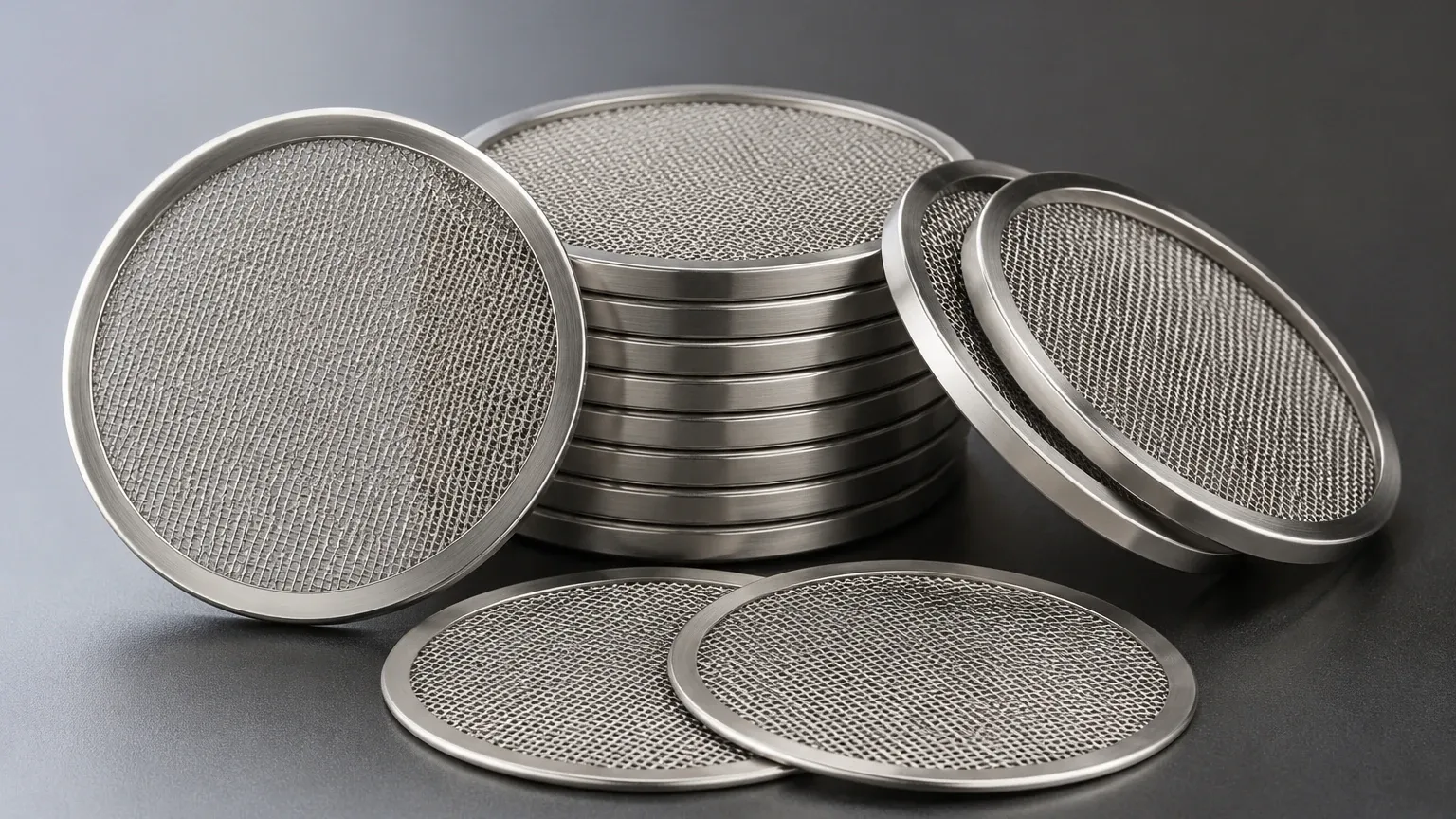
Multi-layer Filter Discs & Packs are the standard for polymer extrusion and heavy-duty hydraulic systems. These packs are engineered with a gradient structure:
* Support Layers: Coarse mesh layers on the outside provide mechanical stability and prevent the finer internal layers from collapsing under pressure.
* Filtration Layers: One or more layers of fine mesh in the center determine the actual micron rating of the pack.
* Drainage Layers: Intermediate layers that facilitate the flow of the filtrate toward the outlet, reducing the overall pressure drop across the assembly.
These layers are often spot-welded together or bound by a metal rim (aluminum or stainless steel) to ensure they act as a single, cohesive unit during installation and operation.
Engineering Considerations for 8-Inch Filtration Systems
When specifying an 8 diameter filter, engineers must look beyond the physical dimensions and consider the operational variables that impact the Total Cost of Ownership (TCO) and system uptime.
Pressure Drop and Flow Capacity
The pressure drop ($ΔP$) across a filter is a function of the mesh's open area and the viscosity of the fluid. For an 8-inch disc, the surface area is approximately 50.27 square inches. If the flow rate is too high for this surface area, the $ΔP$ will increase rapidly, leading to premature "blinding" of the filter and potential mechanical failure. Engineers must calculate the effective filtration area (EFA), accounting for the area lost to rimming or support structures.
Micron Rating: Nominal vs. Absolute
It is vital to distinguish between nominal and absolute filtration ratings. A nominal rating indicates the filter's ability to retain a percentage of particles of a certain size, whereas an absolute rating guarantees the retention of all particles above that size. For critical applications like pharmaceutical manufacturing or precision hydraulics, absolute-rated 8-inch discs are mandatory to prevent downstream contamination.
Temperature and Thermal Expansion
In plastic extrusion, temperatures can exceed 300°C (572°F). The 8 diameter filter must be manufactured with materials and binding methods (such as specialized welding or high-temp alloys) that account for thermal expansion. If the filter and the housing expand at different rates, bypass-leaks can occur, allowing unfiltered material to pass through the system.
Applications of 8-Inch Diameter Filters
The 8-inch diameter is a versatile size used across several heavy industries. Its large surface area makes it suitable for processes that involve high volumes of throughput.
Plastic and Polymer Extrusion
In the production of films, fibers, and resins, the 8 diameter filter is used in "screen changers." These devices allow for the continuous filtration of molten plastic. The filter removes "black specks," un-melted resin, and foreign contaminants that would otherwise cause defects in the final product or damage the extrusion die.
Chemical and Petrochemical Processing
Large-scale chemical reactors utilize 8-inch discs to protect sensitive pumps and valves from catalyst fines or scale buildup. The corrosion resistance of stainless steel 316L is particularly valued here, as it ensures the filter does not contribute metallic ions to the chemical stream.
Food and Beverage Industry
In the filtration of edible oils, syrups, and beverages, 8-inch diameter filters are used in batch processing. These filters must comply with sanitary standards, ensuring that the mesh is free of lubricants or manufacturing residues and that the design allows for thorough cleaning or sterilization.
Maintenance, Cleaning, and Replacement Cycles
Understanding the lifecycle of an 8 diameter filter is essential for operational efficiency. While some filters are designed for single use, many stainless steel discs and packs can be cleaned and reused multiple times.
Cleaning Methods
For polymer-coated filters, pyrolysis (burn-off) ovens are often used to remove organic buildup. For chemical or water applications, ultrasonic cleaning is the preferred method. This process uses high-frequency sound waves to create cavitation bubbles that dislodge particles trapped deep within the mesh pores. Chemical cleaning with mild acids or bases may also be employed, provided the filter material is compatible.
Determining Replacement Frequency
The replacement cycle is typically governed by the pressure differential. Once the $ΔP$ reaches a pre-determined threshold, the filter is considered "spent." Continuous monitoring of upstream and downstream pressure is the most reliable way to prevent filter breakthrough or system shutdowns. In high-stakes environments, scheduled preventative replacements are often more cost-effective than waiting for a pressure spike.
Customization and OEM Solutions
Standard 8-inch filters may not meet the requirements of every unique industrial application. Customization is often necessary to optimize performance. Kaifil works closely with engineering teams to develop bespoke filtration components tailored to specific needs.
Custom Rim Designs
While standard rims are flat, some applications require recessed or stepped rims to fit into specialized housings. The thickness of the rim also plays a role in the sealing capability of the filter assembly.
Specialized Layering
For high-viscosity fluids, a custom-layered pack might include a "pre-filter" layer of coarse expanded metal or perforated plate to protect the fine wire mesh from large debris, thereby extending the service life of the entire pack.
Prototyping and Material Testing
For new product developments, Kaifil provides prototyping services to help engineers test different mesh combinations and diameters. This empirical approach ensures that the final 8 diameter filter selected provides the optimal balance of flow rate, filtration precision, and structural durability.
Conclusion: Selecting the Right 8 Diameter Filter
Choosing an 8 diameter filter is a technical decision that impacts the overall efficiency and safety of industrial operations. By focusing on material grade, weave type, and pack construction, engineers can ensure their systems remain productive and their products remain pure. Whether for plastic extrusion, chemical processing, or hydraulic systems, the reliability of Filter Discs & Packs is a cornerstone of industrial success.
When evaluating suppliers, it is important to confirm manufacturing tolerances, material certifications, and the ability to provide customized configurations. A well-engineered 8-inch filter does more than just trap particles; it protects the integrity of the entire production process, reduces downtime, and lowers the total cost of ownership through superior durability and performance.
