


Adhesive Filter Discs Nearby
In the landscape of industrial filtration, the requirement for precision-engineered components often leads procurement officers and design engineers to search for "adhesive filter discs nearby." While geographic proximity can offer advantages in terms of shipping speed and initial consultation, the technical complexities of these components necessitate a deeper evaluation of manufacturing capabilities, material science, and engineering support. Adhesive filter discs—often a specialized subset of Filter Discs & Packs—serve critical roles in venting, pressure equalization, and contaminant exclusion across industries ranging from automotive electronics to medical device manufacturing.
Selecting the right filtration component requires an understanding of how stainless steel wire mesh interacts with adhesive substrates and the environmental conditions of the final application. This guide examines the technical parameters, material considerations, and sourcing strategies essential for integrating these components into industrial systems.
Understanding the Industrial Role of Adhesive Filter Discs
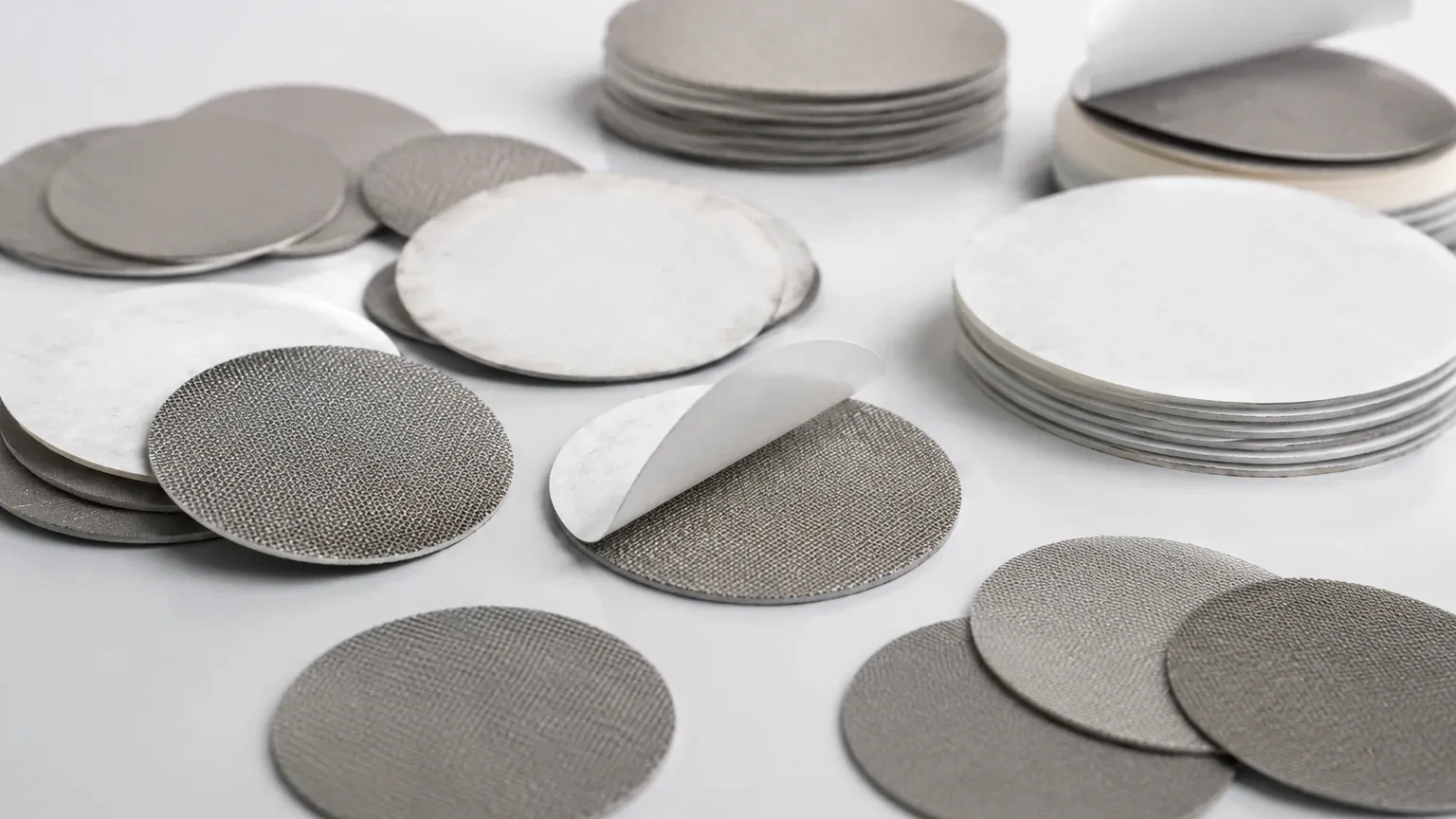
Adhesive filter discs are composite components consisting of a filtration medium—typically stainless steel wire mesh or synthetic membranes—integrated with a pressure-sensitive adhesive (PSA) or a heat-activated adhesive ring. Unlike traditional mechanical fastening methods, such as clamping or welding, adhesive backing allows for rapid installation and a low-profile footprint, which is essential in compact electronic housings or medical sensors.
Within the broader category of Filter Discs & Packs, adhesive-backed versions are primarily used for:
* Protective Venting: Allowing air and gases to pass through while blocking liquids, dust, and particulate matter.
* Pressure Equalization: Preventing seal failure in enclosures subjected to temperature fluctuations.
* Acoustic Protection: Protecting sensitive microphone or speaker components in industrial communication devices without significantly attenuating sound.
When searching for adhesive filter discs nearby, engineers are typically looking for a solution that balances filtration efficiency with the structural integrity of the adhesive bond. A failure in either the mesh or the adhesive can lead to system contamination or catastrophic pressure buildup.
Material Science: Mesh and Adhesive Compatibility
The performance of a filter disc is dictated by its constituent materials. For industrial applications, stainless steel is the preferred medium due to its mechanical strength and thermal stability.
Stainless Steel Wire Mesh Selection
Most high-quality Filter Discs & Packs utilize AISI 304 or 316L stainless steel. The choice between these grades depends on the chemical environment:
1. Grade 304: Suitable for general industrial use where high-temperature resistance and basic corrosion resistance are required.
2. Grade 316L: The "L" stands for low carbon, which provides superior resistance to pitting and crevice corrosion in chloride-rich environments, making it the standard for pharmaceutical and marine applications.
Beyond the alloy, the weave type influences the flow rate and particle retention. Plain weave mesh offers a straight-through flow path and is easy to clean, while Dutch weave patterns provide higher mechanical strength and finer filtration ratings by creating a tortuous path for particles.
Adhesive Chemistries
The "adhesive" aspect of the search for adhesive filter discs nearby refers to the bonding agent used to secure the disc to the substrate. Common industrial adhesives include:
* Acrylic Adhesives: Known for high initial tack and excellent resistance to UV light and oxidation. They perform well across a broad temperature range, typically from -40°C to 150°C.
* Silicone Adhesives: Selected for extreme temperature environments (up to 260°C) and applications requiring high flexibility. However, they generally offer lower peel strength than acrylics.
* Epoxy-based Pre-forms: Used in heavy-duty industrial filters where the disc must be permanently bonded to a metal housing under high-pressure conditions.
Engineering Considerations for Selection
When evaluating Filter Discs & Packs for a specific project, engineers must move beyond simple dimensions and consider the following technical parameters:
1. Air Permeability and Pressure Drop
Air permeability is measured by the volume of air passing through a specific area of the mesh at a set pressure differential (usually expressed in L/m²/s at 200 Pa). If the permeability is too low, the system may experience vacuum or overpressure conditions. Conversely, if it is too high, the filtration efficiency may be compromised. Engineers must calculate the maximum allowable pressure drop ($ΔP$) across the disc to ensure it does not exceed the structural limits of the adhesive bond.
2. Water Entry Pressure (WEP)
In applications where the disc acts as a moisture barrier, the Water Entry Pressure is a critical metric. This defines the minimum pressure required to force water through the dry mesh. For stainless steel mesh, hydrophobic coatings can be applied to increase the WEP, allowing the disc to repel water while remaining permeable to air.
3. Effective Filtration Area (EFA)
The EFA is the actual surface area of the mesh that is not covered by the adhesive ring or the support frame. When sourcing adhesive filter discs nearby, it is vital to confirm that the adhesive footprint does not unnecessarily restrict the EFA, as this would lead to premature clogging and increased flow resistance.
Sourcing Strategy: Why "Nearby" is a Relative Term
In the globalized supply chain of industrial components, the search for "adhesive filter discs nearby" is often a proxy for a search for reliability and technical transparency. While a local distributor might offer quick delivery of stock items, custom filtration challenges often require direct collaboration with a manufacturer like Kaifil.
The Limitations of Local Stocking
Local hardware or general industrial distributors often carry standard sizes that may not meet the specific micron ratings or adhesive requirements of a specialized hydraulic or chemical processing system. Industrial filtration is rarely a "one size fits all" field. A disc that is 0.5mm too large or has an adhesive that outgasses in a vacuum environment can lead to project delays.
The Benefits of OEM Manufacturing
Working with a manufacturer that specializes in custom stainless steel filtration solutions provides several advantages over local off-the-shelf sourcing:
* Custom Geometry: Precision die-cutting or laser cutting ensures that the filter discs fit perfectly into the intended housing, regardless of shape complexity.
* Technical Validation: Manufacturers can provide material certificates (MTRs), bubble point test results, and air permeability data that local distributors may not have access to.
* Scalability: An OEM partner can support the transition from a prototype batch of 100 discs to a production run of 100,000, maintaining consistent quality throughout the product lifecycle.
Evaluating Suppliers and Avoiding Common Risks
When vetting a supplier for adhesive filter discs nearby, engineering teams should confirm specific quality benchmarks to avoid common failure modes.
Common Risks in Adhesive Filtration
1. Adhesive Migration: In high-temperature applications, low-quality adhesives can soften and migrate into the mesh pores, effectively sealing the filter and causing system failure.
2. Delamination: If the substrate surface is not properly prepared or if the adhesive is incompatible with the housing material (e.g., certain low-surface-energy plastics), the disc may peel off under pressure.
3. Bypass Leakage: If the die-cutting process is imprecise, gaps may exist between the mesh and the adhesive ring, allowing unfiltered air or fluid to bypass the media.
Information to Confirm Before Purchase
To mitigate these risks, the following information should be confirmed with the supplier:
* Operating Temperature Range: Does the adhesive maintain its shear strength at the application's peak temperature?
* Chemical Compatibility: Will the adhesive or the 316L mesh react with the gases or fluids present in the system?
* Shelf Life: Many industrial adhesives have a shelf life of 6 to 12 months. Sourcing from a high-turnover manufacturer ensures you receive "fresh" adhesive backing with optimal tack.
Total Cost of Ownership (TCO) and Replacement Cycles
The purchase price of a filter disc is only one component of its total cost. For B2B buyers, the TCO includes the cost of installation, the frequency of replacement, and the potential cost of system downtime if a filter fails.
Stainless steel Filter Discs & Packs are often preferred over synthetic alternatives because they can be cleaned and reused in certain applications, or they simply last longer in harsh environments. While an adhesive-backed disc is typically considered a consumable, choosing a high-durability stainless steel mesh ensures that the filter does not tear or fatigue due to pressure pulses, thereby extending the replacement cycle.
Conclusion: Strategic Sourcing for Precision Filtration
While the initial impulse may be to find adhesive filter discs nearby to satisfy an immediate requirement, the long-term success of an industrial filtration system depends on technical specifications and manufacturing precision. By focusing on material compatibility, air permeability, and the engineering expertise of the manufacturer, procurement teams can secure components that offer reliable performance and a lower total cost of ownership.
For engineers and purchasing teams seeking high-performance filtration components, partnering with a specialist ensures that every variable—from the micron rating of the wire mesh to the peel strength of the adhesive—is optimized for the specific demands of the application. Whether for venting, protection, or precision processing, the right filter disc is a product of rigorous engineering rather than mere geographic convenience.
