


Boeco Germany Filter Discs
In the precision-driven world of laboratory analysis and industrial processing, the selection of filtration media determines the accuracy of results and the efficiency of production cycles. Boeco Germany filter discs have long been recognized within the scientific community for their consistency in laboratory environments, particularly in applications involving qualitative and quantitative analysis. However, as processes scale from the laboratory bench to industrial-grade manufacturing, the requirements for filtration components shift toward higher mechanical strength, chemical resistance, and thermal stability.
For engineers and procurement specialists, understanding the technical nuances of filter discs—whether they are cellulose-based laboratory discs or high-performance industrial Filter Discs & Packs—is essential for optimizing filtration systems. This guide explores the applications of precision filter discs, the criteria for selection, and the transition from laboratory standards to industrial-scale filtration solutions.
Understanding the Role of Precision Filter Discs
Filter discs are foundational components used to separate solids from liquids or gases. In a laboratory setting, such as those where boeco germany filter discs are frequently employed, the focus is often on high purity and specific retention rates. These discs are typically made from high-quality cellulose fibers, glass microfibers, or specialized membranes.
In industrial contexts, the functional requirements expand. While a laboratory filter might only need to withstand the vacuum pressure of a Buchner funnel, an industrial filter disc must often endure high differential pressures, abrasive slurry flows, and corrosive cleaning cycles. The transition from laboratory-grade materials to stainless steel wire mesh or sintered metal becomes necessary when the process demands:
* Reusability: Unlike disposable paper discs, metal filter packs can be cleaned and returned to service.
* Structural Integrity: Maintaining a precise pore size under high mechanical stress.
* Chemical Compatibility: Resisting solvents or acids that would degrade cellulose or polymer membranes.
Technical Specifications of Laboratory vs. Industrial Discs
When evaluating boeco germany filter discs, users typically look at ash content, filtration speed, and micron retention. For example, qualitative grades are used for general filtration, while quantitative grades (ashless) are required for gravimetric analysis.
However, in industrial manufacturing, the technical specifications are defined by engineering parameters that ensure long-term reliability in a production line. At Kaifil, we focus on translating these precision requirements into durable metal structures. Key specifications include:
1. Micron Rating and Filtration Efficiency
In both lab and industry, the micron rating is the most critical factor. Industrial metal filter discs utilize various weave types—such as plain weave, twilled weave, or Dutch weave—to achieve specific retention levels. While laboratory papers might offer fine filtration, stainless steel mesh provides a "fixed" pore structure that does not migrate or deform under pressure, ensuring consistent filtration efficiency throughout the production run.
2. Material Composition
Boeco Germany filter discs are often composed of organic fibers. In contrast, industrial environments frequently require Stainless Steel 304, 316, or 316L. For highly corrosive environments, specialized alloys like Hastelloy or Monel may be used. These materials ensure that the filter does not introduce contaminants into the filtrate, a critical requirement in pharmaceutical and food-grade applications.
3. Permeability and Flow Rate
Flow rate is a function of the open area of the filter media. In laboratory settings, slow filtration is often acceptable to ensure maximum retention. In industrial B2B environments, throughput is a primary KPI. Engineering the right Filter Discs & Packs involves balancing the required micron rating with the need for high flow rates to minimize downtime and energy consumption.
Evaluating Performance: Engineering Considerations
When selecting a filter disc for a specific application, engineers must look beyond the initial filtration rating. The "total cost of ownership" is heavily influenced by how the disc performs under operational stress.
Pressure Drop and Dirt Holding Capacity
Every filter creates a pressure drop (Delta P). As particles accumulate on the surface of the disc, the pressure drop increases. High-quality industrial filter packs are designed with multiple layers—often a combination of a fine filtration layer supported by coarser mesh layers. This "gradient" structure increases the dirt-holding capacity, allowing the system to run longer before requiring cleaning or replacement.
Mechanical Strength and Support
In high-pressure hydraulic or extrusion systems, a single-layer filter disc may fail. Industrial packs often incorporate a "rim" or a spot-welded frame. This prevents the edges of the mesh from fraying and provides the structural rigidity needed to seal the filter within the housing. This is a significant departure from the flexible, unsupported nature of laboratory filter papers.
Customization Options for Industrial Filter Packs
One of the primary advantages of working with a professional manufacturer like Kaifil is the ability to customize the filter geometry and composition to fit specific machinery. While boeco germany filter discs come in standard diameters for lab glassware, industrial applications often require bespoke designs.
Multi-Layer Combinations
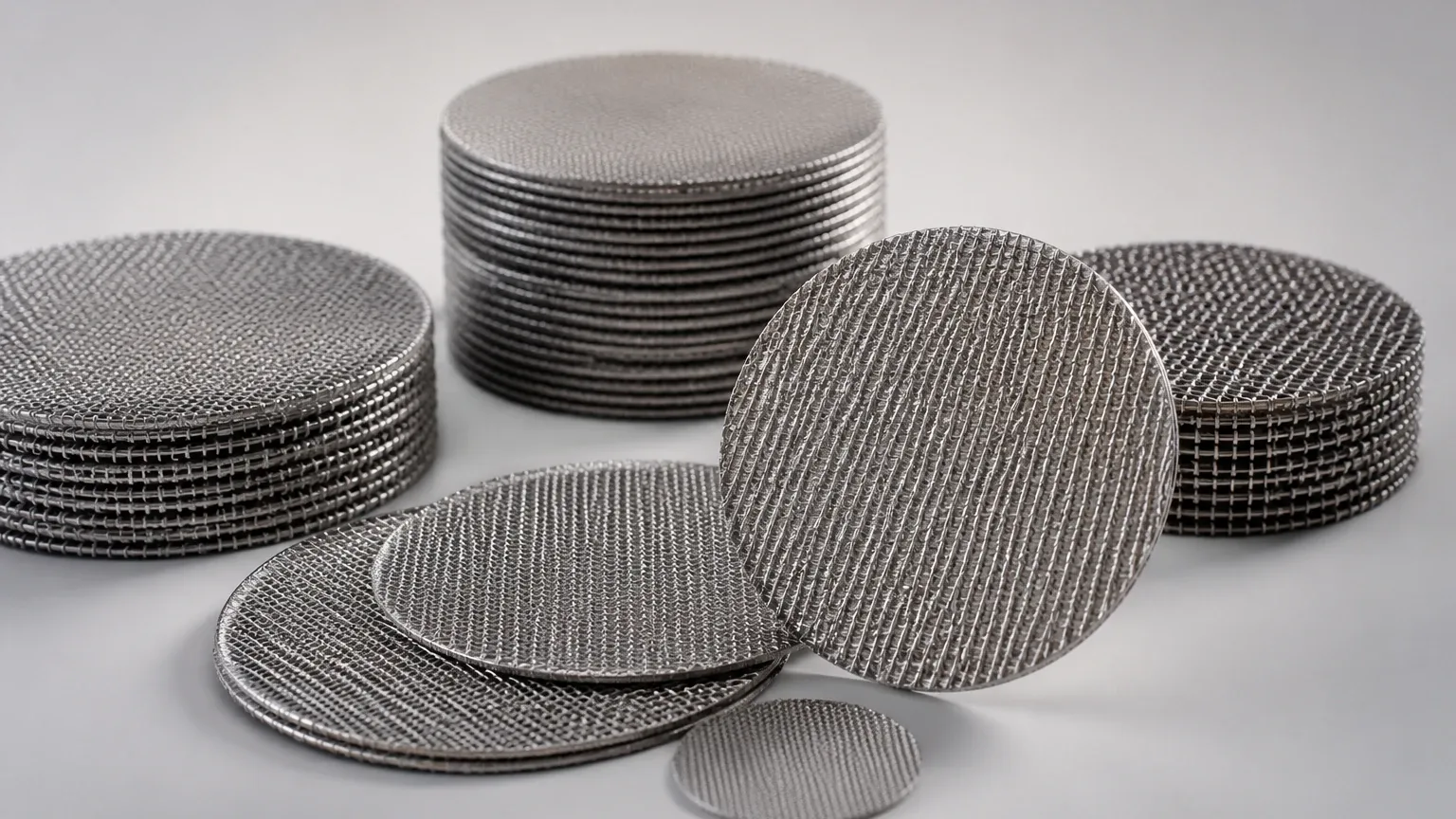
Different layers of wire mesh can be combined to achieve specific results. For instance, a five-layer sintered mesh disc provides extreme mechanical strength and a precise filtration rating, making it ideal for fluidized beds or polymer melt filtration.
Edge Finishing and Assembly
To ensure a bypass-free seal, filter discs can be finished with various edge treatments:
* Aluminum or Stainless Steel Rimming: Provides a solid surface for gaskets and prevents media migration.
* Spot Welding: Bonds multiple layers together to maintain alignment during installation.
* Custom Shapes: Beyond standard circles, discs can be manufactured as ovals, rings, or complex geometric shapes to fit proprietary equipment.
Common Risks in Filter Selection
Choosing the wrong filtration media can lead to significant operational failures. Engineers should be aware of the following risks:
1. Media Migration: In lower-quality filters, fibers or wire fragments can break off and enter the downstream flow. This is unacceptable in pharmaceutical or food and beverage processing.
2. Chemical Incompatibility: Using a cellulose-based disc like a standard boeco germany filter disc in a high-pH or high-temperature environment will cause the media to dissolve or lose its structural integrity.
3. Inaccurate Micron Ratings: Not all "20-micron" filters are equal. It is vital to distinguish between nominal ratings (approximate) and absolute ratings (guaranteed retention of a specific particle size).
Transitioning from Lab-Scale to Industrial Production
Many industrial processes begin in the R&D lab using standard laboratory equipment and boeco germany filter discs. However, scaling up requires a shift in mindset. What works in a 100ml beaker may not be feasible in a 1,000-liter reactor.
When scaling up, engineers should confirm the following before finalizing their filter choice:
* Cleaning Protocols: Can the filter be ultrasonically cleaned or backflushed? Stainless steel Filter Discs & Packs offer this advantage, whereas paper-based discs are single-use.
* Regulatory Compliance: Ensure the materials meet FDA or EU food contact regulations if applicable.
* Supply Chain Stability: For industrial production, a consistent supply of precision-manufactured components is necessary to avoid line shutdowns.
Conclusion
Whether you are utilizing boeco germany filter discs for initial laboratory testing or are ready to implement robust industrial Filter Discs & Packs in a production environment, the principles of precision filtration remain the same. The goal is always to achieve the required separation efficiency while maintaining the integrity of the process.
At Kaifil, we specialize in bridging the gap between high-precision requirements and industrial durability. By focusing on material science and advanced manufacturing techniques, we provide custom stainless steel filtration solutions that meet the demanding needs of the chemical, pharmaceutical, and food processing industries. When your application moves beyond the capabilities of laboratory paper, selecting a custom-engineered metal filter disc is the next step toward optimized, cost-effective performance.
