


Brita Micro Filter Discs
In the realm of water purification and liquid processing, the term "micro filter disc" often brings to mind the consumer-grade solutions used in household carafes and bottles. While products like Brita micro filter discs have set a standard for domestic water improvement, industrial engineering requirements for filtration are significantly more demanding. For engineers and procurement specialists in sectors such as chemical processing, pharmaceuticals, and large-scale food and beverage production, the transition from consumer-level micro-filtration to industrial-grade Filter Discs & Packs involves a shift in material science, mechanical durability, and precise micron control.
Understanding the fundamental differences between consumer-oriented micro-filtration and industrial metal filtration components is essential for optimizing process efficiency and ensuring long-term equipment reliability. This guide explores the technical specifications, material considerations, and engineering advantages of high-performance filter discs in industrial environments.
The Engineering Principles of Micro-Filtration Discs
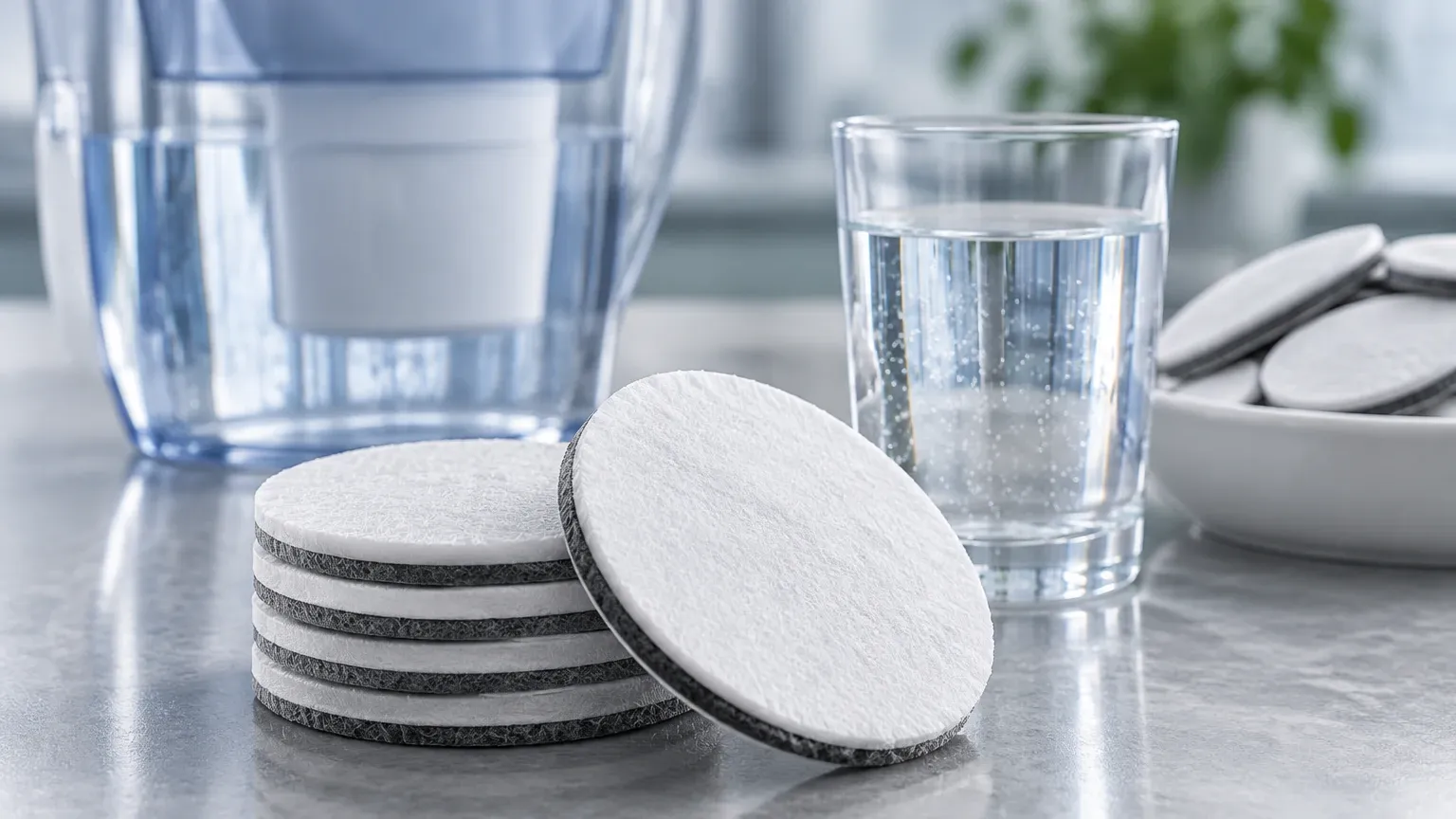
Micro-filtration is a membrane or mesh-based separation process that removes particles ranging from approximately 0.1 to 10 microns. In consumer applications, Brita micro filter discs typically utilize activated carbon technology combined with a non-woven fabric to reduce chlorine, taste, and odor while trapping larger sediments. These are designed for low-pressure, gravity-fed, or manual suction systems where the flow rate is relatively low and the contaminant load is predictable.
In contrast, industrial filter discs must operate under high-pressure differentials, extreme temperatures, and exposure to corrosive chemicals. To meet these challenges, industrial manufacturers like Kaifil utilize stainless steel wire mesh—often in 304 or 316L grades—to create robust filtration media. Unlike the disposable nature of consumer discs, industrial metal filter discs are engineered for structural integrity, allowing them to maintain precise pore sizes even under significant mechanical stress.
Material Selection: Stainless Steel vs. Polymer Media
When evaluating filtration solutions, the choice of material determines the filter's lifecycle and compatibility with the process fluid. While consumer-grade brita micro filter discs rely on carbon and synthetic fibers, industrial applications demand materials that can withstand rigorous cleaning cycles and harsh environments.
Corrosion Resistance and Thermal Stability
Industrial Filter Discs & Packs are frequently manufactured from AISI 316L stainless steel. This alloy offers superior resistance to pitting and crevice corrosion, which is vital in chemical processing and marine environments. Furthermore, metal discs can operate at temperatures exceeding 500°C, a range where polymer-based micro-filters would lose structural integrity or melt.
Mechanical Strength
In hydraulic systems or high-viscosity polymer filtration, the filter media is subjected to high differential pressures. Sintered wire mesh discs provide the necessary mechanical strength to prevent media migration—a common failure point in lower-quality filters where fibers or particles from the filter itself break off and contaminate the filtrate.
Design Configurations: Single Layer vs. Multi-Layer Packs
Industrial filtration often requires a balance between fine filtration accuracy and high flow capacity. To achieve this, engineers specify different configurations of filter discs depending on the application.
1. Single-Layer Filter Discs: These are typically used for simple straining or as a support layer for finer media. They are characterized by high porosity and low pressure drop.
2. Multi-Layer Mesh Packs: By combining several layers of wire mesh with varying aperture sizes, manufacturers create a "depth filtration" effect. The outer layers act as pre-filters for larger particles, while the inner layers provide the final micron rating. These packs are often spot-welded or bound with a metal rim (aluminum, stainless steel, or copper) to ensure they remain intact during high-pressure cycles.
3. Sintered Metal Discs: For the most demanding applications, multiple layers of mesh are diffusion-bonded (sintered) together. This process creates a monolithic structure that is incredibly strong, easy to clean, and offers permanent pore geometry.
Performance Metrics for Industrial Filter Discs
When replacing a consumer-style micro-filtration system with an industrial-grade solution, or when designing a new process line, engineers must confirm several key performance metrics to ensure the Filter Discs & Packs meet the application's needs.
Micron Rating: Absolute vs. Nominal
A common point of confusion is the difference between absolute and nominal micron ratings. A nominal rating refers to the ability of the filter to retain a certain percentage (usually 60% to 90%) of particles of a specific size. An absolute rating, common in precision metal filters, indicates that 99.9% of particles above that size will be captured. For critical pharmaceutical or beverage applications, absolute ratings are mandatory to ensure product safety.
Flow Rate and Pressure Drop (ΔP)
The "clean pressure drop" is the resistance the filter offers to the fluid flow when the filter is new. A well-designed industrial disc maximizes the effective filtration area to keep the pressure drop low, which in turn reduces energy consumption and extends the time between cleaning or replacement cycles.
Dirt Holding Capacity
This refers to the total amount of contaminants the filter can trap before the pressure drop reaches a terminal level. Depth-style packs generally offer higher dirt-holding capacity than single-layer discs, making them more suitable for fluids with high particulate loads.
Applications in High-Precision Industries
While the concept of a micro filter disc is simple, its application in industrial settings is diverse and technically complex. High-quality metal filter discs are used where consumer-grade products would fail instantaneously.
* Food and Beverage: In large-scale water bottling or juice production, metal filter discs are used to remove fine sediments and microorganisms. Unlike plastic components, stainless steel discs can be sterilized using Steam-In-Place (SIP) or Clean-In-Place (CIP) protocols.
* Pharmaceutical Manufacturing: Filtration of active pharmaceutical ingredients (APIs) requires media that does not shed fibers and can withstand aggressive solvents. Sintered discs are the standard here due to their purity and stability.
* Polymer and Fiber Production: In the extrusion of plastics and synthetic fibers, filter packs are used to remove gels and impurities from molten polymers. These filters must withstand pressures of several thousand PSI.
* Hydraulic and Lubrication Systems: Protecting sensitive valves and pumps from wear particles requires consistent micro-filtration. Metal discs provide the necessary durability to handle the high-velocity flow of hydraulic oils.
Maintenance, Cleaning, and Total Cost of Ownership
One of the primary advantages of industrial stainless steel Filter Discs & Packs over disposable alternatives like Brita micro filter discs is their reusability. While the initial investment in metal filtration is higher, the total cost of ownership (TCO) is often lower due to the extended lifecycle.
Cleaning Methods
Metal filter discs can be cleaned using several methods, depending on the contaminant:
* Ultrasonic Cleaning: High-frequency sound waves create cavitation bubbles that dislodge fine particles from deep within the mesh.
* Backwashing: Reversing the flow of fluid through the filter to flush out trapped debris.
* Chemical Cleaning: Using acids or alkalis to dissolve organic or inorganic scaling, provided the filter material (e.g., 316L) is compatible with the cleaning agent.
* Burn-off/Pyrolysis: For polymer applications, filters are placed in high-temperature ovens to carbonize and remove plastic residues.
Replacement Cycles
In an industrial setting, the replacement cycle is determined by the "terminal pressure drop." Once a filter can no longer be cleaned to an acceptable baseline pressure, it must be replaced. High-quality manufacturing ensures that the mesh does not fray or deform over multiple cleaning cycles, maximizing the interval between replacements.
Technical Specifications for Procurement
When sourcing industrial filter discs, procurement teams should provide the following information to the manufacturer to ensure an accurate match for the application:
* Dimensions: Outside diameter (OD), inside diameter (ID), and total thickness.
* Mesh Count/Micron Rating: The required level of filtration and the type of weave (e.g., Plain, Twilled, or Dutch weave).
* Material Grade: Typically 304, 316, or 316L stainless steel, though specialized alloys like Hastelloy or Monel are available for extreme conditions.
* Construction Type: Single layer, multi-layer spot-welded, or rim-bound packs.
* Operating Conditions: Maximum operating temperature, maximum differential pressure, and the chemical composition of the fluid.
Conclusion
While the technology behind brita micro filter discs serves a vital role in providing clean drinking water at the consumer level, industrial processes require a more robust, engineered approach. By utilizing high-quality stainless steel Filter Discs & Packs, industrial operators can achieve precise filtration, withstand harsh operating environments, and benefit from the long-term cost savings of reusable media. Whether for chemical processing, food production, or hydraulic systems, selecting the right filter disc is a critical decision that impacts both product quality and operational efficiency.
