


Disc Filter 130 Micron
In industrial filtration, selecting the precise aperture size is critical for balancing throughput with particle retention. A disc filter 130 micron specification occupies a vital niche in liquid and gas processing, often serving as the primary defense for sensitive downstream equipment or as a final polishing stage in heavy-duty industrial cycles. For engineers and procurement teams, understanding the technical nuances of this specific filtration grade is essential for optimizing system performance and extending the service life of mechanical components.
At this level of precision, the filtration media is typically constructed from high-grade stainless steel wire mesh. The 130-micron rating—equivalent to approximately 120 mesh in standard US sieve sizes—offers a robust solution for removing fine sand, scale, and suspended solids without inducing the excessive pressure drops associated with sub-100-micron filtration.
Technical Specifications of 130 Micron Filtration
The performance of a disc filter 130 micron is determined by the geometry of the weave and the diameter of the wire used. In stainless steel wire mesh, the 130-micron aperture is achieved through a precise count of longitudinal (warp) and transverse (weft) wires.
Mesh Count and Aperture Precision
For a 130-micron rating, a 120-mesh weave is common. However, the effective filtration area (EFA) depends heavily on the wire diameter. A thinner wire increases the open area percentage, allowing for higher flow rates, but may sacrifice mechanical strength. Conversely, thicker wires provide better resistance to high-pressure differentials but increase the resistance to flow.
Weave Types
* Plain Weave: The most common structure where each weft wire passes over and under one warp wire. This provides the most consistent aperture size for 130-micron applications.
* Twilled Weave: Used when thicker wires are required for a given mesh count, providing greater durability for high-pressure hydraulic or heavy-viscosity fluid applications.
Material Engineering for Filter Discs & Packs
Material selection is the foundation of filtration reliability. Since 130-micron filters are often used in aggressive environments, the alloy must be chosen based on chemical compatibility and thermal requirements.
Stainless Steel 304
This is the standard grade for general industrial use. It offers excellent strength and basic corrosion resistance, making it suitable for water treatment, food and beverage processing, and general hydraulic oil filtration where extreme acidity or salinity is not present.
Stainless Steel 316 and 316L
For chemical processing or marine environments, 316-grade stainless steel is preferred due to the addition of molybdenum, which enhances resistance to pitting and crevice corrosion. The low-carbon variant, 316L, is often specified for welded Filter Discs & Packs to prevent carbide precipitation during the manufacturing process, ensuring the integrity of the filter under thermal stress.
Specialized Alloys
In high-temperature or highly corrosive vapor phases, alloys such as Inconel or Monel may be utilized. However, for the majority of 130-micron industrial applications, 316L stainless steel remains the industry benchmark for its balance of cost and performance.
Structural Variations: Single Layer vs. Multilayer Filter Packs
A disc filter 130 micron can be supplied as a single-layer component or integrated into a complex multilayer assembly. The choice depends on the mechanical demands of the system.
Single Layer Discs
These are typically used in low-pressure applications or as secondary strainers. They are cost-effective and easy to clean, but they lack the structural rigidity to withstand high back-pressure or heavy cake loading.
Multilayer Filter Packs
To enhance durability, 130-micron mesh is often combined with coarser support layers. A typical 3-layer or 5-layer pack might include:
1. Filtration Layer: The 130-micron mesh that performs the actual separation.
2. Support Layers: Coarser mesh (e.g., 20 or 40 mesh) positioned on both sides of the filtration layer to provide mechanical stability and prevent the fine mesh from deforming under pressure.
3. Drainage Layers: Even coarser layers that facilitate the distribution of fluid across the entire surface of the disc.
These layers can be spot-welded at the edges or sintered together to form a monolithic porous structure that is virtually immune to layer migration.
Key Performance Metrics for Industrial Applications
When evaluating a disc filter 130 micron, engineers must look beyond the micron rating and consider the operational reality of the fluid system.
Flow Resistance and Pressure Drop (ΔP)
The 130-micron aperture provides a relatively high open area (often between 35% and 45%). This results in a low initial pressure drop. However, as particles accumulate, the ΔP will rise. It is critical to calculate the "clean pressure drop" to ensure the pump system has sufficient head to maintain flow as the filter loads.
Dirt-Holding Capacity
Unlike depth filters (such as pleated cartridges), a standard wire mesh disc is a surface filtration medium. Its dirt-holding capacity is limited to the surface area of the disc. In applications with high solids loading, engineers often specify pleated disc designs or multi-disc "leaf" configurations to increase the available surface area within the same footprint.
Mechanical Integrity
In hydraulic systems, filters are subject to rapid pressure pulsations. A 130-micron disc must be able to withstand these cycles without fatigue. This is where edge binding—using aluminum, copper, or stainless steel rims—becomes essential to prevent the wire ends from fraying and entering the downstream flow.
Critical Selection Criteria for Engineers
Before finalizing a specification for 130-micron filtration components, several environmental factors must be confirmed:
1. Fluid Viscosity: High-viscosity fluids (like heavy polymers or oils) require a larger surface area to maintain the same flow rate through a 130-micron mesh compared to water.
2. Operating Temperature: While stainless steel can handle high temperatures, the expansion coefficients of the filter housing and the disc must be aligned to prevent bypass leakage.
3. Cleaning Protocols: Will the disc be cleaned via ultrasonic bath, backwashing, or chemical solvents? Stainless steel 130-micron discs are highly reusable, but the cleaning method must be compatible with the edge-binding material.
4. Particle Morphology: 130-micron mesh is effective for spherical or granular particles. However, needle-like or fibrous particles may "staple" into the mesh, making cleaning difficult. In such cases, a twilled weave or a specific surface treatment may be required.
Customization Options for OEM Integration
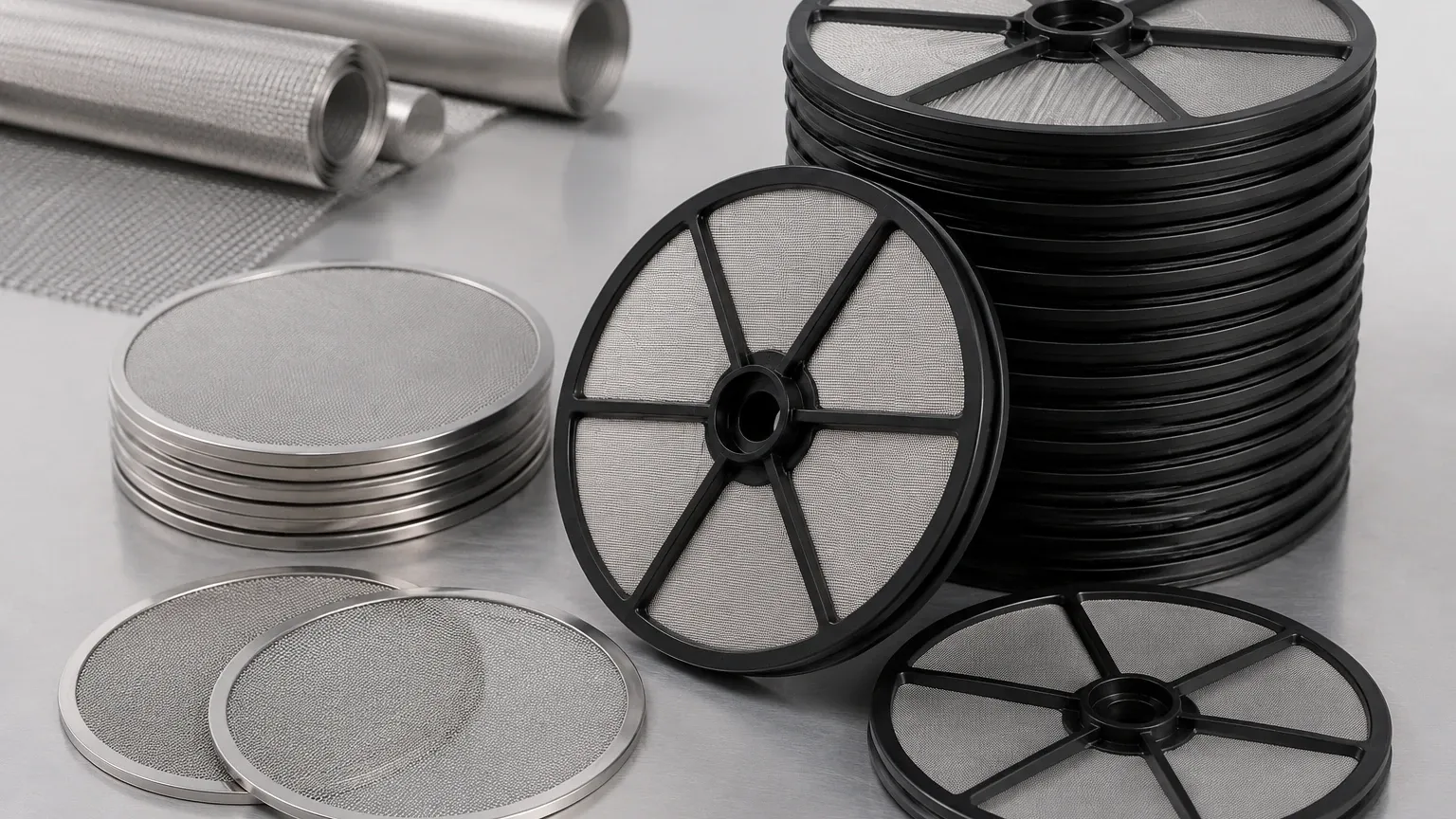
Industrial filtration often requires non-standard geometries to fit proprietary housing designs. Customization of Filter Discs & Packs allows for seamless integration into existing production lines.
Dimensional Variety
Discs can be produced in diameters ranging from a few millimeters for miniature hydraulic valves to over a meter for large-scale chemical reactors. Precision laser cutting or die-stamping ensures that tolerances remain within the required specifications for a leak-proof fit.
Edge Treatments
To ensure safety and ease of handling, as well as to provide a sealing surface, various edge treatments are available:
* Spot Welding: Keeps multilayer packs together without adding bulk.
* Rim Binding: Encasing the edge in a metal U-channel (aluminum or stainless steel) to create a gasket-like surface.
* Sintered Edges: Fusing the wire ends together for the most demanding high-purity applications.
Maintenance and Replacement Cycles
The longevity of a disc filter 130 micron is one of its primary advantages over disposable media. In most B2B industrial settings, these filters are treated as semi-permanent components.
Monitoring Performance
Differential pressure gauges are the standard tool for determining when a 130-micron disc requires cleaning. Once the pressure drop reaches a pre-defined limit (often 15-25 psi depending on the system), the disc should be removed for servicing.
Cleaning Procedures
For 130-micron stainless steel mesh, ultrasonic cleaning is highly effective at dislodging particles trapped within the weave. If the contaminants are organic, high-temperature burnout or chemical cleaning may be necessary. It is important to inspect the mesh under magnification after cleaning to ensure no wires have been broken or displaced, as a single gap larger than 130 microns compromises the entire filtration stage.
Conclusion
The disc filter 130 micron is a versatile and essential component in the industrial filtration landscape. By providing a precise, durable, and cleanable barrier, it protects downstream assets and ensures product consistency. Whether used as a single-layer screen or a complex, sintered multilayer pack, the success of the filtration process depends on rigorous material selection, structural engineering, and an understanding of the specific fluid dynamics at play. For engineers seeking to optimize their systems, focusing on the quality of the weave and the robustness of the disc construction is the most reliable path to achieving long-term operational efficiency.
