


Disc Filter 2
In industrial filtration, the transition from primary coarse separation to high-precision polishing requires specialized components capable of withstanding high pressure while maintaining strict micron tolerances. The term "disc filter 2" often refers to the secondary stage of filtration or high-density multi-layer configurations designed for critical applications. For engineers and procurement specialists, selecting the right Filter Discs & Packs involves a deep understanding of material science, weave patterns, and structural integrity.
Industrial filter discs are not merely circular pieces of wire mesh; they are engineered components designed to provide a specific flow rate and capture efficiency. Whether used in polymer melt filtration, oil refining, or pharmaceutical processing, these discs must perform consistently under fluctuating temperatures and chemical exposures. This guide explores the technical nuances of these components and the criteria necessary for optimizing filtration performance.
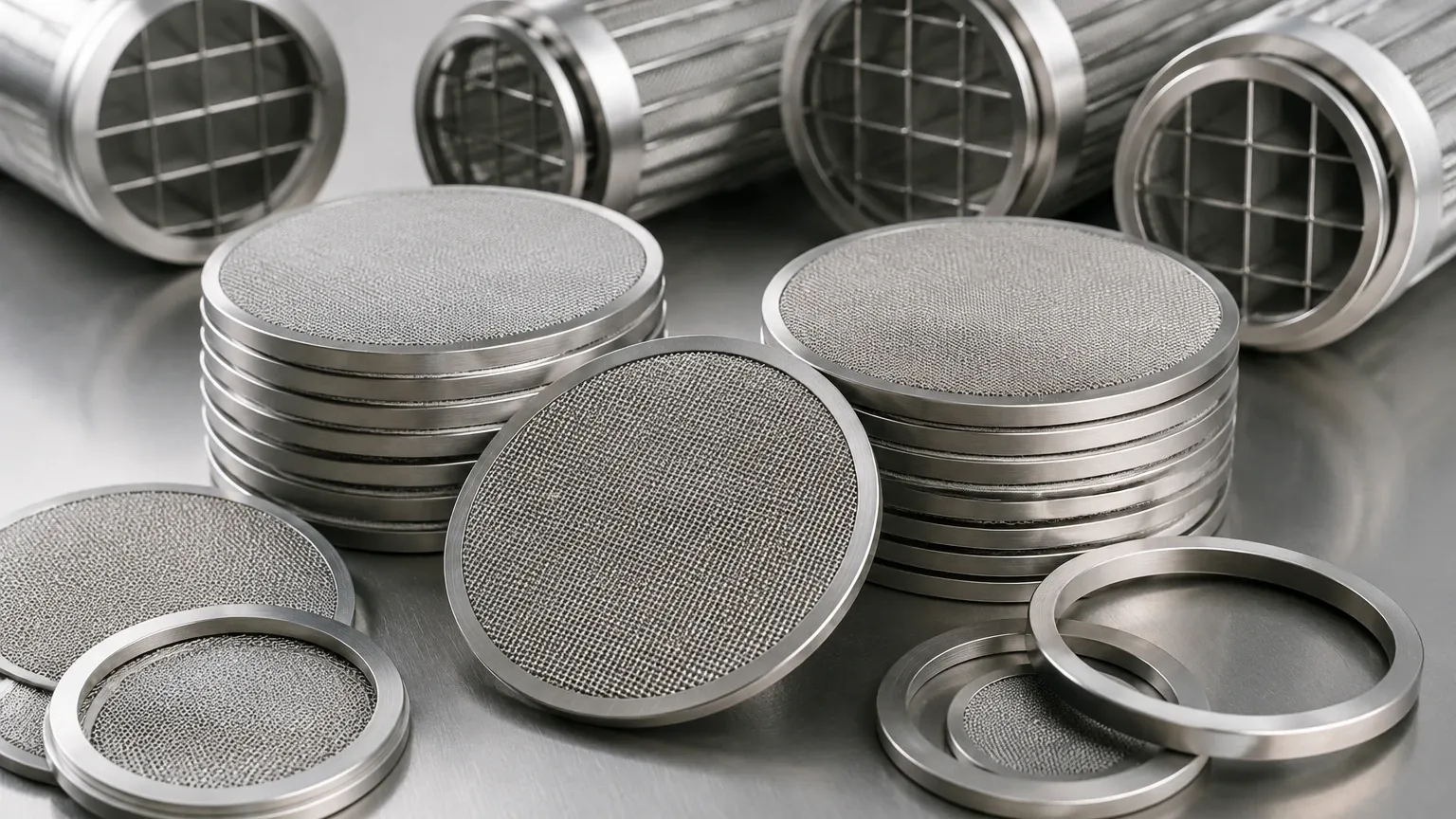
Understanding the Architecture of Industrial Filter Discs & Packs
The fundamental design of a filter disc can range from a single layer of woven wire mesh to complex, multi-layered packs. The choice between these configurations depends entirely on the required filtration accuracy and the mechanical stress the component will face during operation.
Single-Layer Discs
Single-layer discs are typically used for coarse filtration or as a support layer for finer media. They are characterized by high permeability and ease of cleaning. In applications where the particle size distribution is relatively uniform and the pressure drop must be kept to a minimum, a single-layer disc made from a robust weave is often sufficient.
Multi-Layer Filter Packs
Multi-layer packs, often associated with the high-performance requirements of a disc filter 2 stage, involve stacking different mesh counts. A typical configuration includes a fine filtration layer sandwiched between coarser support and drainage layers. This "sandwich" construction prevents the fine mesh from deforming under high pressure and helps distribute the fluid flow evenly across the entire surface area. By combining different mesh specifications, engineers can achieve a balance between fine particle retention and high dirt-holding capacity.
Material Selection and Chemical Compatibility
The longevity of a filter disc is primarily dictated by its material composition. In industrial environments, stainless steel is the standard due to its mechanical strength and resistance to corrosion.
1. AISI 304 Stainless Steel: This is the most common grade used for general industrial applications. It offers good corrosion resistance and is cost-effective for water treatment, food and beverage, and basic chemical processing.
2. AISI 316L Stainless Steel: For more demanding environments, 316L is preferred due to the addition of molybdenum, which enhances resistance to pitting and crevice corrosion in chloride-rich environments. This is often the material of choice for pharmaceutical and marine applications.
3. Specialty Alloys: In cases of extreme temperature or highly aggressive chemical exposure, alloys such as Hastelloy, Monel, or Inconel may be utilized. These materials ensure that the disc filter 2 components do not degrade or leach metallic ions into the process stream.
When selecting materials, engineers must also consider the operating temperature. Stainless steel maintains its structural integrity at temperatures where polymer-based filters would fail, making it indispensable for steam filtration and high-temperature gas processing.
Technical Specifications: Weave Types and Micron Ratings
The performance of Filter Discs & Packs is defined by the weave of the wire mesh. Each weave type offers different characteristics regarding flow resistance and particle capture.
* Plain Weave: The simplest weave where each warp wire crosses over and under each weft wire. It provides high flow rates and is easy to clean, making it suitable for nominal filtration.
* Dutch Weave: This weave utilizes a heavier warp wire and a finer weft wire, resulting in a compact, dense mesh. Dutch weaves (including Plain Dutch and Twilled Dutch) are essential for absolute filtration ratings, as they create a tortuous path for particles, ensuring higher capture efficiency.
* Twilled Weave: In this configuration, each weft wire passes over and under two warp wires. This allows for the use of heavier wires in a given mesh count, increasing the strength and durability of the disc.
Micron ratings are categorized as either nominal or absolute. A nominal rating indicates the ability to retain a majority of particles of a certain size, while an absolute rating guarantees the retention of all particles above a specified dimension. For a disc filter 2 application, absolute ratings are often required to protect downstream equipment from even the smallest contaminants.
Manufacturing Methods: From Sintering to Spot Welding
The method used to assemble filter packs significantly impacts their performance in high-pressure systems.
Sintered Mesh Discs
Sintering is a process where multiple layers of wire mesh are fused together using heat and pressure without the use of binders. This creates a monolithic structure that is incredibly rigid and stable. Sintered discs do not suffer from wire migration, and their pore sizes remain constant even under extreme mechanical stress. This makes them ideal for high-pressure hydraulic systems and polymer filtration.
Spot-Welded Packs
For applications where some flexibility is required or where cost is a primary concern, spot-welded packs are used. Multiple layers are joined at specific points around the circumference or across the surface. While not as rigid as sintered media, spot-welded packs are highly effective for multi-stage filtration where different mesh types need to be combined to handle a broad range of particle sizes.
Critical Evaluation Criteria for Purchasing Teams
When sourcing Filter Discs & Packs, engineers should look beyond the initial price and evaluate the total cost of ownership. Key factors to confirm with a manufacturer include:
* Dimensional Accuracy: Precise outer and inner diameters are critical for ensuring a leak-free seal within the filter housing. Even a millimeter of deviation can lead to bypass, where unfiltered fluid escapes around the edges of the disc.
* Edge Treatment: Discs can be supplied with raw edges, or they can be bound with aluminum, stainless steel, or copper rims. Rimmed edges provide better sealing surfaces and prevent the fraying of wires, which is crucial for maintaining the purity of the process fluid.
* Pressure Drop (ΔP): A high initial pressure drop indicates that the filter media may be too restrictive for the pump capacity, leading to increased energy consumption and shorter service life.
* Cleanability: For B2B operations, the ability to reuse filters is a major cost-saving factor. Stainless steel discs can often be cleaned via ultrasonic baths, chemical cleaning, or back-flushing, extending their lifecycle significantly compared to disposable alternatives.
The Role of Disc Filter 2 in Multi-Stage Systems
In many industrial processes, filtration is a multi-step journey. The "disc filter 2" stage acts as a safeguard. In a typical setup, a primary filter removes the bulk of the contaminants, while the second stage—utilizing high-precision Filter Discs & Packs—performs the final polishing.
This staged approach is vital in industries like beverage production, where the primary stage removes organic matter and the second stage ensures the removal of yeast or bacteria. In hydraulic systems, the second stage protects sensitive valves and actuators from fine metallic wear particles that the primary filter might miss. By optimizing the second stage, facilities can prevent catastrophic equipment failure and ensure the highest quality of the end product.
Maintenance, Cleaning, and Replacement Cycles
To maintain the efficiency of a disc filter 2 system, a structured maintenance schedule is required. Monitoring the differential pressure across the filter pack is the most reliable method for determining when cleaning or replacement is necessary.
1. Monitoring: Once the pressure drop reaches a pre-determined limit (the terminal pressure drop), the discs should be removed for servicing.
2. Cleaning Protocols: For stainless steel media, ultrasonic cleaning is highly effective at removing particles lodged deep within the weave. Chemical soaking may be necessary for organic buildup or scale.
3. Inspection: After cleaning, discs should be inspected for mesh distortion, broken wires, or compromised welds. Any disc showing signs of structural failure must be replaced to prevent downstream contamination.
Conclusion
Selecting the appropriate Filter Discs & Packs is a technical decision that impacts the efficiency, safety, and profitability of industrial operations. By focusing on material compatibility, weave precision, and structural integrity, engineers can ensure that their disc filter 2 stages provide reliable performance in even the most demanding environments. Partnering with a manufacturer that understands these engineering boundaries allows for the development of customized solutions that meet specific micron requirements and operational challenges.
