


Disc Filter 3d Model
In modern industrial engineering, the transition from conceptual design to functional hardware relies heavily on the precision of digital assets. For engineers designing hydraulic systems, polymer extrusion lines, or chemical processing units, integrating a high-fidelity disc filter 3d model into the primary assembly is a critical step. These components, often categorized under Filter Discs & Packs, are the primary line of defense against particulate contamination. A well-constructed 3D model does more than represent space; it serves as a baseline for interference checking, flow simulation, and manufacturing specifications.
At Kaifil, we understand that a filter is rarely a standalone part. It is a precision-engineered component that must interface perfectly with housings, seals, and fluid streams. This article explores the technical nuances of designing and selecting filter discs, the importance of accurate 3D modeling in industrial applications, and the engineering considerations that bridge the gap between a digital file and a physical stainless steel filter.
The Role of 3D Modeling in Filtration System Design
The use of a disc filter 3d model in CAD (Computer-Aided Design) software such as SolidWorks, AutoCAD, or CATIA allows engineers to visualize the spatial constraints of a filtration assembly. In high-pressure environments, such as hydraulic manifolds or melt filtration systems, the clearance between the filter pack and the housing wall can be as narrow as a few microns.
Spatial Accuracy and Interference Checking
3D models allow for automated interference detection. If a multi-layer filter pack is specified with an aluminum rim, the model must account for the compressed thickness of the rim versus the lofted thickness of the mesh layers. Without an accurate model, engineers risk specifying a housing that cannot be properly sealed or, conversely, a filter that rattles within the cavity, leading to bypass and system failure.
Computational Fluid Dynamics (CFD)
Advanced engineering teams utilize the geometry of a disc filter to perform CFD analysis. By representing the wire mesh structure—or at least its equivalent porous media properties—within the 3D environment, designers can predict pressure drops across the filter. This is essential for determining the energy efficiency of a pump or the expected lifespan of the filter media before it reaches terminal pressure differential.
Technical Specifications for Filter Discs & Packs
When searching for or creating a disc filter 3d model, it is vital to define the physical characteristics that impact performance. Filter Discs & Packs are not monolithic; they are complex assemblies of woven wire cloth, often layered to achieve specific filtration goals.
Layer Configuration
* Single Layer Discs: Typically used for coarse filtration or as a support layer. The 3D model for these is relatively simple, focusing on the outer diameter (OD) and the wire diameter.
* Multi-Layer Packs: These consist of multiple mesh counts (e.g., a fine filtration layer sandwiched between two coarse support layers). In a 3D assembly, these must be modeled as a composite stack to ensure the total thickness matches the physical product.
* Sintered Discs: Multiple layers of mesh are heat-treated to bond the wires. These provide high structural integrity and are modeled as a single solid body with specific porosity attributes.
Edge Treatments
The perimeter of the filter disc is a critical interface point. Common edge treatments that should be reflected in a 3D model include:
* Spot Welded Edges: Multiple layers are joined at specific points. The model should reflect the slight compression at these points.
* Rimmed Edges: An aluminum, stainless steel, or copper U-shaped channel is crimped around the edge. This adds significant thickness to the OD, which must be accounted for in the housing design to ensure a proper mechanical seal.
Material Selection and Engineering Constraints
Kaifil specializes in stainless steel filtration solutions because of the material's durability and resistance to extreme conditions. When developing a disc filter 3d model, the choice of material dictates the mechanical properties assigned to the part in a simulation environment.
Stainless Steel Grades
* AISI 304: The standard for general industrial use, offering good corrosion resistance and cost-effectiveness.
* AISI 316L: Preferred for pharmaceutical, food and beverage, and marine applications due to its superior resistance to pitting and chloride-induced corrosion.
* High-Nickel Alloys: For specialized chemical processing where standard stainless steel might fail.
Mesh Weave Types
The weave type determines the filtration accuracy (micron rating) and the flow characteristics. A 3D model might represent these as textures, but the engineering data behind them must specify:
1. Plain Weave: The most common, offering a straight-through flow path.
2. Dutch Weave: Provides a denser structure for fine filtration and higher mechanical strength.
3. Twill Weave: Allows for heavier wires in a given mesh count, increasing durability for high-pressure applications.
Engineering Considerations for Custom Filter Discs
Off-the-shelf components rarely meet the exacting needs of specialized industrial equipment. When engineers move from a generic disc filter 3d model to a custom specification, several factors must be confirmed to ensure the final product performs as expected.
Tolerance Management
In precision filtration, tolerances are often tighter than in general machining. A disc with a nominal 50mm OD might require a tolerance of +0/-0.1mm to fit into a precision-machined seat. The 3D model should reflect the "worst-case" dimensions to ensure the assembly remains functional under thermal expansion or mechanical stress.
Pressure Drop and Effective Filtration Area (EFA)
One common mistake in 3D modeling is failing to account for the reduction in EFA caused by the rim or the support structure. If a 100mm disc has a 5mm rim, the actual area available for fluid flow is significantly reduced. Engineers must calculate the EFA based on the inner diameter of the rim to accurately predict the pressure drop and flow velocity.
Structural Support
Under high differential pressure, a thin mesh disc will deflect. Engineers must decide if the disc filter 3d model requires an integrated support plate (perforated metal) or if the housing itself will provide the necessary backing. For high-viscosity fluids like polymers, the support structure is often as thick as the filter media itself.
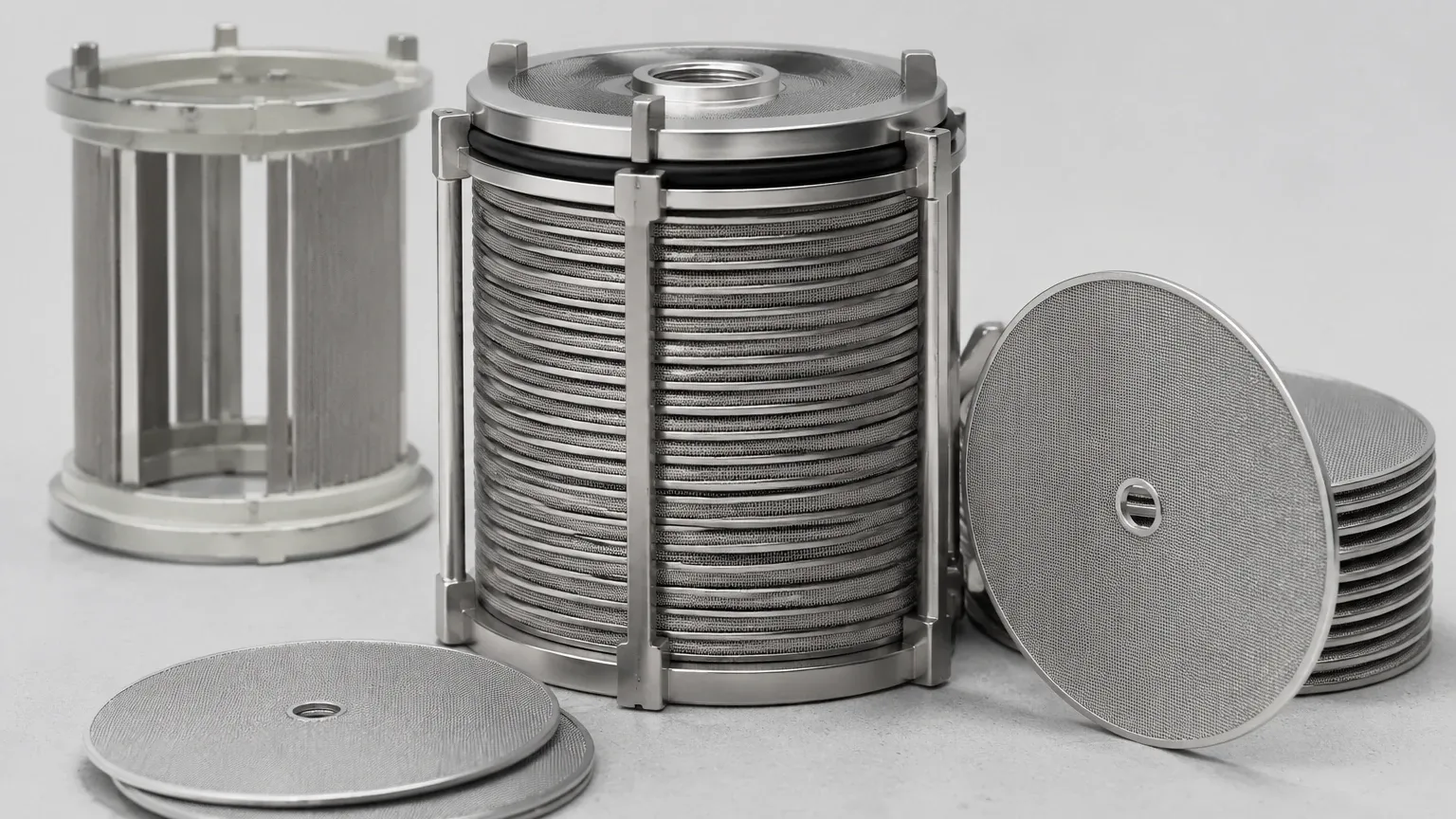
Applications for Filter Discs & Packs
Understanding where these components are used helps in refining the requirements for a disc filter 3d model. Kaifil provides solutions across several demanding sectors:
Polymer and Plastic Extrusion
In the plastics industry, "screen packs" are used to remove impurities from molten polymer. These packs must withstand high temperatures and pressures. The 3D models for these applications often involve complex stacks of varying mesh counts designed to provide graduated filtration.
Hydraulic and Lubrication Systems
Precision hydraulic valves are highly sensitive to particulate matter. Small filter discs are often integrated directly into valve bodies or manifolds. In these cases, the 3D model is essential for ensuring the filter does not obstruct the movement of internal valve components.
Chemical and Pharmaceutical Processing
These industries require high-purity filtration. The Filter Discs & Packs used here must be easy to clean (often via ultrasonic baths) and must not shed fibers. The 3D design often focuses on minimizing "dead zones" where material could accumulate and stagnate.
Moving from 3D Model to Production
Once a disc filter 3d model is finalized and validated within the system assembly, the next step is procurement and manufacturing. Working with a professional manufacturer like Kaifil ensures that the digital intent is accurately translated into a physical component.
Verification of Micron Ratings
While a 3D model can show the physical dimensions, it cannot easily show the micron rating. Engineers must provide clear documentation regarding the absolute or nominal filtration requirements. Kaifil utilizes advanced testing to ensure that the mesh used matches the technical specifications precisely.
Prototyping and Validation
For new designs, it is often advisable to produce a small batch of prototypes based on the CAD data. This allows for physical fitment testing and bench-top flow testing to verify the assumptions made during the simulation phase. Kaifil’s OEM capabilities allow for rapid prototyping of custom shapes and sizes, ranging from a few millimeters to several hundred millimeters in diameter.
Total Cost of Ownership (TCO)
When evaluating a filter design, engineers should consider the replacement cycle. A more robust disc filter, perhaps one that is slightly more expensive due to a sintered structure or a reinforced rim, may offer a lower TCO by lasting significantly longer and allowing for more cleaning cycles compared to a standard spot-welded pack.
Conclusion
A disc filter 3d model is a foundational tool for modern industrial design, enabling engineers to optimize filtration performance while ensuring mechanical compatibility. By considering the nuances of layer configuration, edge treatments, and material properties, technical professionals can specify Filter Discs & Packs that enhance system reliability and efficiency.
Kaifil remains a committed partner to engineering teams worldwide, providing the technical expertise and manufacturing precision required for the most demanding filtration challenges. Whether you are in the early stages of CAD integration or ready to move into full-scale production, focusing on the factual boundaries of mesh engineering ensures that your filtration solution will perform as intended in the field.
