


Disc Filter 4
In the landscape of industrial filtration, the 4-inch diameter filter disc—often referred to in technical procurement as a disc filter 4—represents one of the most versatile and widely utilized specifications for precision fluid and gas processing. These components are critical in maintaining the integrity of downstream equipment and ensuring the purity of final products across sectors ranging from polymer extrusion to pharmaceutical manufacturing. Selecting the correct Filter Discs & Packs involves a deep understanding of material science, mesh geometry, and the mechanical stresses of the specific application environment.
Industrial filtration is rarely a one-size-fits-all endeavor. For engineers and procurement specialists, the "4-inch" designation is the starting point for a complex set of variables including micron rating, flow rate requirements, and chemical compatibility. As a specialized manufacturer, Kaifil focuses on providing engineered stainless steel solutions that address these technical nuances, ensuring that every disc filter 4 performs reliably under demanding industrial conditions.
Understanding Technical Specifications for 4-Inch Filter Discs
The performance of a disc filter 4 is primarily defined by its mesh construction and dimensional accuracy. While the 4-inch outer diameter (OD) is standard, the internal architecture of the mesh determines the efficiency of the filtration process.
Micron Rating and Mesh Count
Filtration precision is measured in microns (μm). For industrial applications, these discs can range from coarse filtration (over 500 microns) to ultra-fine precision (under 5 microns). The mesh count—the number of openings per linear inch—directly impacts the filtration surface area and the pressure drop across the disc. A higher mesh count typically offers finer filtration but may increase resistance to flow, requiring a balance between clarity and throughput.
Weave Types
The method by which the stainless steel wires are interlaced significantly affects the disc's performance:
* Plain Weave: The most common type, where wires cross over and under each other alternately. It provides high open area and low pressure drop, suitable for general-purpose filtration.
* Dutch Weave: This weave uses heavier warp wires and finer weft wires, resulting in a denser, stronger mesh with smaller triangular openings. It is ideal for high-pressure applications where mechanical strength and fine filtration are required simultaneously.
* Twilled Weave: Used for finer filtration requirements, allowing for a heavier wire diameter for a given mesh count, which enhances the durability of the disc filter 4.
Material Selection: Why Stainless Steel is the Standard
In the context of industrial Filter Discs & Packs, material selection is the most significant factor in determining the service life and chemical resistance of the component. Kaifil primarily utilizes high-grade stainless steel to meet the rigorous demands of chemical and thermal processing.
SS 304 vs. SS 316L
* Stainless Steel 304: This is the standard grade for most industrial applications. It offers excellent strength and good corrosion resistance for water treatment, food processing, and general hydraulic systems.
* Stainless Steel 316L: For more aggressive environments, 316L is preferred due to the addition of molybdenum, which enhances resistance to pitting and crevice corrosion in chloride-rich or acidic environments. The "L" (low carbon) designation is crucial for components that require welding, as it prevents carbide precipitation and maintains corrosion resistance at the weld points.
Temperature and Pressure Resilience
Unlike synthetic or paper filters, a stainless steel disc filter 4 can operate in extreme temperatures, often exceeding 500°C depending on the alloy and structural design. This thermal stability is essential for hot melt filtration in plastic extrusion and high-temperature gas filtration in chemical plants.
Structural Configurations: Single-Layer vs. Multi-Layer Packs
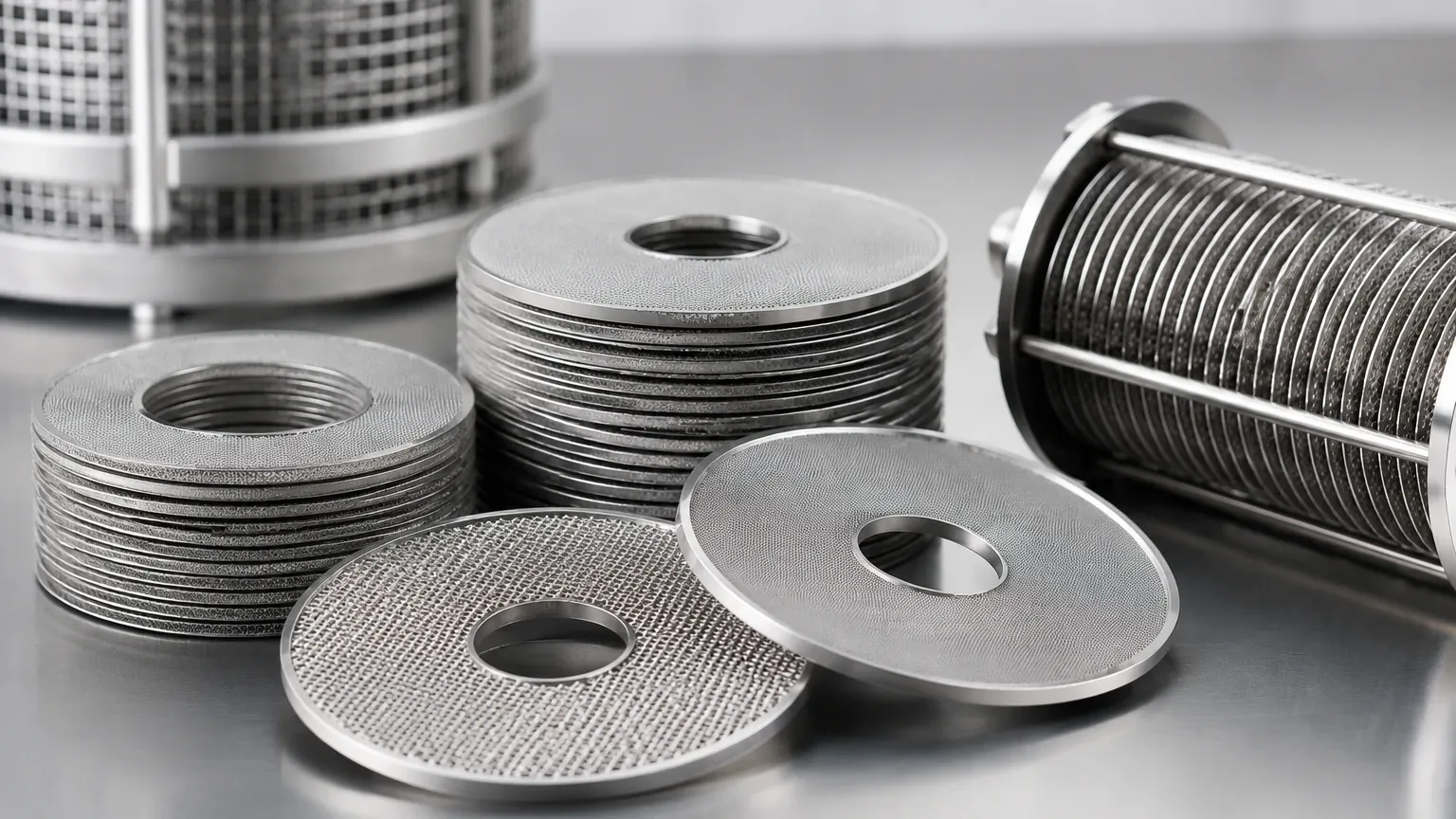
A disc filter 4 may be used as a standalone single-layer mesh or as part of a multi-layer assembly known as a filter pack. The choice depends on the required filtration depth and the pressure the disc must withstand.
Single-Layer Discs
Single-layer discs are typically used in low-pressure systems or as a final safety screen. They are cost-effective and easy to clean, making them suitable for applications where the contaminant load is relatively low and the particle size is uniform.
Multi-Layer Filter Packs
In many high-pressure environments, such as hydraulic systems or polymer processing, a single layer of fine mesh lacks the structural integrity to resist deformation. Multi-layer Filter Discs & Packs solve this by layering different mesh sizes:
1. Filtration Layer: The middle layer(s) that provide the actual micron-rated filtration.
2. Support Layer: A coarser, heavier mesh that provides mechanical strength to the filtration layer, preventing it from collapsing under high differential pressure.
3. Drainage Layer: Ensures even flow distribution across the entire surface of the disc.
These layers can be spot-welded together or bound by an aluminum, copper, or stainless steel rim to ensure they remain a single, cohesive unit during installation and operation. This rimming process is particularly important for the disc filter 4 used in automatic screen changers, where precise fitment is required to prevent bypass.
Key Applications for Disc Filter 4 in Industrial Processes
The 4-inch diameter is a frequent specification in several critical industrial sectors. Understanding these applications helps in selecting the right structural characteristics for the filter.
Plastic and Polymer Extrusion
In the plastics industry, the disc filter 4 is a staple in screen changers. As molten polymer is forced through the extruder, these discs remove impurities such as un-melted resin, metal fragments, or degraded polymer. Because these systems operate at extremely high pressures, the discs must be manufactured with high burst strength and precise edge finishes to prevent leakage.
Chemical and Pharmaceutical Processing
In these industries, the purity of the medium is paramount. Stainless steel filter discs are used to remove catalysts from chemical streams or to ensure the sterility of pharmaceutical ingredients. The ability of stainless steel to be ultrasonically cleaned and sterilized (SIP/CIP) makes it the material of choice for these sensitive applications.
Hydraulic and Lubrication Systems
Precision machinery relies on clean oil to prevent component wear. A disc filter 4 is often integrated into hydraulic manifolds or lubrication lines to capture metallic shavings and environmental contaminants. The high flow-to-surface-area ratio of these discs ensures that the system maintains proper pressure while protecting expensive pumps and valves.
Engineering Considerations: Performance and Durability
When specifying a disc filter 4, engineers must look beyond the basic dimensions. Several performance metrics determine the total cost of ownership and the efficiency of the filtration system.
Effective Filtration Area (EFA)
The EFA is the total area of the mesh that is actually available for fluid to pass through. Rims, welds, and support structures can reduce the EFA. Maximizing the open area while maintaining structural integrity is a hallmark of high-quality Filter Discs & Packs. A higher EFA results in a lower initial pressure drop and a longer service life before the filter reaches its terminal pressure drop.
Dirt Holding Capacity
This refers to the amount of contaminant the disc can retain before the pressure drop becomes unacceptable. Multi-layer designs generally have a higher dirt-holding capacity because they can trap particles of varying sizes throughout the depth of the pack, rather than just on the surface of a single mesh layer.
Mechanical Stability
In pulsating flow or high-vibration environments, the mesh wires can experience fatigue. Precision manufacturing ensures that the wire tension is uniform and that the edges are properly secured. For a disc filter 4, this stability prevents "wire migration," where individual wires break loose and contaminate the downstream fluid.
Maintenance and Replacement Cycles
One of the primary advantages of stainless steel filtration components is their cleanability. Unlike disposable filters, a disc filter 4 can often be refurbished and reused, significantly reducing long-term operational costs.
Cleaning Methods
* Ultrasonic Cleaning: High-frequency sound waves create cavitation bubbles that dislodge particles from deep within the mesh. This is the most effective method for fine Dutch weave meshes.
* Chemical Cleaning: Using solvents or acids to dissolve organic or inorganic deposits. This must be done with careful consideration of the stainless steel grade (e.g., ensuring 316L is used for acidic cleaners).
* Burn-off (Pyrolysis): Used primarily in the plastics industry to remove hardened polymer. The discs are heated in a controlled environment to carbonize the plastic, which is then removed via ultrasonic cleaning.
When to Replace
Despite their durability, filter discs eventually reach the end of their service life. Signs that a disc filter 4 needs replacement include:
* Permanent deformation or "cupping" due to excessive pressure.
* Visible damage to the mesh or broken wires.
* An inability to return to the baseline pressure drop after a cleaning cycle, indicating that the mesh pores are permanently blinded.
Customization and Procurement: Selecting the Right Partner
For most industrial operations, off-the-shelf solutions may not meet the specific requirements of a unique process. Customization is often necessary to optimize filtration performance. When sourcing Filter Discs & Packs, it is essential to work with a manufacturer that understands the engineering behind the product.
OEM Capabilities
Kaifil provides extensive OEM services, allowing for the customization of the disc filter 4 in terms of material grade, layer sequence, and rimming materials. Whether the application requires a specific alloy for high-temperature resistance or a unique rim design for a proprietary screen changer, custom engineering ensures that the filter integrates seamlessly into the existing system.
Quality Control and Validation
In critical applications, such as those in the pharmaceutical or aerospace sectors, the quality of the filter disc must be verifiable. This includes material certifications (MTRs), bubble point testing to verify micron ratings, and dimensional inspections to ensure the 4-inch OD meets tight tolerances. Reliable manufacturers maintain strict quality management systems to ensure consistency across every production batch.
By focusing on technical precision and material integrity, engineers can ensure that their choice of a disc filter 4 contributes to a more efficient, durable, and cost-effective filtration process. Selecting high-quality stainless steel components is an investment in the longevity of the entire industrial system, reducing downtime and protecting the quality of the final output.
