


Disc Filter Arkal
In the landscape of industrial water treatment and fluid processing, the disc filter arkal system has established itself as a standard for depth filtration. Engineers and procurement teams often encounter this technology when seeking reliable methods to remove suspended solids from water sources, particularly in irrigation, cooling towers, and industrial pre-filtration. Understanding the engineering principles, material limitations, and performance characteristics of disc filtration is essential for selecting the right equipment for a specific application.
While plastic disc filters are prevalent in standard water applications, industrial environments involving high temperatures, aggressive chemicals, or high-pressure requirements often necessitate a transition to more robust materials. This guide explores the technical foundations of disc filtration and compares these systems with high-performance Filter Discs & Packs manufactured from stainless steel and other precision alloys.
Engineering Principles of Disc Filtration
The core of a disc filter arkal system lies in its unique approach to depth filtration. Unlike screen filters, which rely on a single surface to capture particles, disc filters utilize a stack of compressed plastic discs. Each disc is precision-engineered with grooves on both sides, running in opposite directions.
When these discs are stacked and compressed, the grooves intersect to create a complex network of traps and channels. This three-dimensional filtration environment forces the fluid to change direction multiple times, effectively capturing particles throughout the depth of the stack rather than just on the surface. The filtration grade is determined by the size and geometry of the grooves, typically color-coded to represent specific micron ratings ranging from 20 to 400 microns.
The Filtration and Backwash Cycle
During the filtration phase, the disc stack is tightly compressed by a spring or hydraulic pressure. The fluid flows from the outer diameter to the inner core, leaving contaminants trapped within the grooves. As solids accumulate, the differential pressure across the stack increases.
Once a pre-set pressure differential is reached, the system initiates a backwash cycle. In an automated disc filter arkal setup, the compression on the discs is released. High-pressure jets of water are then directed from the core outward, causing the discs to separate and spin. This centrifugal action, combined with the reverse flow, effectively flushes the trapped debris from the grooves. Once cleaned, the stack is re-compressed, and the filtration cycle resumes.
Material Science: Plastic vs. Stainless Steel
Most standard disc filters are constructed from technical plastics such as polypropylene or reinforced polyamide (nylon). These materials offer excellent resistance to corrosion in water-based applications and are cost-effective for large-scale installations like agricultural irrigation or municipal water pre-treatment.
However, the technical limitations of plastic become apparent in demanding industrial sectors. Engineers must evaluate the following factors when deciding between plastic disc systems and metal filtration components:
1. Temperature Resistance: Polypropylene discs generally have a maximum operating temperature of approximately 60°C (140°F). In steam applications, hot oil processing, or high-temperature chemical reactions, these components will lose structural integrity. Stainless steel alternatives can withstand temperatures exceeding 500°C.
2. Chemical Compatibility: While plastic is resistant to many salts and dilute acids, it can swell or degrade when exposed to certain solvents, hydrocarbons, or concentrated chemicals. Stainless steel (304, 316L) and specialized alloys like Hastelloy provide broader compatibility for pharmaceutical and chemical processing.
3. Pressure Ratings: Plastic housings and disc stacks have lower burst pressures compared to metallic systems. For high-pressure hydraulic systems or high-viscosity polymer filtration, metal Filter Discs & Packs are the engineering standard.
Evaluating Performance Metrics for Industrial Selection
When specifying a filtration system, engineers must look beyond the initial micron rating. The efficiency of a disc filter arkal system is influenced by several operational variables that impact the total cost of ownership (TCO) and process uptime.
Micron Rating and Beta Ratio
The nominal micron rating of a disc filter indicates the size of particles the system is designed to trap. However, in critical industrial processes, the "Beta Ratio" (the ratio of particles upstream vs. downstream) provides a more accurate measure of filtration efficiency. While disc filters are excellent for removing organic matter and irregularly shaped particles due to their depth, they may have lower efficiency for spherical particles compared to precision-woven wire mesh filters.
Flow Rate and Flux
The flow rate per unit of filtration area, often referred to as flux, dictates the size of the required installation. Disc filters offer a high surface area in a compact footprint. However, as the fluid viscosity increases, the pressure drop across the disc stack rises sharply. Engineers must calculate the "clean pressure drop" to ensure the pump system can maintain the required flow as the filter begins to load with contaminants.
Dirt Holding Capacity
One of the primary advantages of the disc filter arkal design is its high dirt-holding capacity. Because the filtration occurs within the volume of the stack, it can handle higher concentrations of suspended solids than a simple surface screen. This leads to longer intervals between backwash cycles, reducing water waste and mechanical wear on the backwash valves.
Common Risks and Engineering Considerations
Despite their reliability, disc filtration systems are not without risks. Failure to account for specific fluid characteristics can lead to premature system failure or bypass.
* Biological Fouling: In water systems with high organic content, biofilm can grow within the grooves of the discs. If not treated with appropriate biocide or frequent high-pressure cleaning, this biofilm can "glue" the discs together, preventing successful backwashing.
* Abrasive Wear: While the discs are durable, high concentrations of sharp, abrasive particles (like fine sand or metal shavings) can eventually erode the plastic grooves, altering the filtration grade over time. In these instances, hardened metal filter components are preferred.
* Gasket and Seal Integrity: The performance of a disc stack depends entirely on the compression seal. If the internal seals or the compression spring fail, fluid will bypass the filtration media entirely, leading to downstream contamination.
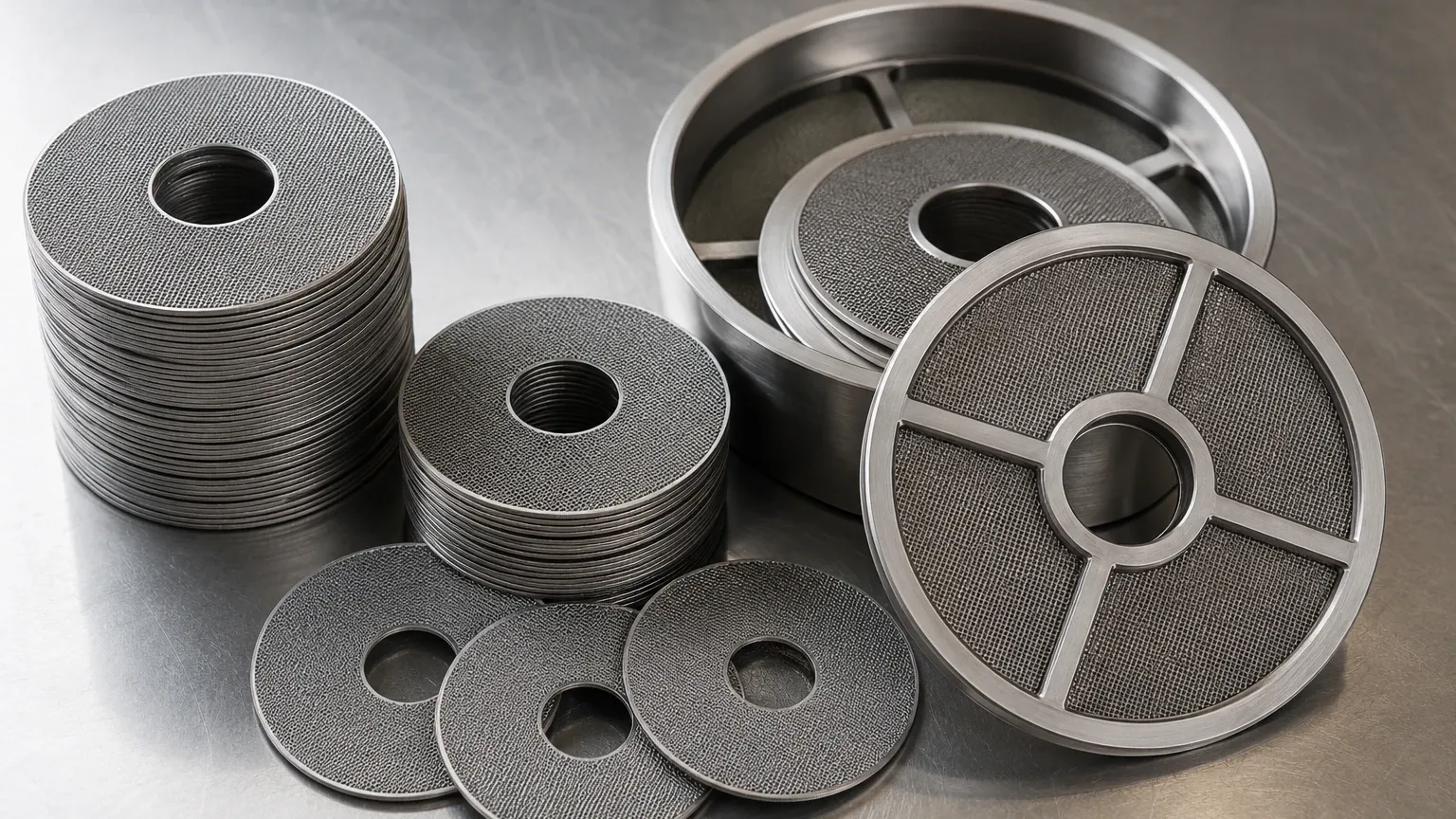
The Role of Custom Metal Filter Discs and Packs
In many B2B industrial scenarios, the standard disc filter arkal configuration is replaced or supplemented by custom-engineered metal solutions. Industries such as polymer extrusion, fiber production, and petrochemical refining require filtration media that can be integrated directly into high-pressure machinery.
Metal Filter Discs & Packs utilize multiple layers of stainless steel wire mesh, often sintered together to create a rigid, porous structure. These components offer several advantages over plastic discs in specialized environments:
* Precision Layering: Engineers can combine different mesh counts to create a graduated filtration effect, mirroring the depth filtration of a disc stack but with much finer control (down to 1-5 microns).
* Structural Rigidity: Sintered mesh discs do not deform under high differential pressure, ensuring consistent filtration performance throughout the production run.
* Cleanability: Unlike plastic discs which are eventually replaced, stainless steel filter packs can often be cleaned using ultrasonic baths, chemical cleaning, or burnout furnaces, allowing for multiple reuse cycles in heavy industry.
Information to Confirm Before Purchasing
Before finalizing a specification for a disc filter arkal system or an alternative metal filtration solution, purchasing teams and engineers should document the following parameters:
1. Fluid Properties: Confirm the viscosity, density, and chemical composition of the fluid. Is it water-based, oil-based, or a corrosive chemical?
2. Contaminant Profile: What is the nature of the solids? Are they hard/abrasive, soft/deformable, or organic/fibrous? This determines whether surface filtration or depth filtration is more appropriate.
3. Operating Environment: Define the maximum operating pressure, surge pressure, and temperature range. Ensure the housing and the internal filter media are rated for these extremes.
4. Maintenance Capabilities: Does the facility have the infrastructure for automated backwashing (compressed air and drainage), or is a manual cleaning process preferred? For metal packs, is there a process in place for ultrasonic cleaning?
5. Regulatory Compliance: In food, beverage, and pharmaceutical applications, ensure all materials (plastics, elastomers, and metals) are FDA-compliant or meet relevant industry standards.
Conclusion
The disc filter arkal remains a cornerstone technology for depth filtration in high-volume water applications. Its ability to manage significant solids loading through a 3D grooved matrix provides a reliable solution for protecting downstream equipment. However, the choice of filtration technology must be driven by the specific rigors of the industrial process. When temperatures exceed the limits of polymers or when precision and durability are paramount, transitioning to stainless steel Filter Discs & Packs ensures that the filtration system supports, rather than hinders, operational efficiency. By carefully evaluating material compatibility and performance metrics, engineers can implement a filtration strategy that balances initial capital expenditure with long-term reliability and performance.
