


Disc Filter Capacity
In industrial filtration, the term "capacity" is often used to describe two distinct but interrelated performance metrics: the maximum flow rate a system can handle (throughput) and the total volume of contaminants a filter can retain before reaching its terminal pressure drop (dirt-holding capacity). For engineers and procurement specialists evaluating Filter Discs & Packs, understanding the nuances of disc filter capacity is essential for optimizing process efficiency, minimizing downtime, and ensuring the longevity of downstream equipment.
Disc filters are versatile components used across various sectors, from polymer melt filtration and hydraulic systems to pharmaceutical processing and food production. Because these filters often operate in high-pressure or high-temperature environments, their capacity is not a static value but a variable influenced by mesh geometry, material properties, and fluid dynamics. This guide examines the technical factors that define disc filter capacity and provides an engineering perspective on selecting the right filtration media for demanding industrial applications.
Understanding the Fundamentals of Disc Filter Capacity
The capacity of a filter disc is primarily determined by its effective filtration area (EFA) and the structural characteristics of the wire mesh. Unlike depth filters, which capture particles throughout a thick medium, thin-metal filter discs often rely on surface filtration or a combination of surface and limited depth filtration in multi-layer configurations.
Effective Filtration Area (EFA)
In any filtration system, the EFA is the total surface area available for the fluid to pass through. For a single filter disc, this is calculated based on the inner diameter of the housing or the exposed mesh area within a bound rim. Increasing the EFA directly enhances the disc filter capacity by distributing the flow over a larger region, which reduces the face velocity—the speed at which the fluid approaches the mesh. Lower face velocities result in lower initial pressure drops and slower rates of cake buildup, effectively extending the service life of the disc.
Pore Size and Open Area
The geometry of the weave determines the "open area" percentage of the mesh. A mesh with a high percentage of open area offers less resistance to flow, thereby increasing the initial throughput capacity. However, there is a technical trade-off: higher open areas often involve thinner wires or larger pore sizes, which may compromise the structural integrity of the disc or the filtration fineness. Engineers must balance the required micron rating with the necessary flow capacity to ensure the system meets both purity and production targets.
Engineering Factors Influencing Throughput and Efficiency
When calculating disc filter capacity for a specific application, several external and internal factors must be considered. These factors dictate how quickly the filter will reach its pressure limit and how often it will require cleaning or replacement.
Fluid Viscosity and Temperature
Viscosity is a primary driver of pressure drop. High-viscosity fluids, such as polymers or heavy oils, require more force to pass through the same mesh openings compared to water or solvents. As viscosity increases, the effective throughput capacity of the disc filter decreases. Temperature plays a critical role here; in many industrial processes, increasing the operating temperature lowers the fluid viscosity, which can significantly improve the flow capacity of the filter packs. However, the filter material must be rated for these elevated temperatures to prevent mechanical failure.
Contaminant Loading and Particle Distribution
The nature of the solids being filtered—their size, shape, and concentration—directly impacts the dirt-holding capacity. If the particle size distribution is narrow and matches the pore size of the mesh, "blinding" or "peening" can occur, where particles become wedged in the openings, rapidly reducing the available capacity. Conversely, a broad distribution of particles can lead to the formation of a permeable filter cake, which may actually assist in filtration but will eventually increase the differential pressure (ΔP).
Flow Velocity and Turbulence
Linear flow is ideal for maintaining consistent filtration performance. As flow rates increase, turbulence can occur near the surface of the mesh, leading to uneven contaminant distribution and localized clogging. Designing systems with appropriate disc diameters ensures that the flow remains within the laminar or transitional regime, preserving the disc filter capacity over a longer duration.
Material Selection and Its Impact on Flow Rates
The material used in the construction of Filter Discs & Packs is a fundamental determinant of both chemical compatibility and mechanical capacity. Stainless steel is the industry standard due to its durability and resistance to various process conditions.
* Stainless Steel 304: Suitable for general industrial applications where basic corrosion resistance is required. It provides a cost-effective solution for non-acidic environments.
* Stainless Steel 316/316L: The preferred choice for pharmaceutical, food and beverage, and marine applications. The addition of molybdenum enhances resistance to pitting and crevice corrosion, ensuring that the mesh maintains its structural integrity and open area even in aggressive chemical environments.
* Specialty Alloys: For extreme conditions involving high temperatures or highly corrosive media, alloys like Inconel, Monel, or Hastelloy may be used. These materials ensure that the filter capacity does not degrade due to material thinning or chemical erosion.
Beyond the alloy type, the type of weave—Plain, Twill, or Dutch Weave—affects the capacity. For instance, Dutch Weave patterns provide a denser structure with higher mechanical strength and finer filtration, but they typically have a lower open area percentage compared to Plain Weave, which may necessitate a larger filter surface to achieve the same flow capacity.
Calculating and Optimizing Disc Filter Capacity for Industrial Systems
To accurately determine the required disc filter capacity, engineers often utilize the Clean Pressure Drop calculation. This involves assessing the pressure loss across a clean filter at a specific flow rate and viscosity.
The Relationship Between ΔP and Service Life
The service life of a filter disc is defined by the time it takes for the pressure drop to rise from its initial state ($P_i$) to its terminal state ($P_t$). A filter with a higher initial capacity will have a lower $P_i$, providing a larger "buffer" for contaminant accumulation. In high-pressure systems, such as plastic extrusion, the terminal pressure can be quite high, allowing for significant cake buildup. In low-pressure gravity systems, however, the capacity is much more sensitive to even minor increases in resistance.
Multi-layer vs. Single-layer Configurations
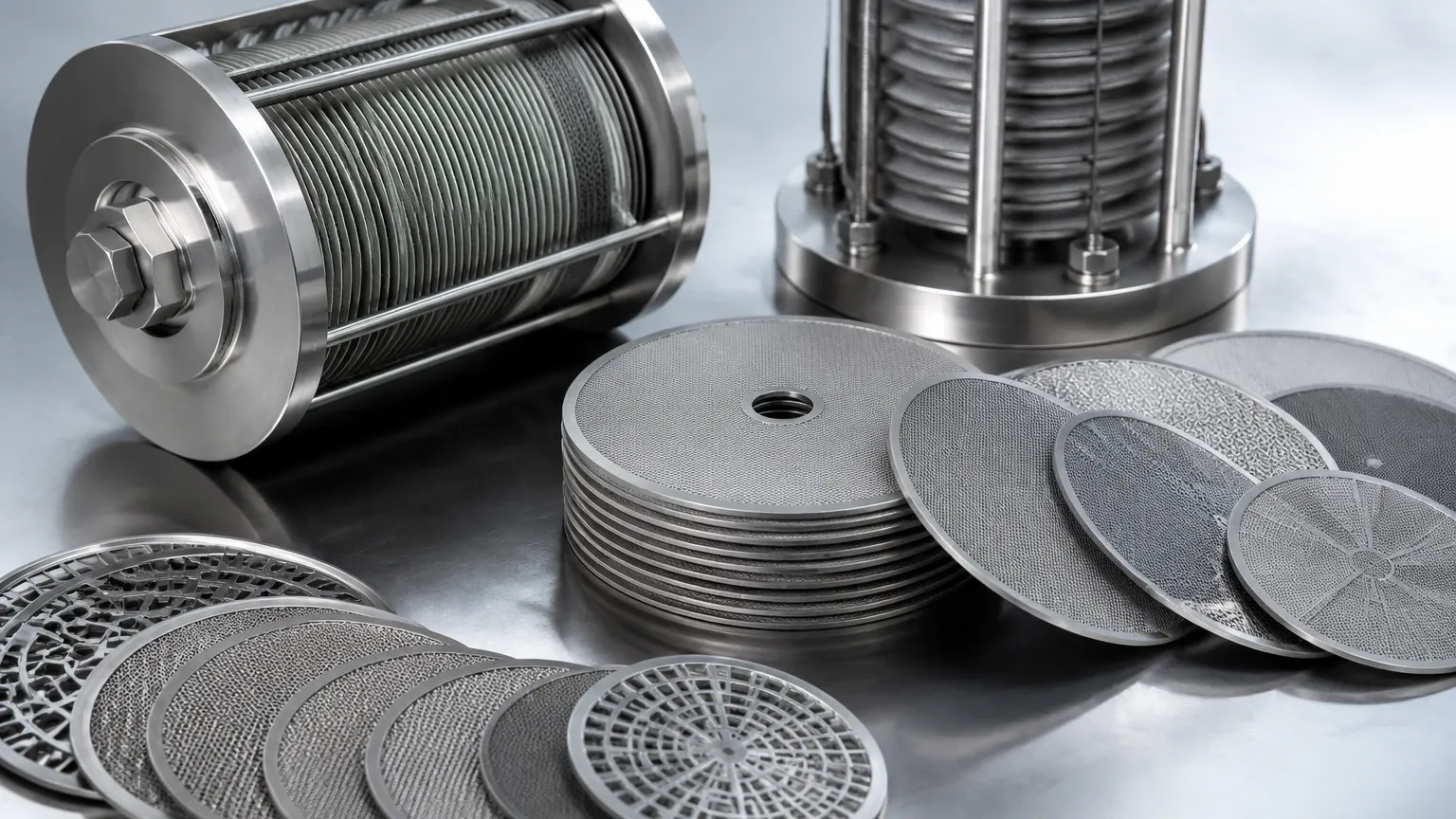
One of the most effective ways to optimize disc filter capacity is through the use of multi-layer filter packs. By layering different mesh counts, engineers can create a gradient filtration effect.
1. Coarse Outer Layers: Act as a support and provide preliminary filtration for large particles.
2. Fine Inner Layer: Performs the primary filtration to the required micron rating.
3. Drainage Layers: Ensure that the fluid can flow laterally toward the discharge point, preventing localized pressure build-up.
This "staged" approach prevents the finest mesh from clogging prematurely, thereby significantly increasing the total dirt-holding capacity of the pack compared to a single-layer disc of the same micron rating.
Common Challenges and Performance Risks in High-Capacity Applications
Maintaining high disc filter capacity requires addressing several common industrial challenges that can lead to premature failure or process inefficiencies.
Media Migration and Deformation
Under high differential pressures, thin wire mesh can deform or "dish." If the mesh stretches, the pore sizes can enlarge, leading to bypass and reduced filtration efficiency. To prevent this, filter discs are often reinforced with thicker support meshes or integrated into rigid rims (aluminum, stainless steel, or copper). These rims not only provide structural support but also ensure a leak-proof seal within the filter housing, preventing fluid from bypassing the media.
Blinding and Cleaning Cycles
Blinding occurs when the mesh openings are blocked by sticky or irregularly shaped particles. For reusable stainless steel discs, the ability to be cleaned (via ultrasonic baths, backflushing, or chemical cleaning) is a key component of their total lifecycle capacity. If a disc cannot be effectively cleaned, its "recovered capacity" diminishes with each cycle, eventually requiring a full replacement. Selecting the right weave type is essential here; for example, plain square weaves are generally easier to clean than complex Dutch weaves.
Edge Leakage
In high-capacity systems, even a small percentage of bypass can lead to significant downstream contamination. The integrity of the disc edge is critical. Spot-welded packs or rimmed discs are designed to eliminate the risk of edge leakage, ensuring that 100% of the fluid passes through the filtration media, thereby utilizing the full disc filter capacity.
Selection Criteria for Industrial Filter Discs & Packs
When specifying Filter Discs & Packs for a new or existing system, engineers should follow a structured evaluation process to ensure the selected components meet the required capacity and performance standards.
1. Define Micron Rating: Determine the absolute or nominal filtration level required to protect downstream components or meet product quality standards.
2. Analyze Fluid Characteristics: Confirm the operating temperature, chemical composition, and viscosity. This dictates material selection and the required EFA.
3. Evaluate Flow Requirements: Calculate the maximum and average flow rates. Ensure the disc diameter and mesh open area can accommodate these rates without exceeding the initial pressure drop limits.
4. Consider Contaminant Levels: Estimate the solids loading in the influent. High solids loading may require multi-layer packs or larger surface areas to maintain reasonable change-out intervals.
5. Mechanical Constraints: Identify the maximum allowable pressure drop and the physical dimensions of the filter housing. Ensure the disc construction (e.g., rimmed vs. unrimmed) is compatible with the sealing mechanism of the equipment.
The Role of Customization in Maximizing Capacity
Standard filter sizes often fail to meet the specific demands of specialized industrial processes. Custom-engineered Filter Discs & Packs allow for the optimization of every variable, from the specific alloy and weave pattern to the exact layering sequence and rim material. By tailoring the disc to the specific particle size distribution and flow dynamics of the application, manufacturers can achieve a balance of high throughput and high dirt-holding capacity that off-the-shelf solutions cannot match.
For instance, in the production of synthetic fibers, the filtration of the polymer melt requires discs that can withstand extreme pressures while removing microscopic gels. A customized multi-layer pack, designed with specific drainage layers, can significantly extend the time between screen changes, directly impacting the plant's overall production capacity and reducing the total cost of ownership.
In conclusion, disc filter capacity is a multifaceted concept that requires a deep understanding of material science and fluid mechanics. By focusing on the effective filtration area, mesh geometry, and the structural integrity of the filter media, industrial professionals can select filtration solutions that provide reliable, high-performance service in even the most demanding environments. Whether the goal is to increase throughput in a chemical refinery or ensure purity in a pharmaceutical lab, the correct application of filter disc technology is a cornerstone of operational excellence.
