


Disc Filter Design
In industrial filtration, the efficiency of a system often depends on the precision of its smallest components. Disc filters, utilized extensively in polymer extrusion, chemical processing, and hydraulic systems, serve as critical barriers against contaminants. A robust disc filter design must account for fluid dynamics, mechanical stress, and chemical compatibility to ensure consistent performance. For engineers and procurement specialists, understanding the technical nuances of these components is essential for optimizing production uptime and maintaining product purity.
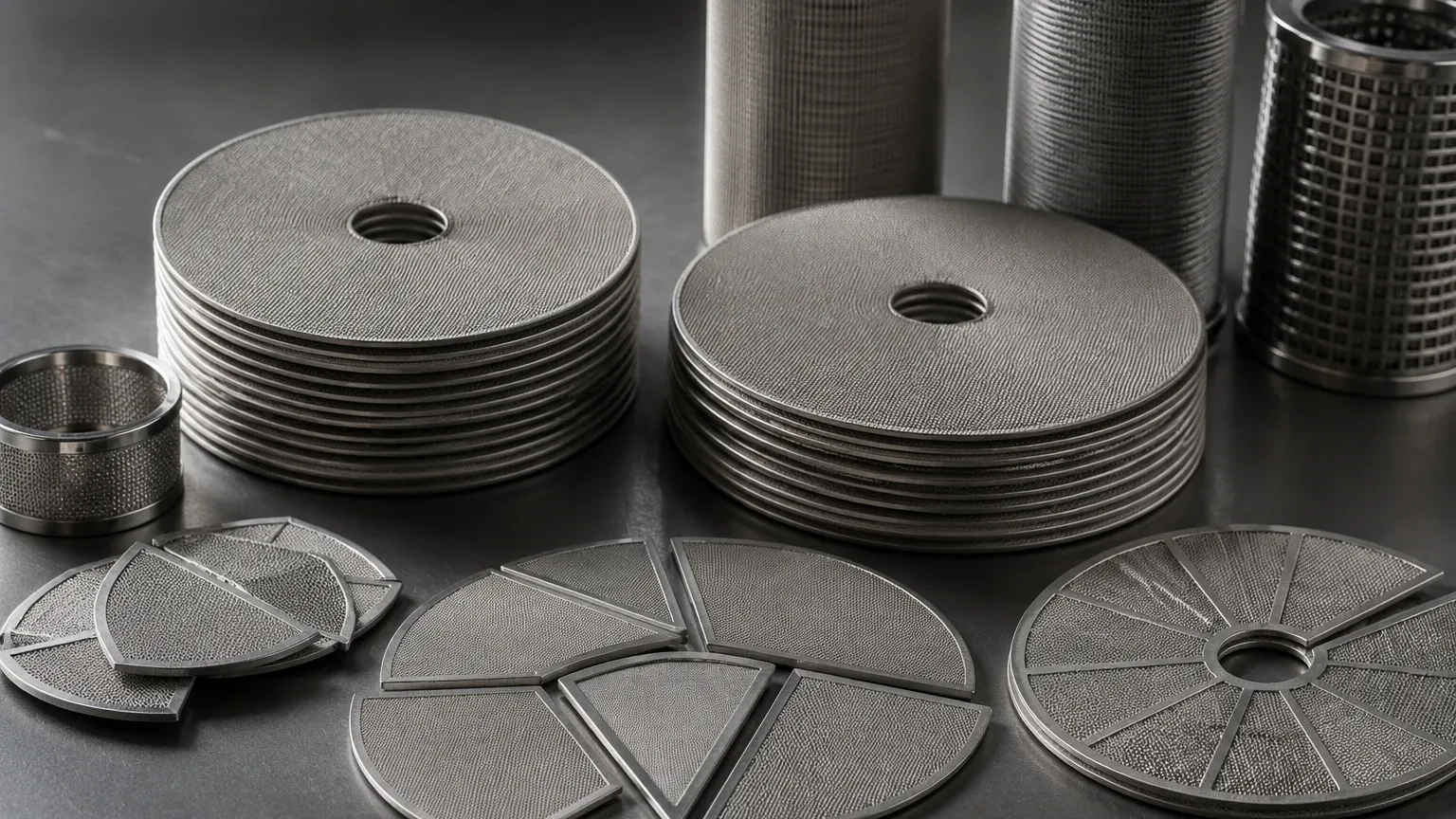
Industrial disc filters are typically manufactured from stainless steel wire mesh or sintered metal fibers. Their primary function is to remove solid particles from liquid or gaseous streams under varying pressures and temperatures. Because these filters often operate in demanding environments—such as high-temperature melt filtration or corrosive chemical environments—the design process requires a rigorous evaluation of materials and structural configurations.
Material Selection in Disc Filter Design
The foundation of any high-performance filter is the material from which it is constructed. In the context of Filter Discs & Packs, stainless steel is the industry standard due to its balance of mechanical strength and corrosion resistance.
Stainless Steel Grades
* Type 304: Suitable for general industrial applications where basic corrosion resistance is required. It is commonly used in food processing and standard hydraulic systems.
* Type 316/316L: Contains molybdenum, which provides superior resistance to chlorides and acids. This is the preferred choice for pharmaceutical and marine applications.
* Specialty Alloys: For extreme environments involving high concentrations of sulfuric acid or high-temperature oxidation, alloys such as Hastelloy, Monel, or Inconel may be integrated into the disc filter design.
Beyond the alloy type, the physical form of the media—whether it is woven wire mesh, sintered metal fiber felt, or perforated plate—dictates the filtration characteristics. Woven wire mesh offers precise pore sizes and is easily cleaned, while sintered fiber felt provides high porosity and dirt-holding capacity, making it ideal for depth filtration applications.
Structural Configurations: Single vs. Multi-layer Packs
A critical decision in disc filter design is whether to utilize a single-layer disc or a multi-layer filter pack. The choice depends on the required filtration fineness and the mechanical pressure the filter must withstand.
Single-Layer Discs
Single-layer discs are typically used in low-pressure applications or as pre-filters. They are cost-effective and easy to replace. However, they lack the structural rigidity required for high-viscosity fluids or high-differential pressure scenarios.
Multi-layer Filter Packs
Multi-layer packs consist of several layers of wire mesh with varying micron ratings. A typical disc filter design for a multi-layer pack includes:
1. Filtration Layer: The middle layer(s) with the finest mesh, responsible for capturing particles at the target micron rating.
2. Support Layers: Coarser mesh layers on either side of the filtration media that provide mechanical strength and prevent the fine mesh from deforming under pressure.
3. Drainage Layers: Coarse layers that facilitate the flow of the filtrate away from the filtration zone, reducing the overall pressure drop.
To maintain the integrity of these layers, they are often joined via spot welding or bound with a metal rim (aluminum or stainless steel). Rimming not only keeps the layers aligned but also provides a better sealing surface within the filter housing, preventing bypass.
Filtration Media and Weave Patterns
The weave pattern of the wire mesh is a primary variable in disc filter design, influencing both the flow rate and the particle retention capability.
* Plain Weave: The most common pattern, where wires cross over and under each other. It provides high flow rates and is suitable for general filtration tasks.
* Twill Weave: Each warp wire passes over and under two shute wires. This allows for a heavier wire diameter and higher strength for a given micron rating.
* Dutch Weave (Plain and Twill): Features a higher density of shute wires than warp wires. This creates a "tortuous path" for particles, offering excellent filtration accuracy and high pressure resistance. Plain Dutch weave is often used for fine filtration in hydraulic systems, while Twill Dutch weave is utilized for the finest sub-micron applications.
When designing a disc filter, engineers must match the weave pattern to the particle size distribution of the contaminant. If the weave is too open, contaminants pass through; if it is too tight, the filter will blind prematurely, leading to frequent downtime.
Engineering for Pressure Drop and Permeability
One of the most significant challenges in disc filter design is managing the pressure drop ($ΔP$). As fluid passes through the filter media, resistance causes a loss in pressure. If the $ΔP$ is too high, it can lead to pump strain, reduced flow rates, or even structural failure of the filter disc.
Permeability is the measure of how easily a fluid can pass through the filter. In a well-engineered disc filter, the design maximizes the effective filtration area (EFA). For a circular disc, the EFA is simply the surface area minus the area covered by the rim or support structures. To optimize permeability, designers often use sintered wire mesh, where multiple layers are fused together under heat and pressure. This process creates a rigid structure with fixed pore sizes that does not shift under high pressure, maintaining a constant flow resistance throughout the filter's service life.
Manufacturing Techniques for Precision Components
Precision in manufacturing is what separates a standard filter from a high-performance component. Advanced disc filter design relies on several key manufacturing processes:
1. Laser and Plasma Cutting: These methods ensure that the discs are cut to exact tolerances, which is vital for a proper fit in the filter assembly. Clean edges prevent fraying of the wire mesh.
2. Sintering: By bonding the contact points of the wires, sintering eliminates the risk of media migration—where individual wires or fibers break off and contaminate the downstream fluid.
3. Ultrasonic Cleaning: Post-production cleaning is essential to remove any residual oils, metal shavings, or dust from the manufacturing process. This is particularly critical in the food, beverage, and pharmaceutical industries.
4. Spot Welding and Rimming: For multi-layer packs, precise spot welding ensures the layers stay together during handling and installation. Rimming provides a compressed edge that acts as a gasket, ensuring that 100% of the fluid passes through the media.
Application-Specific Design Requirements
The optimal disc filter design varies significantly across different industrial sectors. Engineers must tailor the specifications to the unique demands of their process.
Polymer and Plastic Extrusion
In polymer melt filtration, the filters must withstand extremely high temperatures (up to 400°C) and pressures (up to 300 bar). The design usually involves multi-layer sintered packs with heavy-duty support mesh to prevent the fine filtration layer from "ballooning" or bursting.
Hydraulic and Lubrication Systems
For hydraulic fluids, the focus is on maintaining ISO cleanliness codes. Disc filters in these systems are often designed for high-frequency pressure pulses. The use of 316L stainless steel prevents corrosion from moisture that may accumulate in the oil.
Chemical and Petrochemical Processing
Chemical compatibility is the primary concern here. The disc filter design must account for the pH levels and the presence of aggressive solvents. Designers often specify specific alloys and ensure that all welding processes do not compromise the corrosion resistance of the metal.
Maintenance, Cleaning, and Total Cost of Ownership
While the initial cost of a filter disc is an important factor, the total cost of ownership (TCO) is driven by the filter's durability and cleanability. Unlike disposable synthetic filters, stainless steel Filter Discs & Packs are often cleanable and reusable.
Cleaning Methods
* Backwashing: Reversing the flow of the fluid to dislodge particles from the surface of the mesh.
* Chemical Cleaning: Using solvents or acids to dissolve accumulated contaminants without damaging the stainless steel.
* Ultrasonic Bath: Using high-frequency sound waves in a cleaning solution to remove deep-seated particles from the mesh intersections.
* Burn-off (Pyrolysis): For polymer applications, heating the filter in a controlled environment to carbonize the plastic, which is then removed via ultrasonic cleaning.
A robust disc filter design facilitates these cleaning processes by using materials and construction methods (like sintering) that can withstand repeated thermal or chemical cycles. When a filter can be cleaned 10 to 20 times before replacement, the long-term cost per gallon of filtrate is significantly lower than that of disposable alternatives.
Key Considerations Before Procurement
Before finalizing a disc filter design for a specific project, engineers should confirm the following technical parameters with their manufacturer:
* Operating Temperature and Pressure: Both the steady-state and peak conditions.
* Fluid Properties: Viscosity, density, and chemical composition.
* Contaminant Profile: Particle size, shape, and concentration.
* Target Micron Rating: Whether absolute or nominal filtration is required.
* Mechanical Interface: Exact dimensions, tolerances, and sealing requirements.
By addressing these factors during the design phase, technical teams can ensure that the selected filtration solution provides the necessary protection for downstream equipment while optimizing the efficiency of the overall process. Whether it is a simple single-layer disc or a complex sintered multi-layer pack, the right design is the key to reliable industrial filtration.
