


Disc Filter Discs
In the landscape of industrial filtration, precision and durability are the primary drivers of operational efficiency. Disc filter discs, often referred to as wire mesh filter discs, represent a fundamental component in systems requiring high-accuracy particle separation under varying pressure and temperature conditions. As a specialized manufacturer, Kaifil provides engineered Filter Discs & Packs designed to meet the rigorous demands of chemical processing, polymer extrusion, and hydraulic applications.
Selecting the appropriate disc filter discs involves more than choosing a diameter and a micron rating. It requires a deep understanding of material science, weave mechanics, and the fluid dynamics of the specific application. This guide explores the technical parameters, construction methods, and engineering considerations essential for optimizing filtration performance.
Understanding the Role of Disc Filter Discs in Industrial Systems
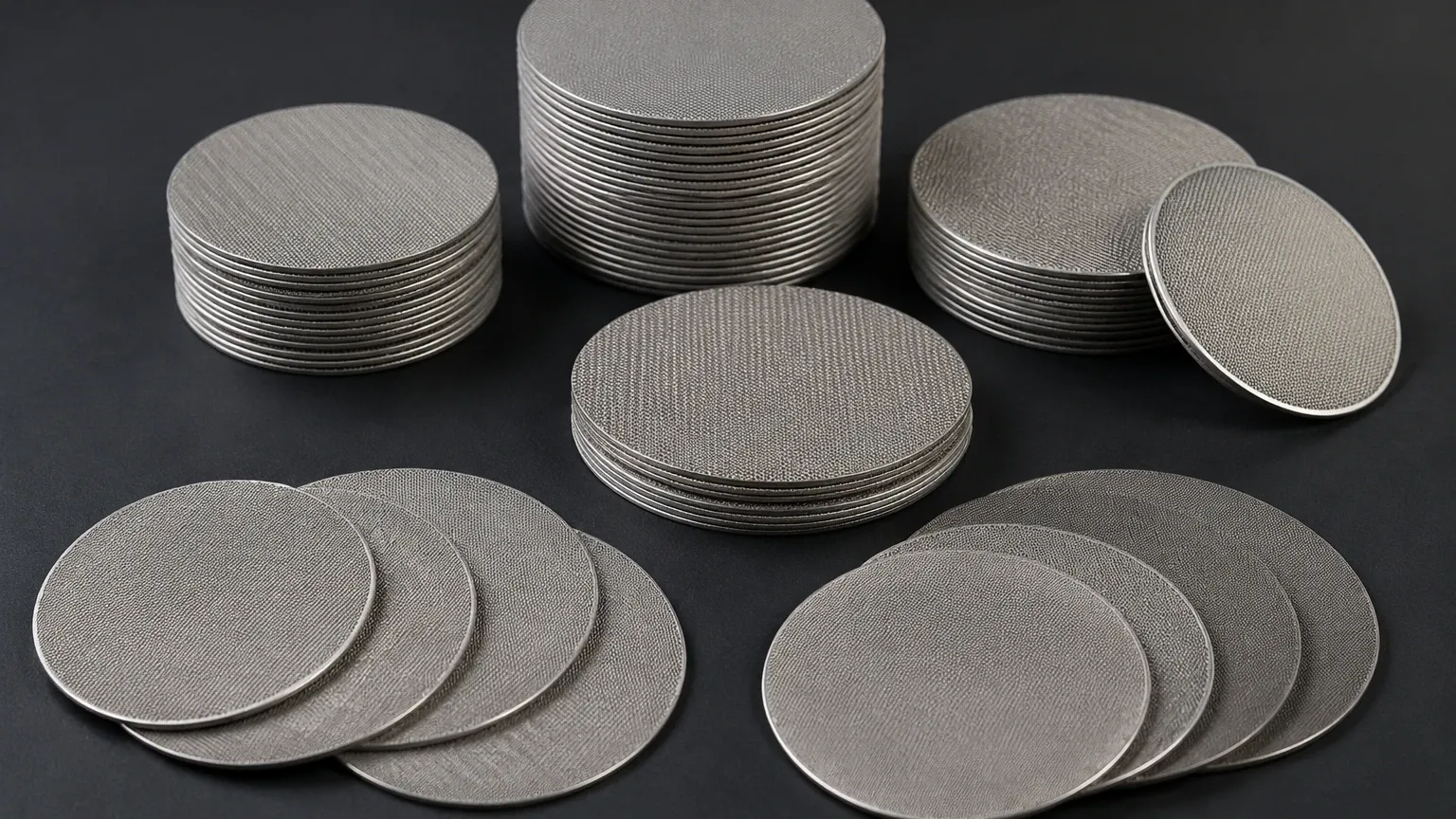
Disc filter discs are circular filtration elements typically manufactured from stainless steel wire mesh. Their primary function is to remove solid contaminants from liquid or gaseous media. Unlike depth filters, which trap particles within a thick medium, wire mesh discs provide surface filtration where particles larger than the mesh openings are retained on the upstream side.
These components are critical in processes where consistent flow rates and precise particle retention are non-negotiable. In polymer extrusion, for example, disc filter discs are used in screen changers to remove impurities from molten plastic, preventing defects in the final product and protecting downstream equipment like spinnerets or molds. In hydraulic systems, they serve as last-chance filters to protect sensitive valves from catastrophic failure due to particulate ingress.
Material Selection and Engineering Specifications
The performance of disc filter discs is largely dictated by the alloy and the wire diameter used in the mesh. Stainless steel is the industry standard due to its mechanical strength and resistance to environmental degradation.
Grade 304 vs. Grade 316L
Stainless steel 304 is the most common choice for general industrial applications, offering excellent strength and basic corrosion resistance. However, for environments involving high salinity, acidic chemicals, or pharmaceutical processing, Grade 316L is preferred. The addition of molybdenum in 316L enhances resistance to pitting and crevice corrosion, while the "L" (low carbon) designation prevents carbide precipitation during welding, ensuring structural integrity in high-temperature zones.
Weave Types and Their Impact
The geometry of the weave determines the filtration accuracy and the mechanical stability of the disc:
* Plain Weave: The simplest pattern, where wires cross over and under each other. It offers high flow rates but is generally limited to coarser filtration levels.
* Twill Weave: Each shute wire passes over and under two warp wires, allowing for a heavier wire diameter in a given mesh count. This increases the disc's durability.
* Dutch Weave (Plain and Twill): These weaves utilize a higher density of shute wires than warp wires, creating a tortuous path for the fluid. Dutch weaves provide the finest filtration ratings (down to 5 microns) and superior mechanical strength, making them ideal for high-pressure applications.
Structural Configurations: Single-Layer vs. Multi-Layer Packs
Depending on the pressure drop requirements and the nature of the contaminants, disc filter discs are produced in several configurations.
Single-Layer Discs
Single-layer discs are used in applications with low pressure differentials and where frequent cleaning or replacement is feasible. They are precision-cut to exact tolerances to ensure a tight seal within the filter housing.
Multi-Layer Filter Packs
In many industrial scenarios, a single layer of mesh lacks the necessary rigidity or dirt-holding capacity. Multi-layer Filter Discs & Packs are engineered by layering different mesh counts. Typically, a fine filtration layer is sandwiched between coarser support layers. The support layers protect the delicate fine mesh from deformation under pressure and provide a drainage path for the filtered fluid.
Bonding and Edging
To prevent bypass and ensure ease of handling, multi-layer packs can be finished in several ways:
* Spot Welding: The layers are joined at specific points to maintain alignment.
* Rimming (Framing): The edges of the disc are enclosed in a metal rim, usually made of aluminum, stainless steel, or copper. This provides a superior seal, prevents edge fraying, and adds significant structural rigidity.
* Sintering: In extreme high-pressure environments, the layers are diffusion-bonded (sintered) together. This creates a monolithic structure where the wires cannot shift, ensuring a permanent and unchanging pore size.
Technical Selection Criteria for Engineering Teams
When specifying disc filter discs for a new or existing system, engineers must evaluate several interconnected variables to avoid premature failure or system inefficiency.
Micron Rating: Absolute vs. Nominal
It is vital to distinguish between nominal and absolute filtration. A nominal rating refers to the ability of the mesh to retain a majority of particles at a certain size, whereas an absolute rating guarantees that no particle larger than the specified size will pass through. For critical applications like pharmaceutical manufacturing or fine chemical synthesis, absolute-rated disc filter discs are mandatory.
Pressure Drop ($ΔP$)
The pressure drop across the filter disc is a function of the mesh open area, fluid viscosity, and flow velocity. An incorrectly specified disc can lead to an excessive initial pressure drop, reducing the effective service life of the filter and increasing energy consumption by the pumps or extruders.
Effective Filtration Area (EFA)
The EFA is the total surface area available for filtration. In disc-based systems, increasing the EFA usually involves increasing the disc diameter or using a multi-disc stack. A higher EFA results in lower flux (flow per unit area), which generally improves filtration efficiency and extends the time between cleaning cycles.
Application-Specific Considerations in Demanding Environments
Different industries impose unique stresses on filtration components. Understanding these helps in customizing the disc design.
Polymer and Plastic Extrusion
In this sector, disc filter discs must withstand temperatures exceeding 300°C and pressures up to 500 bar. The primary challenge is "gel" removal and preventing the mesh from collapsing into the breaker plate. Strong support layers and high-quality stainless steel are non-negotiable here.
Chemical and Petrochemical Processing
Corrosion is the primary concern. Engineers must account for the chemical compatibility of the mesh, the rimming material, and even the welding flux. In some cases, specialized alloys like Hastelloy or Monel may be required if standard 316L stainless steel is insufficient for the chemical load.
Food and Beverage
Hygiene and cleanability are paramount. Disc filter discs used in this industry must be free of lubricants from the weaving process and often require ultrasonic cleaning before installation. The construction must be free of crevices where bacteria could proliferate, favoring rimmed or sintered designs over simple spot-welded packs.
Manufacturing Precision and Quality Assurance
The reliability of a disc filter disc is only as good as the manufacturing process used to create it. At Kaifil, we emphasize precision at every stage of production.
Cutting Technologies
Traditional mechanical punching is efficient for high-volume production of standard sizes. However, for custom geometries or very thin meshes, laser cutting or EDM (Electrical Discharge Machining) is used to ensure burr-free edges and dimensional accuracy within microns. This precision is critical for ensuring that the disc fits perfectly in the housing, preventing any "bypass" of unfiltered fluid.
Cleanliness and Inspection
Industrial filters must be delivered in a state that does not introduce new contaminants into the system. Post-production cleaning, often involving ultrasonic baths, removes residual oils and metallic dust. Quality control includes bubble point testing to verify the integrity of the mesh and the accuracy of the micron rating, ensuring that every disc meets the specified performance boundaries.
Optimizing Performance and Total Cost of Ownership
While the initial purchase price of disc filter discs is a factor, the total cost of ownership (TCO) is driven by durability, cleaning costs, and the impact on production uptime. High-quality stainless steel discs can often be cleaned and reused multiple times, provided the cleaning process (such as pyrolysis, chemical cleaning, or ultrasonic treatment) does not damage the mesh structure.
Investing in a more robust multi-layer pack or a rimmed disc may have a higher upfront cost but often results in significantly lower operational costs due to extended service intervals and reduced risk of filter failure. Furthermore, working with an OEM partner like Kaifil allows for the development of customized filtration solutions tailored to specific flow conditions, which can optimize energy usage and product yield.
For engineers and purchasing teams, the goal is to balance filtration fineness with mechanical longevity. By selecting the right combination of alloy, weave, and structural configuration, industrial operations can achieve stable, high-performance filtration that protects both the product quality and the downstream equipment.
To explore specific configurations or request a technical consultation on custom filtration requirements, Review product options and application support to ensure your system operates at peak efficiency.
