


Disc Filter for Water Tank
In industrial water management, maintaining the purity of stored liquids is a critical engineering challenge. Whether for chemical processing, food and beverage production, or pharmaceutical manufacturing, the water stored in tanks must remain free of particulate matter, sediment, and biological contaminants. A disc filter for water tank applications serves as a primary line of defense, utilizing precision-engineered wire mesh to capture solids before they can compromise downstream processes or damage sensitive equipment.
Selecting the appropriate Filter Discs & Packs requires a deep understanding of fluid dynamics, material science, and the specific mechanical requirements of the storage system. This article examines the technical specifications, design variations, and engineering considerations essential for integrating disc filters into industrial water tank environments.
Technical Specifications and Material Engineering
The performance of a disc filter is fundamentally determined by its material composition and the weave of the wire mesh. In water tank applications, stainless steel is the industry standard due to its corrosion resistance and structural integrity.
Grade 304 vs. Grade 316L Stainless Steel
For standard industrial water applications, Type 304 stainless steel provides excellent durability and resistance to oxidation. However, in environments involving deionized water, high-salinity water, or chemical additives, Type 316L is preferred. The addition of molybdenum in 316L enhances resistance to pitting and crevice corrosion, which is vital for filters that remain submerged or in contact with stagnant water for extended periods.
Weave Types and Filtration Precision
The precision of a disc filter depends on the weave pattern of the wire mesh. Engineers typically choose between three primary types:
1. Plain Weave: Suitable for high-flow applications with relatively large particle size requirements. It offers a high percentage of open area and low pressure drop.
2. Dutch Weave: This weave uses different wire diameters in the warp and weft directions, creating a denser, more robust mesh. It is ideal for fine filtration and high-pressure environments where structural stability is paramount.
3. Twilled Weave: Used for the finest micron ratings, allowing for a thicker mesh that can withstand significant mechanical stress without deforming.
Structural Design of Filter Discs & Packs
In industrial water tanks, filters are often subjected to varying flow rates and pressure fluctuations. The structural design of the filter must account for these stresses to prevent bypass or mechanical failure.
Single-Layer vs. Multi-Layer Discs
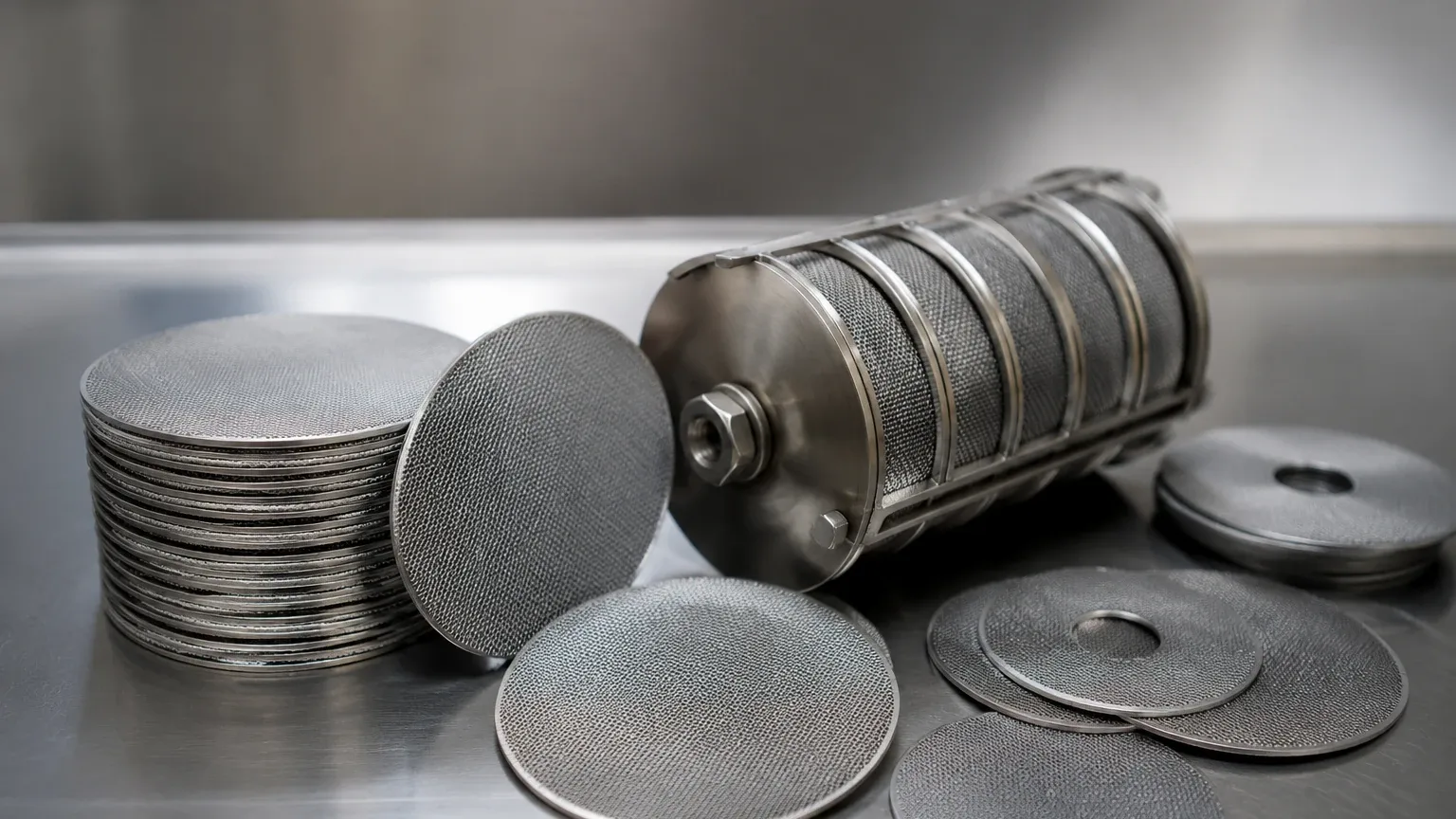
Single-layer filter discs are cost-effective for simple straining tasks. However, for most water tank applications, multi-layer Filter Discs & Packs are recommended. These packs consist of several layers of wire mesh bonded together through spot welding or rimming.
* Surface Layer: The finest mesh layer that determines the filtration accuracy.
* Support Layers: Coarser mesh layers that provide mechanical strength and prevent the fine mesh from collapsing under pressure.
* Drainage Layers: Ensure that the filtered water flows efficiently through the assembly, minimizing the pressure differential (ΔP).
Edge Finishing and Rimming
To ensure a leak-proof fit within a housing or tank port, disc filters often feature specialized edge treatments. Rimming involves wrapping the edge of the disc in a metal U-channel—typically aluminum or stainless steel. This not only prevents the wire mesh from fraying but also provides a flat, stable surface for gaskets and seals, ensuring that all water passes through the filter medium rather than around it.
The Role of the Disc Filter for Water Tank Protection
A disc filter for water tank serves multiple roles depending on its placement within the system. Understanding these roles is crucial for proper sizing and specification.
Inlet Filtration
Placing a disc filter at the tank inlet prevents sediment, pipe scale, and external debris from entering the storage vessel. This reduces the frequency of tank cleaning and protects internal components like level sensors and heating elements from abrasive wear.
Outlet and Pump Protection
Installing filter discs at the tank outlet ensures that the water delivered to the process remains clean. This is particularly important for protecting high-pressure pumps and spray nozzles, which can be easily clogged by even small particles. In these cases, the disc filter acts as a "last chance" safety component.
Tank Venting and Breathability
As water levels rise and fall, air must move in and out of the tank. A disc filter installed in the vent assembly prevents airborne dust, insects, and microbial spores from entering the tank. For these applications, the filter must balance fine filtration with high air permeability to prevent the tank from collapsing or over-pressurizing.
Engineering Selection Criteria
When specifying a disc filter for water tank systems, engineers must evaluate several performance metrics to ensure long-term reliability.
Micron Rating: Absolute vs. Nominal
* Nominal Rating: Indicates the filter's ability to retain a majority of particles of a specific size (e.g., 90% of 20-micron particles). This is suitable for general-purpose water storage.
* Absolute Rating: Refers to the diameter of the largest hard spherical particle that will pass through the filter under specified test conditions. This is critical for pharmaceutical or high-purity chemical applications where zero-bypass is required.
Flow Rate and Pressure Drop (ΔP)
The pressure drop across a clean filter disc should be kept as low as possible—typically below 2-5 psi for gravity-fed systems. A high initial ΔP indicates that the filter is undersized or the mesh is too dense for the required flow rate. Engineers must calculate the Effective Filtration Area (EFA) to ensure the disc can handle the peak flow requirements of the tank system without causing cavitation in downstream pumps.
Chemical and Thermal Compatibility
While stainless steel is robust, certain water treatments (such as high-concentration chlorine or acidic descaling agents) can affect the lifespan of the filter. It is essential to confirm that the mesh material and the rimming metal are compatible with the specific chemical profile of the water and the cleaning protocols used on-site.
Maintenance, Cleaning, and Replacement Cycles
One of the primary advantages of stainless steel Filter Discs & Packs is their cleanability. Unlike disposable synthetic filters, metal discs can be refurbished multiple times, significantly reducing the total cost of ownership (TCO).
Cleaning Protocols
1. Backwashing: For coarse filters, reversing the flow of water can dislodge surface-level debris.
2. Ultrasonic Cleaning: For fine or multilayer packs, ultrasonic baths are highly effective at removing deep-seated particles from the mesh interstices without damaging the wire structure.
3. Chemical Cleaning: Soaking in mild detergents or specialized solvents can remove organic biofilms or mineral scale.
Identifying Replacement Needs
A disc filter should be replaced if it shows signs of permanent deformation (blinding), wire breakage, or if the pressure drop remains high even after thorough cleaning. In critical applications, a scheduled replacement cycle is often established based on empirical data to prevent unexpected downtime.
Customization and OEM Considerations
Every industrial water system has unique geometric and functional requirements. Standard off-the-shelf filters may not always provide the optimal fit. Customization options for Filter Discs & Packs include:
* Custom Shapes: Beyond circular discs, filters can be manufactured in oval, rectangular, or complex geometric shapes to fit specific tank ports or manifold designs.
* Variable Micron Layers: Engineers can specify a custom stack of mesh layers to achieve a specific balance between filtration depth and flow capacity.
* Integrated Gaskets: Some designs incorporate polymer or rubber seals directly onto the rimmed edge to simplify installation and ensure a hermetic seal.
Conclusion
Integrating a disc filter for water tank applications is an essential step in safeguarding industrial water quality. By selecting high-quality stainless steel Filter Discs & Packs, engineering teams can ensure consistent filtration performance, protect downstream equipment, and minimize maintenance costs.
When evaluating filtration solutions, it is vital to look beyond the initial purchase price and consider the material grade, structural design, and cleanability of the component. A well-specified metal disc filter provides a durable, high-performance solution that meets the rigorous demands of modern industrial processing. For engineers and purchasing teams, partnering with a manufacturer that offers technical guidance and OEM customization is the most effective way to achieve optimized filtration results tailored to specific application needs.
