


Disc Filter for Drip Irrigation
In modern agricultural and industrial water management, the efficiency of a drip irrigation system is fundamentally tied to the quality of its filtration. Drip irrigation emitters, designed to deliver precise amounts of water and nutrients directly to the root zone, possess extremely small orifices. These narrow passages are highly susceptible to clogging from organic matter, sand, silt, and chemical precipitates. To mitigate this risk, engineers and system designers rely on the disc filter for drip irrigation as a primary defense mechanism. Unlike traditional screen filters, disc filtration provides a unique combination of surface and depth filtration, making it particularly effective in handling diverse water qualities.
For industrial-scale operations and manufacturers of irrigation equipment, selecting the right filtration components is critical. High-quality Filter Discs & Packs are engineered to withstand the rigorous demands of continuous operation, ensuring that the irrigation network remains functional and the crop yield is protected from the consequences of uneven water distribution.
The Mechanics of Disc Filtration Technology
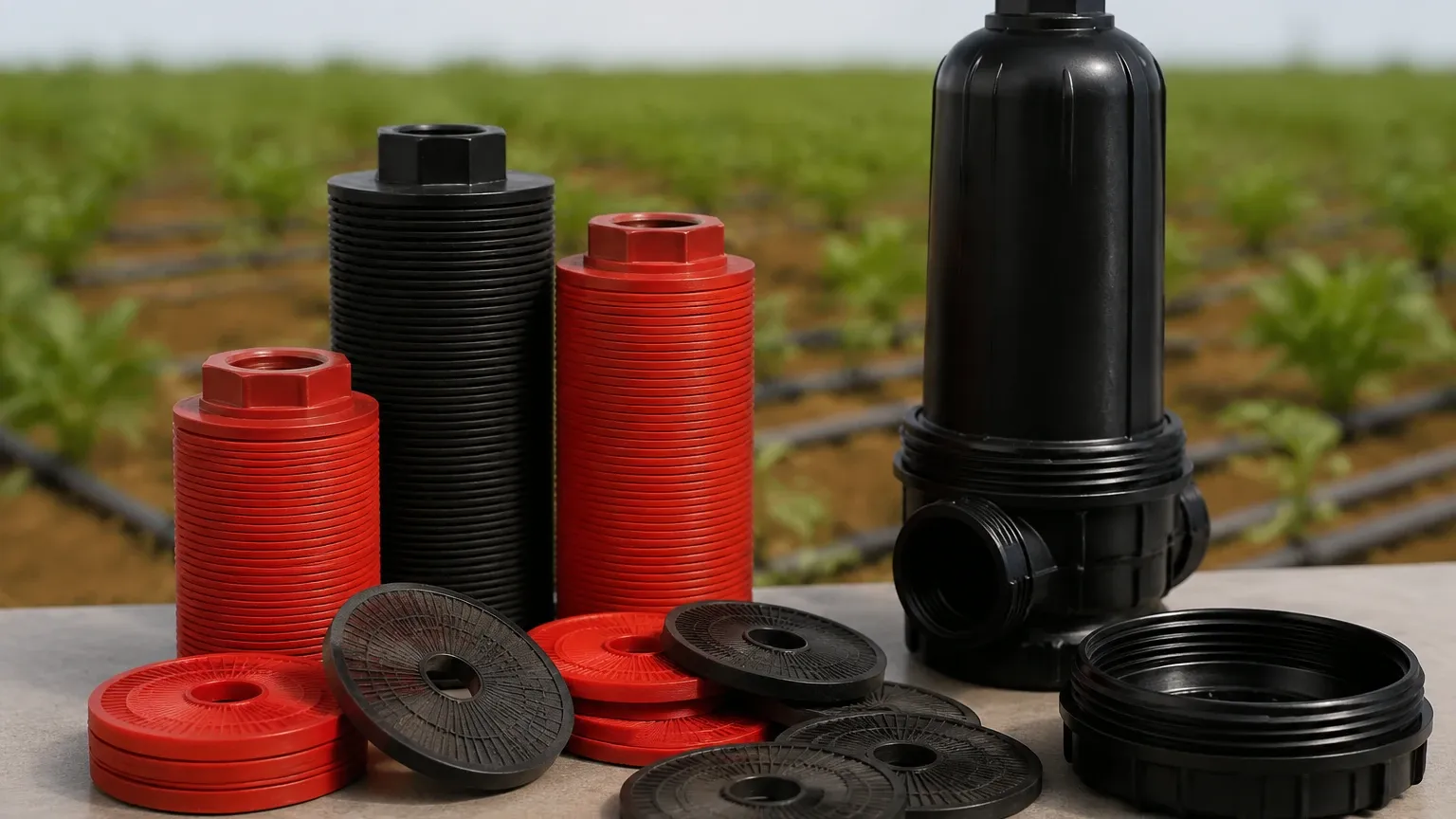
A disc filter operates using a stack of thin, grooved plastic or metal discs. These discs are compressed together on a telescopic spine. Each disc is manufactured with microscopic grooves on both sides; when stacked, the grooves of adjacent discs cross each other, creating a complex series of intersecting channels. This structure forms a three-dimensional filtration matrix.
When water enters the filter housing, it is forced through these channels from the outside of the stack toward the center. The filtration process occurs in two stages:
1. Surface Filtration: Larger particles are trapped on the outer surface of the disc stack.
2. Depth Filtration: Smaller particles are captured within the intersecting grooves as the water travels through the depth of the compressed stack.
This dual-action mechanism is what distinguishes the disc filter for drip irrigation from simple screen filters. While a screen filter only captures particles larger than its mesh size on a single plane, the disc stack provides multiple opportunities to trap contaminants, significantly increasing the dirt-holding capacity and extending the intervals between cleaning cycles.
Key Advantages of Using a Disc Filter for Drip Irrigation
For technical professionals evaluating filtration options, disc filters offer several distinct advantages over screen and media (sand) filters, particularly in challenging environments.
Superior Handling of Organic Loads
One of the primary challenges in irrigation is the presence of algae, moss, and other organic debris, especially when sourcing water from open reservoirs or canals. Screen filters often fail in these scenarios as organic matter can "slime" over the mesh, leading to rapid pressure drops. The depth filtration of Filter Discs & Packs allows them to trap organic fibers and soft particles within the grooves without immediately sealing the entire filter surface.
Durability and Chemical Resistance
Industrial irrigation often involves the injection of fertilizers (fertigation) or acids for pH adjustment. Disc filters, particularly those utilizing high-grade polymers or stainless steel components, offer excellent resistance to corrosive chemicals. This durability ensures that the filter elements do not degrade or lose their filtration precision over time, even when exposed to aggressive agricultural chemicals.
Compact Footprint and Scalability
Compared to media filters, which require large tanks and significant amounts of sand or gravel, disc filters are highly compact. They can be installed in modular configurations to handle varying flow rates. This scalability makes them ideal for both small-scale precision farming and large-scale industrial landscapes where space and installation costs are significant considerations.
Engineering Specifications: Micron Ratings and Flow Rates
When specifying a disc filter for drip irrigation, engineers must balance filtration precision with system flow requirements. The performance of the filter is defined by its micron rating and its ability to maintain a manageable pressure differential ($ΔP$).
Determining the Required Micron Rating
The filtration grade required is usually dictated by the drip emitter manufacturer. Most drip systems require filtration between 100 and 130 microns (equivalent to 120 to 150 mesh). If the filtration is too coarse, emitters will clog; if it is too fine, the filter will require excessive cleaning, leading to operational inefficiencies. In high-precision applications, multi-layered Filter Discs & Packs can be used to provide graduated filtration, capturing larger particles in the outer layers and finer particles toward the core.
Flow Rate and Pressure Drop Considerations
Every filter introduces a degree of resistance to the flow. Engineers must calculate the "clean pressure drop" and establish a threshold for the "dirty pressure drop" at which the filter must be cleaned or backwashed. A typical disc filter system is designed to operate with a pressure loss of less than 3-5 psi when clean. If the flow rate exceeds the filter's rated capacity, the velocity of the water can force contaminants through the disc stack, compromising the downstream system.
Material Selection: Enhancing Durability with Stainless Steel
While plastic disc filters are common in standard agricultural applications, demanding industrial environments often require more robust materials. Stainless steel filtration components offer several benefits that plastic cannot match, particularly in terms of structural integrity and thermal stability.
Custom stainless steel Filter Discs & Packs are frequently used in the pre-filtration stages of industrial water treatment and high-pressure irrigation systems. Stainless steel wire mesh can be sintered or welded into disc forms to provide precise filtration ratings with much higher mechanical strength. This is particularly important in systems where water hammer or high-pressure fluctuations occur, as plastic discs may deform or bypass under extreme stress.
Furthermore, stainless steel components are easier to sterilize and clean using high-temperature water or specialized chemical washes, which is a critical factor in pharmaceutical or food-grade irrigation applications where biofilm growth must be strictly controlled.
Customization and OEM Solutions for Large-Scale Irrigation
No two irrigation projects are identical. Factors such as water source turbidity, seasonal biological loads, and specific emitter requirements necessitate customized filtration solutions. For original equipment manufacturers (OEMs), the ability to integrate bespoke Filter Discs & Packs into their system designs is a significant competitive advantage.
Customization options include:
* Variable Micron Ratings: Tailoring the groove depth or mesh size to specific water profiles.
* Specialized Dimensions: Designing disc stacks that fit into proprietary housing geometries to optimize space.
* Reinforced Structures: Adding support frames or internal cores to ensure the filter pack remains stable under high differential pressures.
By working with a specialized manufacturer like Kaifil, engineers can develop filtration components that are optimized for the specific flow dynamics and contaminant types found in their target applications, rather than relying on off-the-shelf solutions that may underperform.
Maintenance and Operational Efficiency
The longevity of a disc filter for drip irrigation depends on a consistent maintenance regime. There are two primary methods for cleaning disc filters: manual cleaning and automatic backwashing.
Manual Cleaning
In manual systems, the filter housing is opened, and the disc stack is loosened. This allows the discs to separate slightly. The operator then rinses the discs with pressurized water to flush out the trapped debris. While cost-effective for smaller installations, manual cleaning is labor-intensive and requires system downtime.
Automatic Backwashing
For large-scale or remote operations, automatic backwash disc filters are the industry standard. When the pressure differential across the filter reaches a pre-set limit (e.g., 7-10 psi), a controller triggers a backwash cycle. The flow of water is reversed, and the disc stack is decompressed. High-velocity jets of water spray the discs from the inside out, causing them to spin and release trapped particles. This process typically takes less than a minute and uses a minimal amount of water, ensuring continuous irrigation without manual intervention.
Pre-Purchase Considerations for Purchasing Teams
Before finalizing a procurement order for irrigation filtration components, purchasing teams and engineers should confirm several technical details to ensure long-term performance and cost-effectiveness:
1. Water Analysis: What is the nature of the contaminants? (e.g., sand vs. algae). This determines whether a standard disc or a specialized multi-layer pack is needed.
2. System Pressure: What are the minimum and maximum operating pressures? Ensure the Filter Discs & Packs are rated for the peak pressure of the pump system.
3. Chemical Compatibility: Will the system be used for fertigation? Verify that the disc materials and seals are compatible with the intended chemicals.
4. Replacement Cycle: What is the expected lifespan of the filter elements under typical operating conditions? High-quality metal components often offer a lower total cost of ownership (TCO) due to their extended service life compared to cheaper plastic alternatives.
Conclusion
The disc filter for drip irrigation remains one of the most reliable and versatile technologies for protecting sensitive irrigation emitters. By providing a three-dimensional filtration path, these systems effectively manage both inorganic and organic contaminants that would quickly overwhelm other filter types. Whether utilizing standard polymer discs for agricultural use or high-performance stainless steel Filter Discs & Packs for industrial water treatment, selecting the correct filtration component is the most effective way to ensure the longevity and efficiency of a drip irrigation network. Through careful engineering, material selection, and regular maintenance, disc filtration provides a robust solution for the most demanding water quality challenges.
