


Disc Filter for Water Treatment
In industrial water treatment, the selection of filtration media significantly impacts operational efficiency, maintenance frequency, and the overall quality of the output. While various technologies exist, the use of a disc filter for water treatment—specifically those constructed from high-grade stainless steel—has become a standard for applications requiring durability and precision. These components are essential in protecting downstream equipment, such as membranes and high-pressure pumps, by removing suspended solids and particulate matter from the water stream.
Industrial-grade Filter Discs & Packs are engineered to withstand harsh environments where plastic or disposable media might fail. This guide examines the technical considerations, material properties, and engineering requirements involved in selecting the right disc filtration solution for industrial water applications.
The Role of Disc Filters in Industrial Water Treatment
Disc filters operate on a principle of surface or depth filtration depending on their configuration. In a water treatment context, they are often utilized for pre-filtration in reverse osmosis (RO) systems, cooling tower water loops, and wastewater reclamation. The primary function of a disc filter for water treatment is to provide a consistent barrier against contaminants while maintaining a low pressure drop.
Unlike traditional sand filters, which require significant space, or disposable cartridge filters, which generate ongoing waste, stainless steel disc filters offer a compact and reusable alternative. They are particularly effective in handling high-flow rates and varying solid loads. In industrial settings, these filters are typically housed in pressurized vessels where the water is forced through the mesh layers, capturing particles on the surface or within the multi-layered structure of the pack.
Technical Specifications: Materials and Construction
The performance of a disc filter is fundamentally tied to its material composition. For water treatment, stainless steel is the preferred material due to its mechanical strength and resistance to corrosion.
Stainless Steel Grades
* Type 304 Stainless Steel: This is the standard grade used for general industrial water applications. It provides excellent strength and good corrosion resistance for treated water or low-salinity environments.
* Type 316L Stainless Steel: For applications involving brackish water, seawater, or water with high chloride content, 316L is required. The addition of molybdenum enhances its resistance to pitting and crevice corrosion, which is a common failure point in water treatment systems.
* Specialty Alloys: In highly aggressive chemical processing or high-temperature water systems, alloys like Hastelloy or Monel may be used to ensure the structural integrity of the filter discs.
Weave Types and Filtration Layers
The filtration efficiency is determined by the weave of the wire mesh. Plain weave is common for coarse filtration, while Dutch weave (Plain or Twill) is used for finer micron ratings. Dutch weave patterns allow for a higher density of wires, creating a tortuous path that improves particle retention without significantly compromising flow velocity.
Performance Metrics: Filtration Accuracy and Flow Dynamics
When engineers evaluate a disc filter for water treatment, two primary metrics take precedence: the micron rating and the differential pressure ($ΔP$).
Micron Rating: Absolute vs. Nominal
It is critical to distinguish between nominal and absolute micron ratings. A nominal rating refers to the ability of the filter to retain a major percentage of particles of a certain size. In contrast, an absolute rating indicates that 99.9% of particles larger than the specified micron size will be captured. For sensitive water treatment processes, such as protecting fine spray nozzles or RO membranes, absolute-rated Filter Discs & Packs are generally required to prevent bypass.
Pressure Drop and Flow Rate
The pressure drop across a clean filter disc is a function of the mesh open area and the fluid velocity. A well-engineered disc filter minimizes initial $ΔP$ to reduce the energy load on pumps. As the filter accumulates debris, the pressure drop increases. Engineers must calculate the "terminal pressure drop"—the point at which the filter must be cleaned or replaced—to prevent structural collapse of the mesh or localized breakthrough of contaminants.
Customization and Engineering of Filter Packs
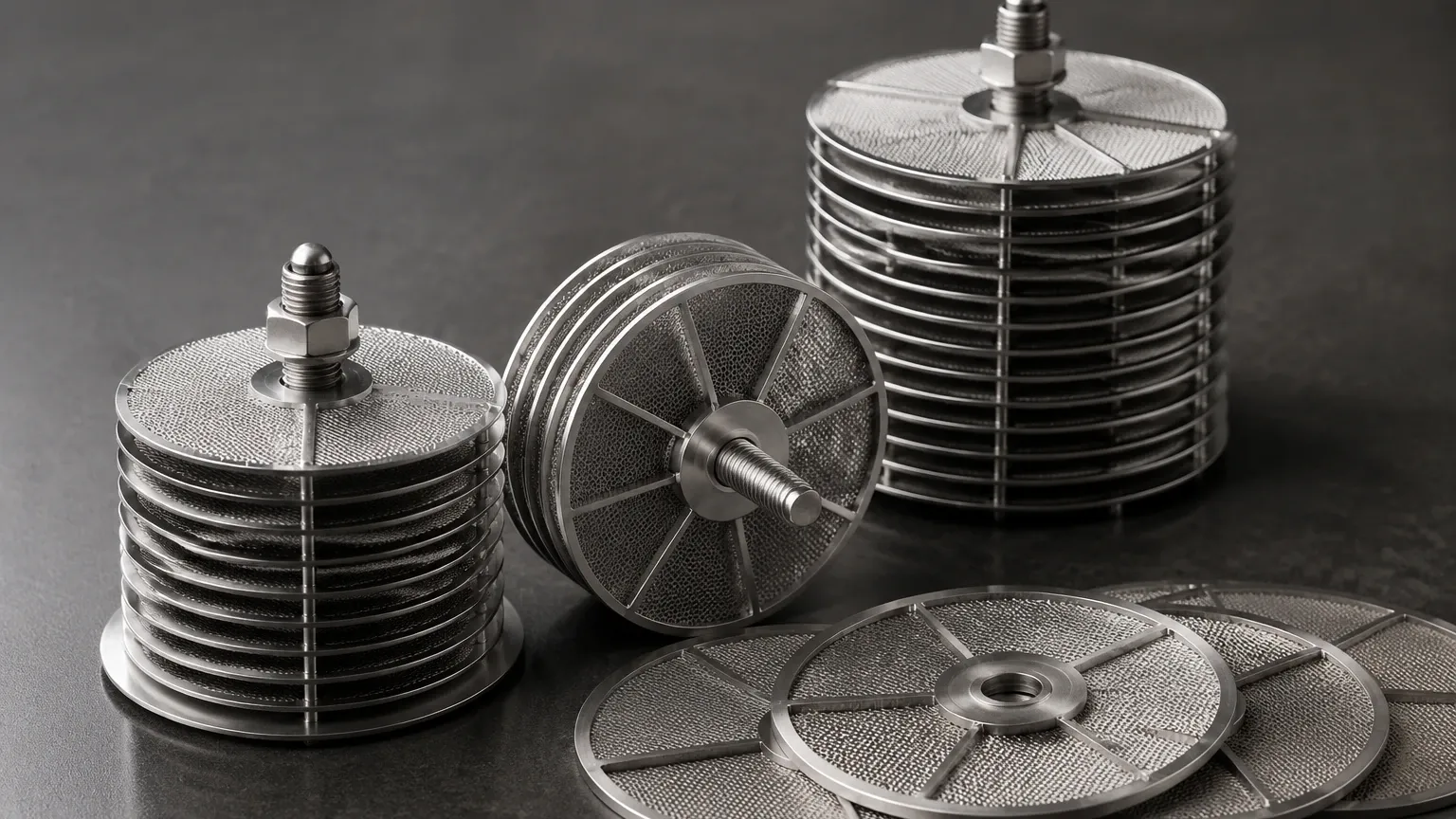
Single-layer discs are often insufficient for high-pressure industrial water applications. Instead, multi-layer filter packs are engineered to provide both filtration precision and structural support. These packs typically consist of several layers of wire mesh bonded together.
1. Filtration Layer: The middle layer, usually a fine Dutch weave mesh, determines the actual filtration accuracy.
2. Support Layers: Coarser mesh layers are placed on either side of the filtration layer. These provide mechanical rigidity, preventing the fine mesh from deforming under high pressure.
3. Drainage Layers: In thicker packs, drainage layers facilitate the even distribution of water across the entire surface area of the disc, ensuring that the filtration capacity is fully utilized.
These layers can be joined through spot welding or sintering. Sintered filter discs are particularly robust, as the wires are diffusion-bonded at every contact point, creating a monolithic structure that will not migrate or fray, even under extreme backwashing cycles.
Operational Considerations: Maintenance and Cleaning
One of the primary advantages of using a stainless steel disc filter for water treatment is its cleanability. Unlike polymer-based media, metal discs can be cleaned and returned to service multiple times, which lowers the total cost of ownership (TCO).
Cleaning Methods
* Backwashing: Reversing the flow of water to dislodge accumulated solids. This is the most common method in automated water treatment systems.
* Ultrasonic Cleaning: For deep cleaning of fine mesh packs where particles may be lodged within the weave, ultrasonic baths use high-frequency sound waves to create cavitation bubbles that strip away contaminants.
* Chemical Cleaning: If the water contains organic fouling or scale, mild acid or alkaline washes can be used on stainless steel discs without damaging the integrity of the mesh, provided the material grade is compatible with the cleaning agent.
Replacement Cycles
While stainless steel discs are durable, they are not infinite. Engineers should monitor for signs of "mesh blinding" (permanent clogging) or mechanical fatigue. In high-vibration environments or systems with frequent pressure surges, the edges of the discs should be inspected for bypass leaks or wire breakage.
Common Risks and Mitigation in Water Filtration
Implementing a disc filter system involves navigating several technical risks that can compromise water quality or system uptime.
* Bypass and Sealing: Even the highest quality filter disc is useless if the seal within the housing is compromised. Engineers must ensure that the disc diameter and thickness match the housing tolerances. Edge-binding (using a metal rim or U-clip) can provide a more secure sealing surface than a raw mesh edge.
* Corrosion Fatigue: In water treatment, the combination of cyclic pressure and corrosive elements can lead to stress corrosion cracking. Selecting the correct alloy (e.g., 316L over 304) is the primary mitigation strategy here.
* Inadequate Support: Under high differential pressure, thin mesh discs can "dish" or bow. If the support structure is inadequate, the mesh may tear. Using multi-layer sintered Filter Discs & Packs provides the necessary internal support to handle these stresses.
Procurement Checklist: Confirming Application Requirements
Before finalizing a purchase order for industrial filter discs, procurement and engineering teams should confirm the following technical parameters with the manufacturer:
* Fluid Characteristics: What is the chemical composition of the water? Are there high concentrations of chlorides or varying pH levels?
* Contaminant Profile: Is the debris hard (sand/scale) or soft (algae/organics)? This determines whether surface or depth-style mesh is more appropriate.
* Operating Conditions: What is the maximum operating pressure and temperature? What is the expected flow rate per disc?
* Dimensional Accuracy: Are the outer and inner diameters (if applicable) specified with tight tolerances to ensure a proper fit in the filter housing?
* Certification Requirements: Does the application require specific material certifications (e.g., 3.1 certificates) to verify the origin and grade of the stainless steel?
By addressing these factors, industrial facilities can ensure that their disc filter for water treatment provides reliable, long-term performance, protecting both the process integrity and the downstream equipment.
